Sunday, 16 August 2015
The wild side guide
Very short post. I've started a new blog, just for fun. It will not replace this blog or overlap with it in any way - it's for wildlife-related musings rather than observations. If you'd like a look, it's here. Contains some Latin and some light swearing (but no swearing in Latin, at least not yet).

Sunday, 9 August 2015
Otmoor
On Friday, Lisa and I went to RSPB Otmoor, in Oxfordshire. Our main goal was to see Brown Hares, and we didn't, but we still had a lovely time at this gorgeous grassland-and-wetland reserve. The weather was stunning - hot sunshine and hardly any breeze - probably not the sort of day for hares to be gallivanting about, in fact. Anyone thinking of going to Otmoor should point their satnav at Otmoor Lane (the entrance is at the end of it), and not be perturbed by the total lack of signage on the way!
Before you hit the reserve proper, there's an area of incredibly lovely meadowland, with trails, which is open in spring/summer only. Lots and lots of insects.
 Goldfinch, singing cheerily from a high perch.
 Insects included LOTS of Common Blues, a few darters (many more were on the reserve proper), and this fantastic Magpie Moth, the first I've seen for years.
 My favourite butterfly - a lovely Small Copper. Also lots of Gatekeepers, a few Meadow Browns, some whites including Brimstones.


 This is, of course, Red Kite country, and as we exited the meadow a couple of kites appeared overhead, yelling loudly. One had the severed leg of some bird or other and the other wanted it. Much mid-air scrapping ensued and at least four more kites turned up to observe.

 The visitor trail runs along a ridge overlooking meadowland which looked perfect for hares (grrr). Where the path took a sharp right, there was a large hide overlooking another patch of wet grassland. We spent a little time here to get out of the rather oppressive sun, and had great views of a flock of Lapwings, and a Sedge Warbler.


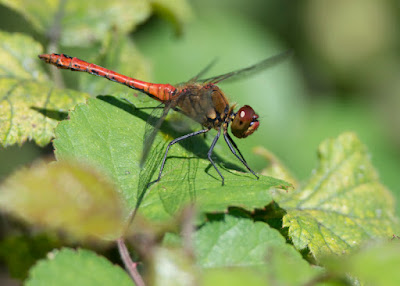
 Along the trails there were lots of Brown Hawkers, and really lots and lots of Ruddy Darters. Also a beautiful Emerald Damselfly. Other odos included a few Common Blues and Blue-taileds and a lone Southern Hawker.

 More butterflies - Brimstone on a teasel and Peacock on Creeping Thistle.
 And the butterfly du jour - a cracking Brown Hairstreak. It was perched very high and at an awkward angle so, considering that, I'm really pleased with the pic. This reserve also has the much rarer Black Hairstreak, though you'd need to come in June/early July to see it.
 The trail passes two viewpoints (actually more like hides without doors) which overlook open water. The views are fab - I can imagine a winter visit would provide great views of wildfowl. Not too much wildfowl on show in high summer, though this Great Crested Grebe chick was making enough of a racket to make things seem quite busy. Also here were Mallards, Coots, Moorhens, a couple of Cormorants and Little Egrets and a few Canadas and Greylags.

 Couple more little birds - this adult Goldfinch was pointedly ignoring its begging chick, while the Bullfinch was sharing a tree with a crowd of juvenile Reed Buntings.
 Last and least (in size but not cuteness), a newly fledged Reed Warbler which had yet to learn the furtive ways of its kind and sat squeaking away in full view. Aw.
Before you hit the reserve proper, there's an area of incredibly lovely meadowland, with trails, which is open in spring/summer only. Lots and lots of insects.


Bushy Park and Home Park
I spent a couple of days with Paula and Susan this week, and we had much fun and also ran 11 miles on Thursday morning, which makes me feel rather better about the fact that I'm doing the Great North Run next month. There was also a bit of walking in the parks. Home Park, for those who don't know (which included me until the other day) is south of and adjacent to Bushy Park and is kind of wrapped around Hampton Court Palace and its gardens.


 First off, some Odonata. The Banded Demoiselle and Common Darter were in Bushy Park, on a little lush channel that we paused by for a sit-down (well, the others sat down, and I stalked the bankside as the sun went in and out). Then we have a Blue-tailed Damsel and what I presumed was a male Red-eyed from Home Park, but I am now wondering if the latter was actually a Small Red-eyed. Unfortunately I was a dummy and didn't take any shots that are sharp on the diagnostic tail end.


 The centrepiece of Home Park is the ornamental Long Water, a very long canal-like parallel-edged lake. Very picturesque. This was where the Red-eyed was. It also hosted Canada and Egyptian Geese, a family of Mute Swans, Coots and an assemblage of manky and non-manky Mallards, plus a fly-by Common Tern.

 Part of a big flock of Black-headed Gulls in Home Park, at various stages of moult. And a Meadow Brown hunkering down in the grass, waiting for some sunshine.


 Bushy Park has Fallow and Red Deer. I suppose Home Park does too but I only saw Fallows there, the bucks and does very much in separate bedrooms mode and many of the does with fawns in tow. Here are four of the five standard colour variants - the missing one is the pure white form.

 To get from one park to the other you can go through Hampton Court Palace gardens (some of them, anyway), including a lovely rose garden and a thriving kitchen garden. The young Blackbird was in the former, the Jackdaw in the latter.

 Back in Bushy Park, one of four baby Mandarins on one of the bigger waters, and a still smart-looking Gatekeeper.

 And to finish, another entry in my occasional dog-blog series - here is Ruby the flat-coated retriever, and Clive the mini-schnauzer, having fun in Bushy Park.


Monday, 3 August 2015
Down with the dragons at Sevenoaks
It's been a lovely weekend. It is currently being a nice Monday morning too but no gallivanting for me today. I did go out after work on Sunday though, just down to Sevenoaks Wildlife Reserve for a couple of hours. The reserve is often very quiet in high summer but has a pleasant mellow vibe about it, and sunshine + flowers + new camera made for a thoroughly nice time.
 The wildlife garden was my first stop. The pond here is a pond no longer - completely dried out, I don't think even the most desperate Southern Hawker would come and oviposit on the bare stones that remain. It is surrounded by Purple Loosestrife spikes in full bloom, one of my favourite summer flowers.
 I made a bee-line for Long Lake. Actually I did look in at Willow hide,
as I figured the low water levels might have attracted a wader, but it
was rammed with humans so I left (but did see there was a Little Egret
on the far bank).At the near end there were a couple of Brown Hawkers hawking about - one a female which came and oviposited very close to where I was standing. Also at least two male Emperors.
I made a bee-line for Long Lake. Actually I did look in at Willow hide,
as I figured the low water levels might have attracted a wader, but it
was rammed with humans so I left (but did see there was a Little Egret
on the far bank).At the near end there were a couple of Brown Hawkers hawking about - one a female which came and oviposited very close to where I was standing. Also at least two male Emperors.
 I carried on to the meadow bit at the far end of Long Lake. Lots of damsels here, including this fresh male Common Blue. It's nice to see that new damsels are still appearing, makes it feel like we have a bit more summer yet.
 Male Banded Demoiselle. Looks like I've done some cheesy Photoshop vignetting on this image but I haven't, honest.
 Moments after I spotted this Comma, it took off and chased after a Brown Hawker. Somehow it didn't get itself killed doing this, and returned to its perch to resume its combative stance.
The field here is now nearly grass-free and full of various tall flowers. I wonder what the management has planned for this area. Overhead were quite a few Herring and Black-headed Gulls, and one or two Swifts - I also heard the calls of House Martins. A single Kingfisher belted down the lake.
 Wildfowl today was mostly just Mallards and Tufties, though I admit didn't have much of a look at East Lake. The D7200 made a good fist of getting focused on this close and fast Tuftie.
 The surface of Long Lake is probably 50% lilypads at the moment. With a bit of searching I found a few Red-Eyed Damselflies on some of them, including this ovipositing pair with another male politely looking the other way.
 From the riverside vegetation came an almost constant racket of Wren noise - squeals of fledglings and cross rattling of adults. Robins were also about, and I heard a brief splutter of Reed Warbler song.
 One of my favourite moths in the Long Lake meadow - Pyrausta aurata. Or Mint Moth if you really have to give it an English name.
 I tried Willow hide again on my walk back, and the human count was down to one so I took a seat next to her. Sadly the mud was wader-free, but the Mute pair that live on this lake were about, with two half-grown cygnets. One of these was a white 'Polish' type - this is a sex-linked mutation, which means it's probably a female. Her sibling was a normal 'ugly duckling' type. I don't recall ever seeing a Polish form swan here before - wonder if that means one or both of the adults are new birds.
 Looking good, Dad. Despite your giant comedy feet.
The egret was still on the far bank when I arrived. Too far for photos but nice to see. Then a second one showed up, flew across the lake and settled high in a willow tree. It stayed there for a while then came down to the water to feed, giving me my best ever views of a Sevenoaks Little Egret.
 Sadly, the light wasn't very good. Or, to put it another way, luckily, the light was amazing. The egret was VERY backlit so I experimented with exposure to try to get a nice shot. This one was at -0.7.

 Somehow it was now gone 6.30pm and I decided I had to make tracks. On the return path I took some backlit plant pics just because I was drawn to the subjects - a load of unripe Blackberries, and this fearsome-looking Spear Thistle strung with a mesh of spider silk. At the top end of West Lake I found a Southern Hawker patrolling a small clearing.
 A juvenile Blackbird was foraging on the path near the visitor centre. Not a great photo but this is ISO 3200 - and the D7200 certainly does a lot better in low light than the D300 did.
I had a quick look in Grebe hide before packing up. As with last time there were plenty of juvenile Blue and Great Tits coming to the feeders. I thought I heard a Bullfinch here too but couldn't locate it. There was a Chiffchaff hooeeting its socks off.
 Last bird of the day - a Blackcap sitting in full view (if not full light).


The field here is now nearly grass-free and full of various tall flowers. I wonder what the management has planned for this area. Overhead were quite a few Herring and Black-headed Gulls, and one or two Swifts - I also heard the calls of House Martins. A single Kingfisher belted down the lake.


The egret was still on the far bank when I arrived. Too far for photos but nice to see. Then a second one showed up, flew across the lake and settled high in a willow tree. It stayed there for a while then came down to the water to feed, giving me my best ever views of a Sevenoaks Little Egret.


I had a quick look in Grebe hide before packing up. As with last time there were plenty of juvenile Blue and Great Tits coming to the feeders. I thought I heard a Bullfinch here too but couldn't locate it. There was a Chiffchaff hooeeting its socks off.

Subscribe to:
Posts (Atom)
