Sunday, 27 February 2011

Back on the patch

It was a beautiful sunny morning and I was in Sevenoaks for a change, so I decided to skip aikido and head for Sevenoaks Wildlife Reserve. I got the camera out on the way, as I was seeing so much photogenically lit (albeit common) birdlife around.

The most interesting fly-by was probably this male Great Spotted Woodpecker...

... while the most alarming would be this Canada Goose, who was honking loudly and seemed to be on a collision course. Unlike the woodie shot, this one is uncropped from the 300mm lens. I was very brave and didn't duck.

One of several beady-eyed Jackdaws checking me out from their vantage points on handy TV aerials.

A remarkably confiding Collared Dove (or maybe it didn't realise I was looking at it) enjoying the early morning sun at the top of the access track.

Once in the reserve, I was very pleased to find a small flock of Lesser Redpolls close to the start of the main track, and my delight was only slightly diminished by their extreme flightiness and tendency to hide behind branches.

It was very encouraging, after such a cold December, to hear lots of Goldcrests while going round the trails. This one even found time in its busy schedule to pose for a quick snap.

I only had time to visit one hide on the main reserve - Willow. Not too much to see here, lots of Gadwalls, including these two, plus Teals, Egyptian Geese and the (even more) usual suspects. The water seemed very high.

I completely fluffed my attempts to photograph the Egyptian Geese in flight, but one of the three shots I got of this passing Gadwall drake was sharpish.

On the way back, I stopped for a long hard stare at the particularly gnarly tree that's covered in dead ivy branches, and was rewarded with a Treecreeper.

The alders were playing host to quite a few Siskins. Light and the need to hold the camera almost vertical made getting any photos rather difficult. Here is one of the few that sorta kinda worked.

A sign of spring - some lovely pussy willow. Photographed from Grebe hide, where the feeders were being largely ignored as all the tits and finches concentrated on trying to get off with each other.

On the track out, I got surprisingly close to this Redwing, but before I could move to a spot where I could see its whole head, a car came along and scared it off . This is still quite possibly my best Redwing shot to date.

Walking home, I spotted this nice male Grey Wagtail trotting along the margin of one of the Bradbourne Lakes - a nice addition to the usual crowd of 'mucky Mallards' that frequents these small and rather shady ponds.

I'd planned to go for a walk with Michele later today, hence the need to be home by 11am. By then, the clouds were gathering in a slightly ominous way. We opted to have a quick walk in Knole Park rather than anything more ambitious.

We had hoped to find a cast antler or two. No luck, but some of the deer had photogenic moments. Here's a white Fallow doe...

... and a not-white Sika hind.

Finally, two of a party of five or so very loud Ring-necked Parakeets. Birdlife was not very much in evidence in the park today. We did see a Sparrowhawk on the way home (after I'd packed the camera away, naturally).

Friday, 25 February 2011

Notes from a small garden

What with work, cat-sitting and dad-sitting, there has been precious little time for birding lately. However, I am currently in Brighton looking after the lovely Mango and Pepper (they are cats, not dads) and have been pointing the camera at a few things in the garden in between work.

Not only that, but my sister and her family stayed here with me for a couple of days, and we had a wander down to the seafront. I'll spare you the family photos, but here's a couple of Herring Gulls.

A youngster, executing an impressively sharp turn... but still keeping a very level head.

This one had found a mussel - maybe picked off the steel struts of the pier (the one that hasn't been burned to a crisp).

Close views were easy. Pity it was such a dull day...

Two days later we had wall-to-wall sunshine and I spent some time in Mike's garden, seeing what came along.

Yep, more Herring Gulls. They nest on the rooftops pretty much throughout the town, and are always floating along overhead. This one is a third-winter (I think).

A fine adult male, looking all dramatic and handsome with the sun behind him.

I like this one because the head is sharp but the wingtips blurred. Sort of makes me look like I know what I'm doing...

It wasn't all about gulls. The sunshine brought out a few insects, which inspired me to bring out the macro lens. Here is an unidentified fly sp.


A pair of Long-tails showed up, and I fluked a shot or two despite their infuriating restlessness.

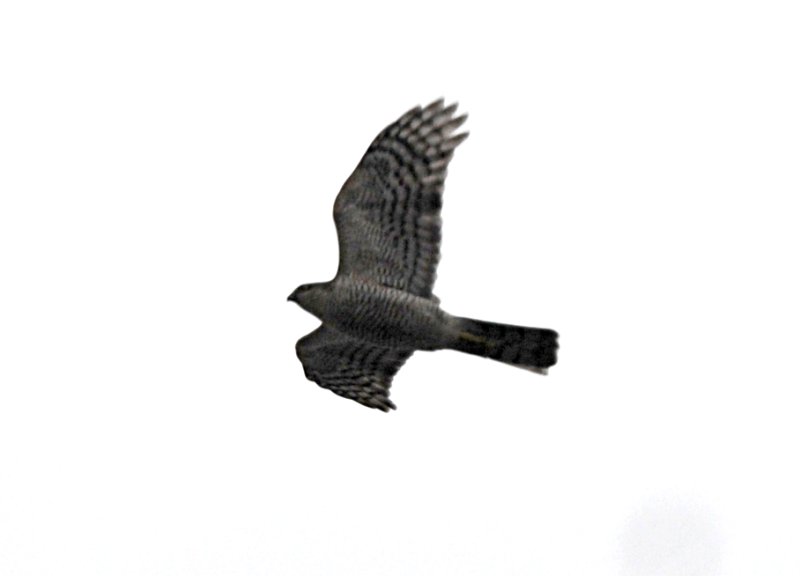
And finally... would a blog post of mine be complete without a blurry fly-by Sparrowhawk? No, it would not.

Oh, I forgot to say. My new teleconverter is busted - it's doing the same disconnection thing the old one did.  However, apparently I've had it too long for it to be replaced so it will have to go back for repair instead. I'm really tempted to buy a Nikon tc, though, as I have rather lost faith in the Kenko ones. Anyway, all these shots (except the macro one) were taken with the 300mm on its own, and it's reminding me that I do really love this lens as it is, even though it is a bit on the short side.

Tuesday, 1 February 2011

New year bird race

This is a very late report from Weds 5th January, when Rob and I joined Nigel and Jim for the annual January big birding day. We do a more-or-less dawn to dusk birdwatch on a designated day in early January, following more-or-less the same route. All birds seen or heard by anyone in the group go on the list.

Rob saw a Woodcock flying across the A21 on our way down to Nigel's, I unfortunately was looking out of the side window and missed it. We reached Nigel's just after 8am and had tea while watching the bird feeders in the garden. Nige had already added the usual stuff plus a bonus Redwing flock, and I found a Nuthatch straight away, soon followed by a Treecreeper. However, the semi-regular Marsh Tit refused to show itself. Jim then arrived and we set off for Fairlight cliffs for a seawatch.

It was very windy and, though sunny for now, looking like that wasn't going to last. We struggled up a muddy track to the cliff edge and began to scan the sea. Red-throated Diver and Great Crested Grebe quickly joined the list, the latter in large rafts far out among the big waves. Jim spotted a couple of Guillemots flying low westwards, while Rob looked the other way and found a Kestrel struggling against the high winds. Nige found a distant Fulmar, then I found a couple closer in. However, overall it was disappointing - we have in previous years had Gannet, scoters, Eider, Black-throated Diver, Peregrine and Raven from here. A Green Woodpecker on the trudge back was some consolation.

Next stop was Pett Level, where Nige had found a Red-breasted Goose among a big flock of White-fronted Geese a few days before. Sadly most of the White-fronts had moved on, and there was no sign of the Rough-legged Buzzard that had also been seen here a couple of days ago. We walked alongside the canal, noting Curlews, Lapwings and Golden Plovers in the field, and got to a point where we could scope the distant geese. There were maybe 15 Whitefronts as well as Greylags and Canadas. From the small hide here we added Shoveler, Gadwall, Marsh Harrier and Reed Bunting, but a bit further on were gutted to be told by other birders that we'd just missed a Merlin.

We headed back for the car. I was trailing a little behind the three chaps at this point, and noticed a flock of corvids mobbing something bigger over the fields by a small patch of woodland. Expecting to see another Marsh Harrier I raised my bins and was delighted to see that it was in fact a Red Kite. I yelled into the wind and got the guys onto the bird just in time.

We drove on, pausing to check the pools (not much there) and the beach (ditto). It was high tide and waders were feeding on the roadside fields. We stopped to look at them, finding Knot, Dunlin and Grey Plover. Further along were a small crowd of Brent Geese, mainly dark-bellied but with a few pale-bellieds. Nige found a Black Brant (the North American subspecies of Brent Goose) among them.

Next was Scotney Gravel Pit, a massive gravel pit straddling the Kent and East Sussex border, close to the sea. We've had some great birds here over the years, such as Long-tailed Duck, Scaup, all three divers, all three rare grebes... but not today. Few birds were braving the choppy water, and the islands held nothing new for the list. We did get a flock of Stock Doves, though.

We drove down past Dengemarsh, next to RSPB Dungeness, in search of Red-legged Partridges in the fields - no luck. This was getting depressing. Nige helped cheer things up by phoning in our lunch order to the Pilot Inn, famed purveyor of fine fish and chips. We headed there via Lydd where we hoped to get a Mistle Thrush on the green - we didn't, but got a bonus flyover Sparrowhawk instead. We also paused on the way to look at the ARC pit from the road, and were rewarded with a quartet of new duck species (Smew, Goosander, Goldeneye and Ruddy Duck). There were an impressive 10 Smews on the pit, all of them redheads. At least one of the two Goosanders was a handsome drake.

The Pilot had our lovely food ready when we arrived, enabling an efficient lunch stop. We were only in there half an hour, but in that time the sun disappeared and we emerged to leaden skies, threatening rain at any moment. We drove on past Derek Jarman's famous cottage by the beach, and stopped to check a couple of flocks of large gulls, hopeful of finding the Glaucous that has been here for a month or so. We drew a blank though, and while we were checking (from the car) the rain began to fall. I spotted a Merlin zipping along the beach behind the gulls but no-one else saw it.

We carried on to the RSPB reserve, whereNige found a Black-necked Grebe from the visitor centre. Word was that Bitterns had been showing well from Scott hide so we hurried there, full into the driving wind and rain, and slumped with some relief onto the benches. It was the kind of weather where any sensible Bittern would be hiding in the most sheltered spot it could find. Undaunted, Nige scanned the waters and found a few Pintails. Then Jim quietly drew my attention to something creeping along the shore right in front of us - a lovely Water Rail, which we all watched with great enjoyment.

It was nearly 4pm by now, and getting dark as well as miserable. We were hurrying back to the car park when a Firecrest called loudly from thick bushes by the track. Cue Nige and Jim stalking around the bushy area and peering into it, but without sight. Then the Firecrest called again from another bush on the other side of the track. How the cheeky blighter crossed the track unseen by all four of us is a mystery, but we still couldn't find it. However, it joined the list as the last bird of the day. Jim totted up the list on the way back and made it 78 - one of the worst ever (best was 98) but we declared it a most enjoyable day nonetheless. Nige emailed the day after with an improved total of 83.

Cameras mostly stayed under wraps, but here are a few piccies - Black Brant, Stock Dove flock and a load of Wigeons.


Monday, 3 January 2011

Oh dear...

... three days into yearlisting and I've turned into a twitcher. Today we went to Westcliff-on-sea in Essex to look for 'Rossi', the famous Ring-billed Gull who's been wintering there since 2004. On the way, we decided to call in at Pitsea to look for Waxwings - but then I spotted a flock in a roadside tree on the A13, close to a parking layby, and bullied Rob to turn around at the next roundabout. Naturally, when we came back they had gone. So it was on to Pitsea, where we got lost trying to find our way into the big supermarket carpark where the birds had been seen yesterday. However, our convoluted approach proved fruitful, as we found a flock of Waxwings down a side road on the way.

There were probably about 30 of them. They were not feeding but sitting about in the treetops, occasionally having a little fly around and constantly calling, their trills a pleasant contrast to the squeaks and rattles of the many Starlings that were sharing their trees.

It wasn't the photographic cornucopia I'd hoped for, as they were quite high up and the light wasn't great.

Nevertheless, it was great to spend a bit of time with such stunning and charismatic creatures. A car pulled up while we were there and the driver told us that this particular road had attracted Waxwings on many occasions. Not sure why, there seemed to be nothing for them to feed on here.

We had a bit of time before we needed to be in Westcliff (I'd read that the best time was 2-4 hours either side of high tide, and today high tide was 11.30ish) so we looked in at the nearby Wat Tyler Country Park. The tide being what it was, there were few waders to see on the creek, but I did add Black-tailed Godwit to the yearlist. This looks like a great place for a birding day, we'll have to come back another time.

This fine fellow was in a field by the access track, just trotting along looking fairly relaxed. When we pulled over and wound down the window, he loped away to the safety of the miniature railway track, from where he shot us baleful looks.

On to Westcliff, where we located the coast road and drove along it til we found Rossi's Ice Cream Parlour, the haunt of Rossi the gull, and scored a nearby free parking place by some mad streak of luck. There were lots of gulls floating about in the very calm sea, nearly all of them Black-headed.

 New for the yearlist - a Turnstone. It and half a dozen of its friends were skittering along the shingly shore, in the company of Feral Pigeons.

Scanning my way through the gulls, I found no Rossi but there were a couple of Mediterranean Gulls, sadly too far out for nice photos. First time I've photographed them in winter plumage, and of course a new species for the yearlist.

Someone put some bread out for the gulls up on the promenade, and I took a look through the bins and thought I spotted Rossi among them. I took a couple of insurance pics and then we hurried over - too late, the melee was all over by the time we were anywhere near.

Examination of the pics showed that I had indeed spotted Rossi - he muscled through the swirling Black-heads to land on the wall and take his share of bread. Great photo opportunities if we'd been up there. We decided to give it a little longer.

Every Common Gull made me look twice. They are somewhat similar to Ring-bills - only a little smaller, with yellowy legs and even the suggestion of a ring on the bill. This photo shows the bill mark is more of a smudge than a neat ring, and also shows the Common's dark eyes - Ring-bills are pale-eyed, and more extensive white in the wingtip.

Finally, a really good candidate flew out - yes, it was Rossi himself. He settled on a breakwater that was just appearing as the tide retreated. I went over for a closer look, aware that this bird is well known to be approachable and tolerant of humans.

And there we have it. Lovely neat bill ring, pale mantle, pale eye, yellow legs. I took a lot of shots, inching closer until the Black-heads started looking twitchy (though Rossi himself didn't seem at all bothered) then rejoined a relieved Rob to get in the car and warm up.

Saturday, 1 January 2011

New year, new year list

Hello out there,

I've decided to keep a year list this year. Nothing fancy, just a straightforward British year list - hopefully it will motivate me to get out on those days when I would normally look at the sky and think '.... nah'. The list got off to a blinder when we heard the distant quavery fluting of a Tawny Owl outside at about 1.20am, which I suppose cemented my resolve to give it a go. I will try to include in my blog posts at least a record shot of the more unusual species, which will mean an increase in blurry and heavily cropped images for you to enjoy. You have been warned...

I wasn't so keen when the alarm went off at 6.30am, but did manage to get up by 8am (adding a heard Magpie and Wren in the meantime) and walked down to Sevenoaks Wildlife Reserve to see if I could rack up a creditable start to the list. It was a 1990s-style winter morning - mildish, grey and damp.

Lots of the resident passerines are singing already, which made it very easy to add Song and Mistle Thrush, Great Tit, Greenfinch and Robin on the walk down, along with a bit of a bonus in the form of a 30-strong Fieldfare flock overhead. Then it was on to the reserve itself. I went into Grebe Hide to get the camera ready, then took a few shots. Just for fun, here's my very first photo of 2011:

Not a great start. Hopefully things will improve, and I'll remember how to focus the lens... Besides the Blue and Great Tits there was a party of Long-tails around.

I went to Tyler hide first. There was lots about, including lots of gulls. This Lesser Blackback was the closest of them - there were also several Herring and Common Gulls (one of the latter is in this photo) and one adult Great Blackback, which I unaccountably didn't bother to photograph.

My first grebe of the year, and it's a Black-necked. This bird has been around for a few weeks - it's high time I paid it a visit. It was rather distant and very actively feeding (ie on view for about 5 seconds per minute).

Moving on from Tyler hide, I finally saw what I'd wondered was a mythical bird, the oft-reported semi-resident female Ruddy Duck. Here she is with my second grebe of the year, a Great Crested.

I carried on to Slingsby hide but there was nothing to see - the lake was completely iced up at this end. I did get a Great Spotted Woodie on the way.

On the way back towards Tyler hide, a Treecreeper. I'm not sure what it thinks it's doing in this photo. Not great pics but at least it didn't shimmy around the far side of the trunk when I showed up.

I looked in at Tyler hide again on the way back and this time there were a couple of female-type Goosanders on view. Another nice bird to get in the bag, though I'd have preferred a nice smart drake (but then who wouldn't?)


Here's part of the vast herd of Coots grazing the Serengeti (aka the small grassy foreshore bit that you can see from Tyler). Lots of Coots, lots of Moorhens, but where's my Water Rail?

I went up to Willow hide next. This proved disappointing. Not only was the lake completely iced over, but one of the two stools was missing, and the other had been relocated by some idiot to the icy surface of the lake. This not only spoiled the view, but spoiled the chances of short people like me from enjoying the view, as the benches in this hide are set too low. I didn't hang around, but carried on past Long Lake to the field at the end. Overhead large noisy Siskin flocks roved around the alder trees, but I couldn't turn any of the Siskins into Redpolls.

By the field, I surprised myself by taking a recognisable photo of a Redwing. These thrushes are often amazingly shy and suspicious, and this one quickly flew away when it realised I had spotted it, even though it was so high in the tree that this is a nearly 200% crop.

With the light so poor, black and white subjects were a bit more appealing than colourful ones.

Last photo of the day. A bit better than the first... a drake Teal on one of the pockets of unfrozen water on the big lake.

So after about 3.5 hours' birding the year list stands at 54. I got some great bonuses, but many SWR regulars eluded me - the likes of Stock Dove, Sparrowhawk, even Goldfinch for pity's sake. Still, there are 364 more days to go.

Tuesday, 21 December 2010

Slimbridge.... in November

Here is the promised Slimbridge blog, in lieu of anything more recent as I have been mainly staying in working. I have missed Red-necked and Black-necked Grebes AND a Smew at Sevenoaks Wildlife Reserve - though they may still be there if they find an unfrozen corner I suppose. If we get a nice day this week I'll go down and have a look. Anyway. Here's Slimbridge, from November. We called in on our way home from a trip to Cornwall (a bit of a detour but not that much). Weather was horrid at first but got better.

It wasn't the best time of year to visit. Slimbridge is best known for its Bewick's Swans and White-fronted Geese but numbers of both peak later in the winter. There was a good mix of wildfowl around though, including plenty of Pintails. This one was among vast crowds of Pochards on what I think is called the Rushy Pen. There were also a few Bewick's here.

As we made our way to the wilder parts of the reserve, flocks of ducks and geese sped overhead, including Pintails, Wigeons and... Mallards. Note gloomy weather, don't be fooled by those scraps of blue sky.

The summer walkway was shut, but from the nearest hides there were large flocks of Wigeons on view. The sun came out briefly against a backdrop of stormy skies and something panicked the Wigeons into flight. We didn't see what had alarmed them but got some photos of the resultant chaos.

From the Kingfisher hide, there were no Kingfishers but nice close views of a feeding station, though there wasn't much actually feeding on it.

A female Chaffinch. demonstrating that the sun had come out again.

One of two Grey Squirrels that were monopolising the hanging feeders, and having little squeaky rows with each other.

On the way back to the visitor centre, we passed an exhibit of Cranes, some destined for reintroduction to the UK. I assume this guy knows what he's doing...


More sunshine, though the skies still looked ominous (and indeed it rained really hard most of the way home). Slimbridge, like most other WWT centres, has lots of captive birds like these Greater Flamingoes which no doubt help pull in the punters, and some of the birds are here as part of conservation projects. It's certainly a good place to learn your wildfowl. Wild wildfowl-wise, plenty to see - it's good for waders too when the tides are right. I would urge, beg and implore the people in charge to do something about the hides though - they are well sited but bench and window position/size makes them a real pain to use for those of us under 6ft tall.