Friday, 7 February 2014

A sunny interval at Dunge (and Hythe)

After much scrutiny of weather forecasts, Phil (check his fab blog here) and I decided to hang on til today for a trip to Dungeness, trusting the BBC with their promise of afternoon sunshine. We drove past numerous flooded fields and rolled into the reserve entrance at just gone 10am, noting a Buzzard wheeling overhead at the start of the track.

I include this horrid photo of a Curlew to a) show how grey and gloomy it was when we arrived and b) because it was the only wader we saw in our whole time at Dunge. Not even a Lapwing to be seen.

After a failed search for a Black-necked Grebe from the visitor centre, we visted all the hides along Burrows Pit in turn. From the first, we found three redhead Smews, which did some flypasts before settling among some (sadly distant) Tufted Ducks for a short while. There were also a couple of female Goldeneyes, again miles away.

Much closer at hand, something was fossicking about in a bramble patch directly in front of the hide. It proved to be a Chiffchaff and came out briefly into full view, before deciding it was too cold and windy for all that, and diving back into the brambles.

On to the next hide, from where we could see a huge number of Shovelers, ducks and drakes, and more Tufties, plenty of Coots and not much else.

Phil then called my attention to a small gull flying over the water, and although I thought it was going to be a Black-headed I took a few shots anyway, and examination of these (on max zoom) revealed that it was in fact a Little Gull.

In the scrub below the hide window, a couple of Long-tailed Tits were bouncing around, but not really coming out and giving us the chance of a clear shot - too windy for such little and unwieldy-tailed birds.

We moved on to the Frith hide, and found a large flock of dozing Tufties close to the windows on the nearside. As you can see, the sun had started to come out at this point, although the wind was brisk and played havoc with the Tufties' headgear.


A Smew came closeish to feed near the shore, as did a Great Crested Grebe. Right over on the other side was a huge flock of what, going by the noises they were making, had to be Wigeons and Teals.

We had just got up to leave when a female-type Goosander popped up close inshore, right in front of us. We rehooked the windows open and took a stack of shots of this beautiful bird.


In between its fishing dives it had an argument with a Coot, and revealed that it was carrying no weapons (apart from its fearsome double saw of a bill).

We did take a look at the last hide but saw nothing much from it apart from Cormorants, many of them perched in the row of stunted trees where they nest (I think). Back to the visitor centre, noting a Little Grebe on the pathside pond on the way, and then over the road to the ARC, stopping for a moment at the warden's cottage for the compulsory Tree Sparrow check (several showing in the garden bushes).

Arriving at the ARC car park, we found this Kestrel adding a touch of nature to a very complicated-looking telegraph pole.

The ARC hide was empty, allowing us to grab the coveted corner spot and enjoy great views of a hundred sleepy Wigeons close to the hide.

These four drake Gadwalls and their lady friend were engaged in a spot of communal courtship, and there was much chasing around on the water and frantic flights, the whole time we were there.

 Pair o'Mallards. The drake looked very shiny in the sunlight.

A Marsh Harrier that had been exploring the far shore struck out towards the middle of the water, causing the nearby ducks to flee in a rather half-hearted manner.

The flushed ducks joined those close to the hide. The Coots seemed impressed with this Wigeon's belly-flop landing.

We walked from the ARC pit down the road to take a look at the New Diggings, in hope of seeing the Black-throated Divers (two of them) rumoured to be there. The walk is a little hair-raising, as traffic hurtles along this road very fast indeed and the verges are rather narrow most of the way along, but we got there unscathed.

 A scan across the New Diggings revealed only two birds. Happily, they were both Black-throated Divers. Sorry about the photo, they were a really long way out.

Having survived the walk back to the car, we went on to the beach, hoping to find the Glaucous Gull. To cut a short story shorter, we didn't. And our presence upset some of the gulls that were loafing near the boats, causing them to take off and also to release several lengths of silly string-like gull poo.

Disappointingly, there wasn't too much moving offshore, at least not at close range. One thing that was moving was this Guillemot, powering along on its penguin-flipper wings.


On the walk back, Phil stopped in his tracks and drew my attention to something on the shingle to our left. When I saw what it was I said something delightedly inarticulate and began to take photos. The Stoat, for that was what it was, came scampering in its curious gait across the shingle, paused briefly to eyeball us and then vanished behind one of the tiny beach houses.

We decided to try the patch, but again drew a blank, seeing just more of the commoner gull species over the water and not a sniff of a Glonk. The only pics I took on this bit were of House Sparrows by the car-parking area at the power station.

For the last stop of the day, it was off to Hythe to look for Purple Sandpipers. On the way we managed to bring the raptor day-count to four, with a Sparrowhawk from the car. At Hythe the first breakwater we tried held a solitary, worried-looking Turnstone, but we had more luck at the second.

Four smart Turnstones were showing very well on top of the sunlit rocks. A careful check of the shady side revealed a few Purple Sandpipers as well, and after a short wait, one of these (clearly not wanting to disappoint its fans) wandered onto the sunny side.

Oi, wake up sandpiper! It may not be the most action-packed shot ever, but I like it because you can see a hint of actual purple on the scapular area. After sitting on this rock for a while, it woke up and walked back to the shady side.

An interesting find on the beach. This is a Sea Mouse (Aphrodita aculeata), which is a kind of marine worm. There were lots of these in the tideline. They are about 10cm long and their hairy bits are startlingly iridescent when caught in the light.

While Phil clambered over the breakwater rocks looking for a view onto the resting sandpipers, I stuck to the sunny side and photographed passing gulls. I didn't realise at the time that one of them was a Mediterranean Gull.

And finally a Common Gull, inviting us all to admire the magnificence of Hythe's seafront. The sun was about to disappear behind a wall of low cloud, so we decided it was time for us to disappear too.

Monday, 3 February 2014

I'm back and so's my camera - Shellness

Hello all. Well, it took Nikon quite a while to return my camera, presumably because I sent it off just before Christmas. But now it's back, and I took it to Sheppey yesterday to make the most of the sunshine. I went with Rob, having beguiled him with tales (and photos) of the monster high-tide roost that Phil and I had enjoyed there a few weeks ago.

Rob stopped at Leysdown to buy some lunch, and while I was waiting I sat on the sea wall and watched a few Black-headed Gulls as they chased the flies that were resting on the warm concrete. This one came quite close to me in its fly-quest, and my photos show it caught several. Its hood is almost complete - an early sign of spring.

We drove on to Shellness and walked the very boggy track to the shore - not a problem for me as I was wearing my brand spanking new wellies. But the view at the end was disappointing - quiet sea and shore, nothing like the numbers of my last visit. It was nearly high tide, and on the spit beyond the blockhouse there was a dark huddle of mostly Oystercatchers, but very little else was happening.

A Common Seal took pity on us and swam past closeish. Not nearly as close as the seal I'd seen at Leysdown, but sadly that had turned out not to be a seal at all but a dog. This was at least the real thing.

I walked off towards the spit after that, to see if there was any way to get a clear view of the birds out there. The point itself was roped off - the signs said this was because it has breeding Little Terns. Well, not in January it doesn't... but it's just as important to keep the roosting flock safe from disturbance. Once I was past the point and could look back on it in good light I could see the Oyks quite well, but they were mostly asleep and not terribly inspiring as photographic subjects.


I did keep an eye on the big field on the way to the point and back, hoping for a Hen Harrier, but all I got was a Shelduck, and a small flock of Skylarks. A few distant Brents went by on the far side.

A jet-skier went by in the Swale, which didn't bother the Oyks but disturbed some other waders which must have been roosting out of sight. They went up and flew about before returning. Here are some Bar-tailed Godwits...

... and here are some Knots, with a couple more Barwits.

I rejoined Rob and found him photographing a Turnstone that was unconcernedly pottering on the shoreline, a couple of metres from his feet. I didn't know the Sigmonster focused that close... I joined in and took lots of shots of this obliging bird, and the two friends that then joined it.


Lovely little birds. I know they are not exactly difficult to find or photograph but they were a bit of a day-saver for us.

A few waders flew by over the sea after that but the only ones I managed to get my lens onto were this party of Ringed Plovers and Sanderlings. Proof that one in two of all Shellness waders are blurry :) It was by now about 3pm and we decided to go to Elmley for the last bit of daylight, and just drive down the track and back.

There were quite a few Brown Hares on show from the Elmley track, including this one which was sitting very near the track, busily chewing its heels.

Also, lots of Lapwings. But very, very little else. We reached the end, turned around and headed back. It was on the way back that we got lucky with a sighting of a Short-eared Owl, not the easiest bird to find this winter. It was nearly dark by now so the photos are, of course, dire, but here they are anyway.


Wednesday, 18 December 2013

A very short post

Firstly, apologies in advance for future quietness on my blog - have just discovered that my camera's busted so there'll be no pics for a while. Not sure how long these things take but it's going back to Nikon this week for repair.

So to be going on with, here are some pics from Rainham. I was there on Sunday but was mainly occupied doing a book signing and only managed a very short look at the riverbank. Plus it was a very wet and gloomy day so the few photos I took were mostly horrible.

A male Teal heading up the Thames. There were a few Wigeons on the water too. Waders scooting about included Curlews, Golden Plovers and Dunlins. Also saw two Peregrines, a female pursuing a male in a rather ominous manner, given that possibly the same female had a few days previously killed a male on the reserve.

The day was saved by Nelson, the one-eyed young male Kestrel who can be seen regularly on the riverbank and near the visitor centre. He is as fearless as the other well-known Rainham Kestrel, the female called Kes, who I haven't seen for ages but maybe he is a relation of hers. I found him sitting in a small tree by the river and he seemed unconcerned by my presence (though I noticed he kept his good eye turned to me at all times!) so I took lots of pics from various angles. I'd have probably burned up the whole memory card if it hadn't been really raining at the time.


Wednesday, 4 December 2013

Sheppey day

Hello, and apologies to all for the long gap betwixt this post and the last one. Work, life, you know the score. I had a trip to Elmley Marshes with Phil (of Sharp by Nature) today and it was fab, despite very murky grey skies all day that made for very murky grey photographs, some of which I present below for your viewing pleasure.

I met Phil at West Malling station and we were at the start of the access track by about 10am. This is my first visit to the site since it ceased to be an RSPB reserve (new management's website is here). Not a lot seemed to have changed at first glance. We began the traditional slow pootle down the long driveway, soon stopping to admire Curlews aplenty and lots of bathing Starlings, while the first of many Marsh Harriers cruised around in the distance.

This Common Gull flew towards us as I was trying and failing to get nice shots of some of the Curlews.

Finally a Curlew did strike a clear pose for me, on the edge of a largish scrape which I think might be newly dug. Also new was what looks like some anti-predator fencing, and a broad strip by the track that was planted with big seeding stuff, including many sunflowers. This area was stuffed with hungrily feeding finches, but was on Phil's side of the car - I hoped to get some photos on the return journey.

I was eagerly scanning the fields for hares but found none. This Pheasant was sprinting across the sloping field close to the car park.

We parked up, and I went over to check the Barn Owl box, noticing as I went that the car park was full of fine-looking chickens, one of which gave me a casual peck in passing.

Aw. Barn Owl was at home, and doing a charming head-tilt in our direction. On the grass below, a small flock of Black-tailed Godwits were feeding, while Teals were in the water and Wigeons grazing on the far bank.

We went on into the reserve, noting on the right of the trail a great big pile of earth which we theorised could be a new raptor viewing mound. We even climbed up it to check but could see no raptors from up there, though it did supply terrific views.

A little further along the first of the day's many Kestrels came flapping along, and obligingly hovered quite close by for an impressively long time.

As we walked hide-wards, there were huge numbers of birds in view much of the time, though at a great distance away. Out on the fields, a big flock of Canada Geese was accompanied by a few Brents, while swirling masses of Lapwings were on the horizon and little gangs of ducks (Mallards, Wigeons and Shelducks) were constantly going overhead.

Things looked pretty quiet from the Wellmarsh hide, but a closer look revealed a tightly packed crowd of waders on one of the many little islands. They were mainly Dunlins but with a fair few Knots, Grey Plovers and Turnstones. The only other island to hold any birds had a lone Avocet and a few Snipes, but it did later collect some overspill from the most popular island. A few Shovelers were out on the water, and two Marsh Harriers patrolled the far shore.

On we went to the Counterwall hide, which overlooked a completely deserted scrape. However, there was some pleasing 'little bird' action here in the shape of a pair of Stonechats.


They both came pretty close and posed nicely. It is interesting how these birds pair up when on their winter territory. I just pulled my copy of Stonechats - a guide to the genus Saxicola off the shelf and learned that these winter pair bonds don't necessarily persist when the birds return to the breeding grounds - they may have a territorial function only.

We had a debate at this point about whether to continue to the other hides or to go to Shellness instead, and Shellness won that one quite easily. So we packed up and headed back.

Another confiding Kestrel gave us some close views on the walk back. We also heard Bearded Tits calling from a reedbed halfway along the return trail but they weren't showing themselves.

It may not be a Beardie but it's still a very cute reedbed denizen. This Reed Bunting was one of a group of four, and bravely sat around distracting us while the other three made their getaway.

On the driveway back, we stopped again by the weedy strip to check out the finches. The flock, made up of Linnets, Greenfinches and Goldfinches, seemed to have shrunk a bit since we first encountered it, but there were still a few birds busily demolishing the sunflower heads.

There were lots of Lapwings alongside the track. Among them we spotted a couple of Ruffs - this one, and another with an almost completely white head.

The drive to Shellness produced a flock of (probably Red-legged) partridges and another close-up Kestrel. We arrived just as a party of birders was packing up to leave, and they told us that the high-tide roost was pretty epic, so we took the path behind the 'Shellness estate' to the beach. We were about 30 minutes after high tide, but the path was still fairly inundated with sea water, suggesting it had been a REALLY high tide. As soon as we got out onto the beach it became obvious that there were birds aplenty on the shores, probably some tens of thousands of them. I suggested we sit quietly by one of the breakwaters and see if any of the waders would come close to us after a while, and to my great gratification they did. Even some of the many Brent Geese chilled out enough to swim right past us. It was a most wonderful experience and my only wish is that we could have had some sunlight... maybe next time.


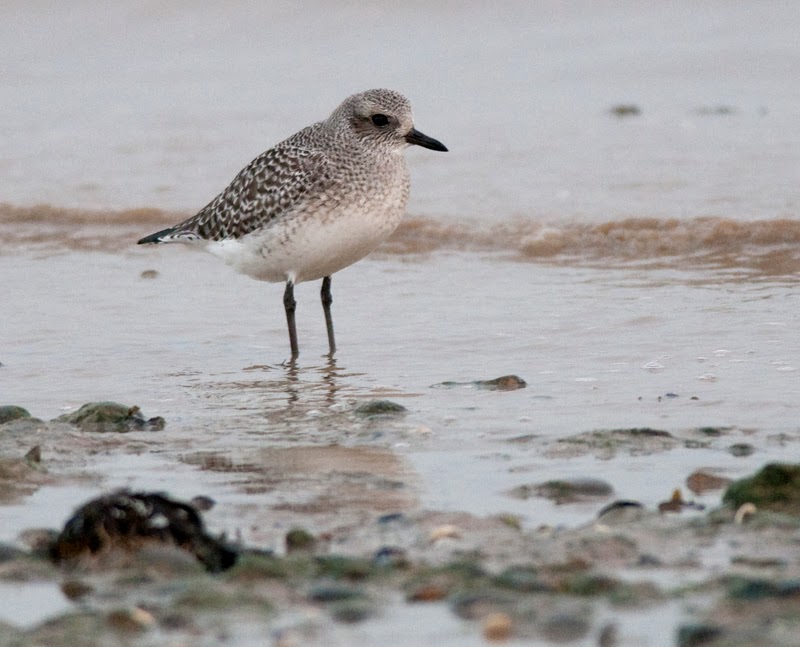
From the top, here we have Brent Geese, Dunlin, Sanderling, Grey Plover, Redshank (with bonus blurry Dunlin), a bunch more Dunlins, and a Turnstone.

Just as we were thinking about packing up, as the light was getting ridiculous, a smallish-but-not-that-smallish falcon came bombing along the shoreline and revealed itself to be a very lovely male Peregrine. It chased but couldn't catch one of the little waders, and then carried on to wreak havoc among the huge cluster of Oystercatchers on a distant spit.

The traumatised Oyks came around and landed quite near to where we were sitting, though by this point the tide had gone out far enough that they were not all that close to us. I'm pleased to report that we were able to get up and sneak away without disturbing any of them.