Wednesday, 28 September 2011

Bough Beech and SWR

On Sunday afternoon, we went to Bough Beech, racing the gathering clouds. That's about all there is to say about that. Well, I did take a few photos, but it was very quiet, and nearly everything was out of range.

 As ever when visiting a reservoir in early autumn, our fingers were crossed for an Osprey. No luck but there were three Common Buzzards sailing around.

The water levels were super-low, and there were a fair few birds congregating around the channel by the causeway, including a very close Little Egret. However, it flew before we could head in its direction, so I offer a Grey Heron instead.

On the other side of the road, there was very little water, just a winding ditch lined with Teals. The drakes are almost out of their eclipse plumage now.

We walked down to the visitor centre, looking at the feeding station on the way. Empty feeders, no birds. There was this Red Admiral on the apple tree, desperately trying to soak up some warmth before the sun disappeared for the day.

The pond behind the barn was no longer a pond but a lush grassy field. The pathway alongside it was closed, with a sign up saying that some habitat development work was underway and also, excitingly, there were plans to build a hide here. That should be really good.

The sun was gone but we bought icecreams anyway. Heading back to the car park, we found a female Southern Hawker whizzing about over the ditch that connects the reservoir to the pond that's no longer a pond. I tried in vain to take its photo while Rob made sarcastic remarks about my lack of skill, then I handed him the camera and he failed just as miserably. We did enjoy some point-blank views of the little beauty though, before she lost patience and zoomed away.

And so to today - the second still, warm, cloudless day of what looks to be a true Indian summer. Rob has a new lens, so we went to Sevenoaks Wildlife Reserve to test-drive it. He had to go straight off to work after a couple of hours so I haven't seen his photos yet but here are some of mine.

I'm quite impressed that I managed a sharpish shot of this Blue Tit at the feeders by Grebe hide - it was very early and, according to my camera, too dark for proper shutter speeds.

We went to Tyler hide, pausing briefly at the viewing mound where we saw a Kingfisher plunge into the shady water directly below, then disappear into the trees on the island. Not too much to see from the hide - a few Black-headed Gulls, Teals, Lapwings and Cormorants. A lone Snipe.

A trio of Pheasants came wandering into view. This female was on the mainland in front of us.

Over on the nearest island was another female, and this unusual-looking male whose plumage was liberally sprinkled with pale fawn feathers.

We went on to Willow hide, nearly colliding with the same or another Kingfisher that belted across from East lake to the river in front of us. From Willow hide, the lake was prettily sunlit, with Gadwalls, Coots and Mallards drifting about. The resident Mute Swans and their full-grown cygnet were on the far shore. All rather so-so, but a lot of new ducks were arriving which kept my camera busy as I tried for flight shots.

These arrivals were all Mallards at first, and then a trio of smaller ducks with white wing-flashes appeared. They were two Wigeons, in company with a male Gadwall (which couldn't quite keep up).

A closer look at one of the Wigeons. Both were males, still with mostly eclipse body plumage.

A series of agitated whistles drew our attention to yet another Kingfisher. It flew in and landed in the large willow that takes up most of the central island. Here it sat in the shade, pretty much out of reach of my lens. I watched it for a while, but got distracted by these scrapping Moorhens.

I therefore missed the Kingfisher making a dive. It came up empty-billed and landed on a slightly more photogenic branch of the willow, but decided it didn't want to stick around for a photo-shoot.

And that was that - it was time to go. We walked back, just pausing long enough to grab a shot of this quizzical-looking Dunnock, and to admire from a distance a Nuthatch in trees behind the visitor centre.


Sunday, 25 September 2011

Settings and tinkerings


Friday was a lovely day. I went to visit Sue for the evening, stopping off at Dunorlan Park as it's on the way. There was nothing much to see besides the usual parkland birds but I took the opportunity to play around with my camera settings and see if I could get sharper in-flight shots.

My models - lots of Black-headed Gulls, adults and juvs. I really should have checked back to see how the Common Terns got on in the summer, they have gone now. Anyway, I think my tweakings have paid off, but I'll need some more demanding subjects to be sure.

I also tried out some close-range stuff. I couldn't get a clear view of this Woodpigeon without actually getting into the lake with it.

 A sunlit Moorhen. I realised the other day that we don't have many nice Moorhen photos, a situation which is, frankly, unacceptable.

When the subject is practically at your feet and moving about a lot, getting any of it in focus can be tricky. I was aiming for this Greylag's eye, as the rule book says I should, but ended up with a load of bill instead. Still quite like the pic though.

Several of the young Black-headeds were passing the time by playing with fallen leaves in the water.

Another young 'blockhead' in flight. I just spent a while tinkering around with this shot to get a more blurred background, see below...

Not too bad for a quick job? Actually I think I prefer the original after all that, but it's fun to play around with editing techniques.

Tuesday, 20 September 2011

A couple more from Shoreham/Rodmell

This is really just a post to see what the new Blogger posting interface is like, but to make it interesting here are a couple of Rob's pics from our recent trip to Shoreham (that's the one by the sea, not the little village near Sevenoaks) and Rodmell near Lewes.

He was using his new 70-180mm macro, which is a really nice lens (and so it should be, it wasn't cheap (actually, it WAS cheap for a secondhand copy)). This Wall Lizard tolerated a pretty close approach.

And here's Rob's take on the female Common Darter we found on our short walk at Rodmell. This close-up shows very clearly the yellow stripes down the legs, which distinguish this species from the otherwise pretty similar Ruddy Darter.

Sunday, 18 September 2011

Afternoon at Oare

Yesterday was a sort of sunny day, except when it was absolutely lashing it down. You know, one of those days. With a fairly fresh breeze into the bargain. We went to Oare in the late afternoon, after a quick trip up and down the Elmley access track where pretty much all we saw was a Brown Hare pretending to be a cowpat.

There was no space to park by the flood, so we parked at the end and walked back - I was rushing ahead, eager to get to the viewpoints before the sun disappeared behind an impressive bank of thick and lumpy greyish orange cloud.

Approaching the flood, I could see that there were very large gatherings of Golden Plovers, Avocets and Black-tailed Godwits, gathered in three separate clusters. Something upset the Golden Plovers and they all went up (along with a few Dunlins) and did a circuit of the flood before returning to their original spot on the muddy spit.

Most of the Black-tailed Godwits were in a long straggly line off the biggest island, but a few were feeding nearby.

This one had a fair amount of bling on its legs. I also saw another with rings plus a little yellow flag thing.

Two gorgeous Little Stints materialised on the right side of the central spit. They were teeny tiny in my viewfinder despite being quite close. They didn't stay very long, but flew off to the far end of the spit.

As the sun started to vanish, something spooked the Avocets. I never saw what it was. Or maybe the Avocets just decided it was time to go, because most of them didn't come back. En masse, they made a great spectacle.

So, to recap. Lots of Blackwits, Avocets and Golden Plovers. Also plenty of Redshanks and Lapwings. A smattering of Dunlins. A single Ruff. A trio of Ringed Plovers on the nearest island. Very little wildfowl - a few Teals and these two Mute Swans.

The Ringed Plovers decided to leave at this point. The sun seemed to have gone for the day, and we were struggling to get any images at all, but we stuck around a little longer. A few terns drifted over, including a Sandwich Tern that settled on the far end of the nearest island. A volley of exciting whistles heralded a fly-by Kingfisher. A Kestrel hovered over the big island, causing precisely zero anxiety among the resting waders.

After about 20 minutes' wait, the sun did reappear briefly. There wasn't much close at hand for it to illuminate, but I thought this adult and juv Black-headed Gull looked really nice.

Thursday, 15 September 2011

Red(-breasted) Herring

The fact that it took me more than two weeks to mention this Red-breasted Goose at Sevenoaks Wildlife Reserve indicates how little faith I have that it's anything other than a fence-hopper. Nevertheless, it's a lovely-looking bird and was the highlight of our visit on Sept 3rd. That, and another meeting with the rogue grey cat (first mentioned here: http://robandmazza.blogspot.com/2011/05/chick-factor.html), who is now sporting a collar tag reading 'Not lost, visiting from Riverhead'.

I went to the reserve again this morning. It was a gorgeous start to the day, cloudless and still. I went straight to Carter hide but found it occupied by other would-be Kingfisher photographers so decided to leave them to it and went on to Willow hide.

Before I got there, I found this very recently fledged baby Woodpigeon and its parent sitting on a stump. The adult flew when it saw me but the youngster stayed put while I took a couple of quick shots.

One of the nice things about blogging my sightings (given that I was never very disciplined about keeping a conventional birding diary) is having the means to compare stuff from year to year. Reading back, I see that last year's first Wigeon was on 25 September. This was the only interesting bird on view from Willow hide. Where are my Green Sandpipers?

My trigger finger wasn't playing ball today. Among the photos I was too slow to get, or messed up completely, were an in-flight Great Spotted Woodpecker, lots of Stock Doves and lots of Chiffchaffs. Maybe I should stick to ducks. This young Tuftie was on West Lake, where I also saw (at a great distance) a Great Crested Grebe carrying a very small chick on its back.

It's spider season. I saw some humungous Garden Spiders in my dad's garden in Hastings at the weekend. Don't know who built this web, but it looked pretty with a bit of backlighting.

Back at the centre, I sat for a little while at the wildlife garden feeding station, having heard Nuthatch and Coal Tit calling nearby. Both came down but I only managed to photograph the Nuthatch. What a pair of feet!

Various birds were zooming about in the trees around the car park. I got a nice surprise when I took a closer look at this one - a juvenile Bullfinch. Evidence of nearby nesting, and my first photo of this species on the reserve.

Friday, 2 September 2011

Sevenoaks and Shoreham

On Bank Holiday Monday, I made the most of a sunny (though coolish) morning with a few hours at Sevenoaks Wildlife Reserve. I got home thinking I'd not seen a lot, but a look through the photos showed that it had actually been OK, all things considered.

Walking down the access track, I noticed quite a lot of bird activity, and decided to have a sit down in the busiest area in front of a big dead ivy-cloaked tree, and see what came along. A few young Greenfinches appeared, then a Willow Warbler which evaded my lens. Finally a stunning Great Spotted Woodpecker flew round and landed on a branch just a few feet away, then noticed me and sped off. I must invest in a bag hide.

On around the reserve, via Carter hide. Here, almost a year to the day since the last time it happened, a Kingfisher flew in and settled on one of the two perches right in front of the hide window, almost as soon as I'd sat down. It was only there for a moment, and in any case my 420mm is too much lens for a photo at such close range. I took off the teleconverter and waited hopefully for a repeat performance, but it was not to be.

On to Willow hide and to my relief the vegetation that had grown up and blocked the view has now been cut down, revealing a vista of Canada Geese, Gadwalls and Coots. Nothing more autumnal yet though, unless you count this busy Jay.

I sat for a while anyway, hoping for something to happen. Another flock of geese arrived, this time including some Greylags, and did some fine wiffling overhead.

Next I went to the meadow area by Long Lake, noting a few Stock Doves around the trees behind the lake en route. The meadow was busy already, with two other photographers and a pair of fishermen. Just as last time there were a few Hornets patrolling the grass, but the cooler weather slowed them down a bit this time and I managed a few photos. I also (as usual) disturbed a Brown Hawker from its perch as I blundered along.

I went back via Carter hide. Not a sniff of a Kingfisher this time, despite all the small fish skipping about in the clear, shallow water. This, however, was not a small fish. I don't know what it is, but it was a big 'un, and it doesn't look right for a carp. Anyone have any ideas?

I set up my chair at the viewpoint over West Lake and attempted to photograph some of the many hirundines going overhead. Then I noticed something bigger, flying eastwards with power and purpose at a considerable height. It was my long-overdue first patch Common Buzzard. A juvenile, I guess, because all its feathers are present and correct (most adults are showing plenty of wing and tail moult at the moment).

Some of the hirundines. There were lots of Sand Martins and only a few House Martins. Sorry for the particular fuzziness of the last shot, but these two Sandies seemed to be engaged in a mid-air food exchange - a behaviour I've not seen in this species before.

I went to Tyler hide, but didn't add anything much except a pair of Teals. Leaving again, I spotted this female Sparrowhawk circling the lake. A two-raptor day is a red-letter day at Sevenoaks...

A shot grabbed on the way back past West Lake. Not much of a breeding season for this female Tuftie, and her lone duckling is still very much at the 'small and vulnerable' stage.

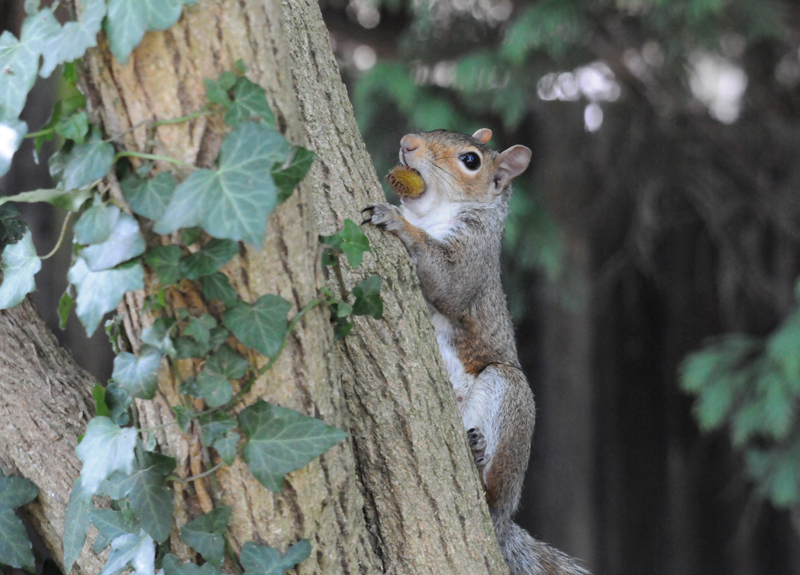
On the way out, I switched to the MacZoom lens for a bit of insect photography. The lens made a reasonable fist with this non-macro subject, hurrying up a tree with a mouthful of beechmast.

At the top of the access track I had a go at photographing the many wasps and other insects visiting the flowering ivy there. I was hoping for a wasp in flight. This was the closest thing I managed, but it wasn't quite what I'd had in mind. I think the 300mm might actually do a better job of this...

In the afternoon, Rob and I went down to Shoreham, grabbing Michele on the way. Our goal was to find some of the Wall Lizards that live on and around Shoreham Fort. The Wall Lizard is a continental species, but has been introduced in a few places along the south coast and seems to like it here.

I suppose it was because of the weather that the lizards were not flaunting themselves high on the fort walls but instead lurking in the shingly vegetation below. Michele proved herself a star lizard-spotter and found several for us, including this one. Rob got better photos, but I haven't managed to get my hands on his memory card yet.

I was excited to spot a Hummingbird Hawkmoth investigating the fort walls (for what, I don't know, but it seemed very interested in them). Unfortunately my efforts to get a sharp photo were in vain, but it is at least IDable.

Done with lizards, we walked along the harbour arm and back again, seeing a few Turnstones and a Little Egret on the way. Then we began the drive home, but stopped off for a short walk over the marshes from Rodmell, a village near Lewes.

We followed a bridleway past meadows and wheat fields, sheltered by the South Downs to the north. Lots of Woodpigeons flew by. Then a raptor appeared in the distance and sped right past us - I shouted 'Hobby' and Rob shouted 'Peregrine'. I screwed up the photography but include this hopeless pic just to show Rob that I was right :)

Rob photographed this female Common Darter from every conceivable angle. I was just pleased to get one with her head sort of sharp despite her wings being in the way. The late sunlight on the tracery of wing veins was rather beautiful actually.

Back at the car park, Michele came up trumps again when she drew my attention to an LBJ high in a big tree. I was expecting a Chaffinch but what I got was this lovely Spotted Flycatcher. I grabbed one photo before it disappeared into the tree's shady interior.