I worked til early afternoon on Sunday and then could take no more, so we went to Tonbridge to see Michele. The weather was supposed to improve, so we hung around at hers drinking tea and glancing at the leaden sky from time to time but it remained resolutely un-sunny. Soon it was time to take Mushu the dog for her post-prandial walk.
Down by the castle, there were a few people feeding the ducks and pigeons. This Grey Squirrel wanted a piece of the action too but was a bit reluctant to descend from the safety of his tree.
Looking across the river to a rather nice garden with a riverside frontage, Michele noticed this male Red-crested Pochard on the bank among the many Mallards. He was fully winged, as he demonstrated when jumping into the water.
What a state. The bouffant orange hair-do should grow in properly over the next few weeks and transform him from ridiculous to magnificently ridiculous.
Back in Michele's front garden, a wildlife drama was unfolding - a hefty Garden Spider preparing her packed lunch. Rob set up the BigMac on a tripod for a few photos but he's still not happy with them. With this kind of shot, any slight breeze can ruin everything. I think it looks pretty good though. You can just make out the poor wasp's face - sinister stuff.
We went on to Haysden Country Park after that for a mini-walk. It was by then 5.30pm and the light was bad, to say the least, but it was nice to look around a new area even though it was rather quiet, wildlife-wise.
This country park contains lakes and rivers, and is pretty much overrun with Himalayan Balsam, a colourful, pungent non-native (and considered invasive) plant with a very effective seed dispersal method. When ripe, the pods explode violently at the lightest touch, scattering seed over the local area.
We noticed several insects visiting the flowers and burrowing into the bucket-like bits at the back. They were unusual-looking things, with a pronounced silvery sheen on their uppersides. Keen to ID them later, I took a few pictures.
It looks like a bee. It looks a lot like a Honey-bee in fact, apart from the silvery fluff on its thorax...
... but hang on. This one looks like a wasp! Then the penny dropped. It is a wasp, and the first one was a bee. The silveryness is Himalayan Balsam pollen, and plenty of it. No wonder these plants are so successful at quickly colonising new areas.
At Haysden Lake, there was little to see. I walked out onto one of the little wooden pontoons to check out the view, and gave this young Great Crested Grebe a fright when it surfaced just a few feet away from me. Scanning the more distant waters revealed a few more GCGs, a mix of adults with fast-diminishing head-dresses and stripy-faced youngsters.
On the way back I took a few photos of the many House Martins feeding overhead. Extremely poor light + very fast and small bird + massive crop = rubbish photos. This was one of the least rubbish, which isn't saying much. Among the House Martins scythed a single, very late Swift. I managed two pics, in which it somehow looks like a mutated flying goose.
As we got in the car, I noticed a splendid male Great Tit on the wooden fence, hungrily eyeing what looked like a Scotch pancake on the top of a nearby bin. I wound down the window and he came over to the bin to do battle with this large and awkward prey item. The light by this point was really minimal, giving me about 1/100 sec at maximum ISO, but by bracing the camera on the window frame I managed a sharpish pic (on about the 40th attempt).
Oh, Rob didn't make it out of bed this morning in time for his planned pre-work trip to Cliffe, so that will have to wait for another time!
Monday, 20 September 2010
Saturday, 18 September 2010
Back at SWR
A sunny, though chilly morning, and Rob and I spent a few hours at the reserve. I was mainly after photos for the current book, and Rob was mainly after Kingfishers.
Arriving at the Willow hide, we were immediately treated to a perched Kingfisher (in a willow, appropriately enough). It was beyond the reach of the 300mm but Rob took some pics with the Bigmos. We were told that it or one of its friends had been visiting the perches in front of the hide lately, but not today.
I amused myself by pointing the 300mm at flying birds. It focuses much more quickly without the teleconverter, and though the reach is quite limited, the resultant photos could be cropped pretty damn hard without losing too much sharpness.
First up, a Stock Dove. I've seen them flying about from this hide before but never tried to get pics til today. Some say this is Britain's most boring bird species. Others don't, because they have never noticed that Stock Doves exist. That's a bit harsh actually. They are attractive in their own way, and pleasingly distinct from any of the million variants of Feral Pigeon.
Next, a Jay, complete with acorn. Jays are widely credited with planting new oak woodlands, as they bury acorns for winter consumption but inevitably some get forgotten and germinate.
These two Shovelers did two circuits of the lake. I didn't get any sharp pics of them against the water, but managed a bit better when they were against the sky. This isn't such a massive crop, as they actually came quite close.
I left Rob to it and went down to 'Reed Warbler corner'. No Reed Warblers any more, they have left, but I did hear a singing Cettis. Then, after a tense wait, I got a brief view of this surprised-looking male Blackcap, before he slipped away into the dense foliage.
I don't know if this is the same Comma I photographed the other day. If it is, it was in a much more show-offy mood today, which was nice.
I also found an adult Green Shieldbug on pretty much the same leaf as the nymph of last week. Must look up how quickly they grow up... Decided to go for an alternative angle for this shot.
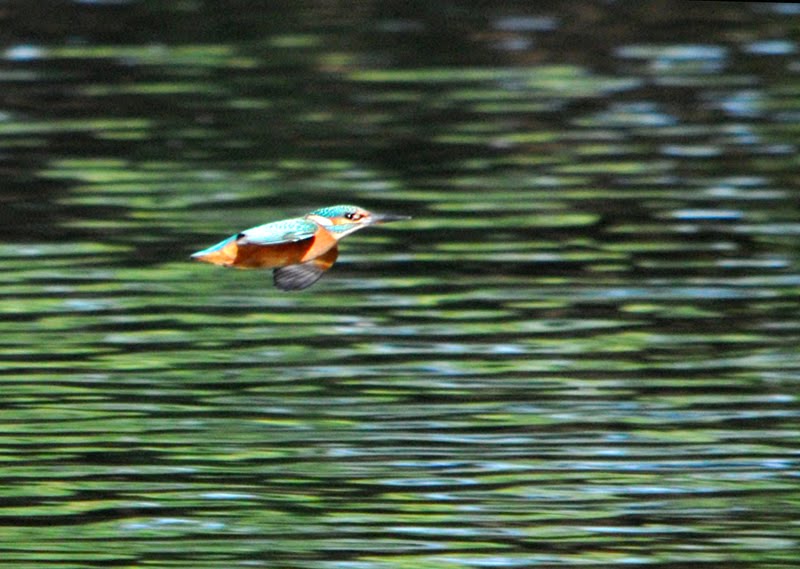
Meanwhile, back at the hide the assembled watchers had a second sighting of the Kingfisher. This time it wasn't sitting around but was whizzing over the water. Here's one of Rob's pics...
... and here's another. They were taken one second apart, according to the file info.
We had to go after that, but close to the visitor centre we paused to enjoy good views of a scruffy Chiffchaff as it flycatched (flycaught?) and leaf-gleaned in a sunny clearing.
Maybe this is his best side, actually.
Rob is planning to call in at Cliffe Pools in the morning. I hope he has a successful time, if so there should be a Rob-tastic blog post coming up soon...
Arriving at the Willow hide, we were immediately treated to a perched Kingfisher (in a willow, appropriately enough). It was beyond the reach of the 300mm but Rob took some pics with the Bigmos. We were told that it or one of its friends had been visiting the perches in front of the hide lately, but not today.
I amused myself by pointing the 300mm at flying birds. It focuses much more quickly without the teleconverter, and though the reach is quite limited, the resultant photos could be cropped pretty damn hard without losing too much sharpness.
First up, a Stock Dove. I've seen them flying about from this hide before but never tried to get pics til today. Some say this is Britain's most boring bird species. Others don't, because they have never noticed that Stock Doves exist. That's a bit harsh actually. They are attractive in their own way, and pleasingly distinct from any of the million variants of Feral Pigeon.
Next, a Jay, complete with acorn. Jays are widely credited with planting new oak woodlands, as they bury acorns for winter consumption but inevitably some get forgotten and germinate.
These two Shovelers did two circuits of the lake. I didn't get any sharp pics of them against the water, but managed a bit better when they were against the sky. This isn't such a massive crop, as they actually came quite close.
I left Rob to it and went down to 'Reed Warbler corner'. No Reed Warblers any more, they have left, but I did hear a singing Cettis. Then, after a tense wait, I got a brief view of this surprised-looking male Blackcap, before he slipped away into the dense foliage.
I don't know if this is the same Comma I photographed the other day. If it is, it was in a much more show-offy mood today, which was nice.
I also found an adult Green Shieldbug on pretty much the same leaf as the nymph of last week. Must look up how quickly they grow up... Decided to go for an alternative angle for this shot.
Meanwhile, back at the hide the assembled watchers had a second sighting of the Kingfisher. This time it wasn't sitting around but was whizzing over the water. Here's one of Rob's pics...
... and here's another. They were taken one second apart, according to the file info.
We had to go after that, but close to the visitor centre we paused to enjoy good views of a scruffy Chiffchaff as it flycatched (flycaught?) and leaf-gleaned in a sunny clearing.
Maybe this is his best side, actually.
Rob is planning to call in at Cliffe Pools in the morning. I hope he has a successful time, if so there should be a Rob-tastic blog post coming up soon...
Oare what?
Sue and I made a quick midweek visit to Oare on Wednesday morning. I have only just got round to writing about it...
The tide was out, way out, so there wasn't that much to see. One thing we did see was a bunch of Spoonbills on a sandbank across the Swale, recognisable because they were a) big, b) white, c) tall, and d) someone had told us they were there. It was a scope situation though, there was really no point attempting a photo.
There were waders scattered about on the mud. The closest one was a godwit, but not a Bar-tailed as I'd expected but a Black-tailed, uncharacteristically feeding on salty mud when a thousand or so of its friends were the other side of the sea wall, behaving like normal Blackwits and walking about in the Flood.
It soon saw sense and flew back inland, obligingly going right over our heads to reveal its wingbars and an almost complete lack of secondaries.
Strong winds (as usual, really) kept avian activity at a low level. We found a Wheatear on the path, and a Yellow Wagtail or two, but I couldn't get close enough for good photos. On the flood there were a few Avocets and Ruffs with the Blackwits, and a couple of Snipe zoomed out of the marshy edges.
One of the few birds that did fly within camera range was this fine Great Black-backed Gull. Not much to say about it apart from I wouldn't want to be in the way of that bill.
The feeding waders had moved closer to the road when we went past again. This Ruff was playing hide-and-seek with me, and my camera (or rather the teleconverter) was playing silly buggers again. I was lucky to get any pics at all...
The teleconverter has gone back to Warehouse Express for replacement now. Hopefully I'll get another one soon... meanwhile I'll have to cope with a mere 300mm!
The tide was out, way out, so there wasn't that much to see. One thing we did see was a bunch of Spoonbills on a sandbank across the Swale, recognisable because they were a) big, b) white, c) tall, and d) someone had told us they were there. It was a scope situation though, there was really no point attempting a photo.
There were waders scattered about on the mud. The closest one was a godwit, but not a Bar-tailed as I'd expected but a Black-tailed, uncharacteristically feeding on salty mud when a thousand or so of its friends were the other side of the sea wall, behaving like normal Blackwits and walking about in the Flood.
It soon saw sense and flew back inland, obligingly going right over our heads to reveal its wingbars and an almost complete lack of secondaries.
Strong winds (as usual, really) kept avian activity at a low level. We found a Wheatear on the path, and a Yellow Wagtail or two, but I couldn't get close enough for good photos. On the flood there were a few Avocets and Ruffs with the Blackwits, and a couple of Snipe zoomed out of the marshy edges.
One of the few birds that did fly within camera range was this fine Great Black-backed Gull. Not much to say about it apart from I wouldn't want to be in the way of that bill.
The feeding waders had moved closer to the road when we went past again. This Ruff was playing hide-and-seek with me, and my camera (or rather the teleconverter) was playing silly buggers again. I was lucky to get any pics at all...
The teleconverter has gone back to Warehouse Express for replacement now. Hopefully I'll get another one soon... meanwhile I'll have to cope with a mere 300mm!
Tuesday, 7 September 2010
Power cut forces birding trip
Today we had no electricity for three hours. This wasn't actually a power cut - there was a man downstairs replacing all the electricity meters. As it wasn't (quite) raining when he switched ours off, I decided to go down to SWR.
There was the same mix of stuff around as there was over the weekend. I am going to try not to be too boring and post different species to those that I posted last time...
... except for this one. This Green Sandpiper was on the near shore, and made its way to within a few feet of where I sat in Willow hide before suddenly noticing me and my camera, and flying off with a startled volley of squeaks. I was dismayed that I'd scared it, but it was already making its way back in my direction by the time I left the hide.
There were a few insects in evidence when the sun was out. One of the less obvious was this immature Green Shieldbug, confident in its camouflage as it relaxed on the upper surface of a nettle leaf.
I took a rare walk down to Long Lake and was so moved by the beauty of the lake when the sun hit it that I... CHANGED LENS and took a few scenic shots. This is probably the prettiest lake on the reserve, though not the most wildlife-rich. I flushed a young Grey Heron when I got here, but saw no other feathered life.
It wasn't a complete blank though. I was happy to see this Comma, even though it wouldn't open its wings for me. There don't seem to have been huge numbers of Commas on the reserve this autumn.
Back at Willow hide, a new species showed up - a small flock of Teals which flew around in a circle before landing rather a long way across the lake. This was the best shot I got. At least it shows off that lovely green speculum.
There were two or three each of Grey and Pied Wagtails foraging on the mud in front of the hide. This one stood out with its peculiarly peachy chest, probably the result of waddling in water full of iron ore.
Add to this - one fly-by Kingfisher, a metric shed-load of Chiffchaffs and the usual backing cast. It still counts as a great trip, because of that very photogenic Green Sandpiper.
There was the same mix of stuff around as there was over the weekend. I am going to try not to be too boring and post different species to those that I posted last time...
... except for this one. This Green Sandpiper was on the near shore, and made its way to within a few feet of where I sat in Willow hide before suddenly noticing me and my camera, and flying off with a startled volley of squeaks. I was dismayed that I'd scared it, but it was already making its way back in my direction by the time I left the hide.
There were a few insects in evidence when the sun was out. One of the less obvious was this immature Green Shieldbug, confident in its camouflage as it relaxed on the upper surface of a nettle leaf.
I took a rare walk down to Long Lake and was so moved by the beauty of the lake when the sun hit it that I... CHANGED LENS and took a few scenic shots. This is probably the prettiest lake on the reserve, though not the most wildlife-rich. I flushed a young Grey Heron when I got here, but saw no other feathered life.
It wasn't a complete blank though. I was happy to see this Comma, even though it wouldn't open its wings for me. There don't seem to have been huge numbers of Commas on the reserve this autumn.
Back at Willow hide, a new species showed up - a small flock of Teals which flew around in a circle before landing rather a long way across the lake. This was the best shot I got. At least it shows off that lovely green speculum.
There were two or three each of Grey and Pied Wagtails foraging on the mud in front of the hide. This one stood out with its peculiarly peachy chest, probably the result of waddling in water full of iron ore.
Add to this - one fly-by Kingfisher, a metric shed-load of Chiffchaffs and the usual backing cast. It still counts as a great trip, because of that very photogenic Green Sandpiper.
Monday, 6 September 2010
Rainham Marshes
I forgot to take any scenic pics of Rainham, so apologies for that. For those who don't know, this is a newish RSPB reserve by the Thames in the grotty heart of east London. The RSPB have turned a rough (in all senses of the word) bit of neglected former army training ground into a lush and thriving reserve of grazing marsh with shallow lakes and deep, reedy ditches. Of course, everywhere you look there are pylons, flyovers and other urban landmarks, but don't look too far and you'll just see flowers and water and wildlife.
Having said all that, it was a rather quiet day. We just walked the reserve trail rather than the river path, being knackered from aikido, so missed the chance of interesting birds on the Thames. However, what we did see on the reserve was quality stuff.
Marsh Frog (Rob's pic). There were several of these, lying around in the shallows. This introduced species is Europe's largest frog, and is a spectacular shade of green. We also saw one Water Vole, and I took a photo of it which is too embarrasingly bad to reveal here.
Rainham has a super-swanky visitor centre, and now also the swankiest hide I've ever seen. On two levels, it is spacious, comfy, has lighting (and, I suppose, heating), comfy and easily moveable seats and windows with a top and bottom glass panel that slide open independently. On view is a marshy soggy area that is probably going to be great in winter, though today there wasn't much to see apart from Gadwalls, Teals, Shovelers, a Little Egret or two and a lot of geese.
Then someone drew our attention to a young Fox making his way along the grassy bank that screened the marshy bit off from the path. This enchanting youngster was searching for something to eat, and made little pounces and dashes into the long grass. His left hind leg was injured, the poor love.
My lens/teleconverter decided to violently misbehave about now, and I couldn't take more photos. The cute Fox was by now right in front of the hide, and too close for my 420mm anyway, but I would have liked a frame-filling pic of his beautiful eyes.
Rob carried on taking pics until the Fox had gone beyond the reach of the 70-300mm, then we took the lens and teleconverter off, tried the camera with just the lens (fine), then replaced the teleconverter. It behaved itself for the rest of the day, so fingers crossed...
How's this for a demonstration of (not much) depth of field? I should have stopped down for a few more shots really. I will next time, promise. This was one of three Common Lizards we saw towards the end of the walk, all relaxing on the boardwalk and enjoying a brief interval of sunshine.
We paused by the feeding station that you can see from the ramp up to the visitor centre. There were several Collared Doves here, sitting around on the sticks from which the feeders hung, not doing much. Then one of them decided to either hump or fight with one of the others (it really wasn't clear what was going on) and a few moments of excitement ensued.
On the drive out, we saw a Hobby. Bird of the day, even though it was only glimpsed through the car window.
Having said all that, it was a rather quiet day. We just walked the reserve trail rather than the river path, being knackered from aikido, so missed the chance of interesting birds on the Thames. However, what we did see on the reserve was quality stuff.
Marsh Frog (Rob's pic). There were several of these, lying around in the shallows. This introduced species is Europe's largest frog, and is a spectacular shade of green. We also saw one Water Vole, and I took a photo of it which is too embarrasingly bad to reveal here.
Rainham has a super-swanky visitor centre, and now also the swankiest hide I've ever seen. On two levels, it is spacious, comfy, has lighting (and, I suppose, heating), comfy and easily moveable seats and windows with a top and bottom glass panel that slide open independently. On view is a marshy soggy area that is probably going to be great in winter, though today there wasn't much to see apart from Gadwalls, Teals, Shovelers, a Little Egret or two and a lot of geese.
Then someone drew our attention to a young Fox making his way along the grassy bank that screened the marshy bit off from the path. This enchanting youngster was searching for something to eat, and made little pounces and dashes into the long grass. His left hind leg was injured, the poor love.
My lens/teleconverter decided to violently misbehave about now, and I couldn't take more photos. The cute Fox was by now right in front of the hide, and too close for my 420mm anyway, but I would have liked a frame-filling pic of his beautiful eyes.
Rob carried on taking pics until the Fox had gone beyond the reach of the 70-300mm, then we took the lens and teleconverter off, tried the camera with just the lens (fine), then replaced the teleconverter. It behaved itself for the rest of the day, so fingers crossed...
How's this for a demonstration of (not much) depth of field? I should have stopped down for a few more shots really. I will next time, promise. This was one of three Common Lizards we saw towards the end of the walk, all relaxing on the boardwalk and enjoying a brief interval of sunshine.
We paused by the feeding station that you can see from the ramp up to the visitor centre. There were several Collared Doves here, sitting around on the sticks from which the feeders hung, not doing much. Then one of them decided to either hump or fight with one of the others (it really wasn't clear what was going on) and a few moments of excitement ensued.
On the drive out, we saw a Hobby. Bird of the day, even though it was only glimpsed through the car window.
All the lens you'll ever need
After months of deliberation, weeks of checking secondhand suppliers and days of tension watching ebay, I got my mitts on a used 300m f4 lens on Saturday. Rob had half-heartedly encouraged me to wait to see if Nikon produced an updated version of this 10-year-old model with VR, but as such a lens didn't seem to be on the horizon at all, when I found a well-priced used one on ebay I went for it.
The lens had its first outing to - where else? Sevenoaks Wildlife Reserve. Post-lunchtime on a Saturday meant it was pretty busy, and also it was a rather gloomy afternoon, but not a problem for putting the new lens through its paces. We went to the Grebe hide and Rob had fun photographing birds at the feeders with the 70-300mm while I pointed new lens at some Chiffchaffs in a willow by the water.
Tits first. The juvenile Blues and Greats are starting to moult into adult plumage. Mid-moult is not a prepossessing look but it's interesting. The glossy black adult feathers appearing on this young Great Tit's crown show just how much paler and duller the juvenile crown feathers are.
The young Blue Tits were more advanced, but you can still see bits of grey on the crown among the blue feathers, and a hint of yellow lingering on the cheeks.
And the Chiffchaffs? Well, that willow is a long way down. Here's a full frame of the clearest shot I got. The Chiffchaff is in the middle. Look carefully... It's tiny in the frame, but how does it look when cropped to a more sensible size?
It looks surprisingly sharp if you ask me. A massive crop like this on the Bigmos would be a blurry disaster.
I put the teleconverter on after this (a Kenko 1.4) but got no better views of the Chiffchaffs, so went out in search of more obliging quarry.
First I tried a few macro shots in the wildlife garden. I think this is a Honey Bee-mimicking hoverfly, in the little fake cornfield. Sorry about the green mesh.
At Willow hide, a young Pied Wagtail was wandering about on the muddy areas. Very little else there - loafing geese, a few Gadwalls, one sleepy Tuftie, zero Green Sandpipers. It would take a long time to list all the other birds that weren't there, so let's move on.
Next we went to Bough Beech, where we saw nothing photographable, then I returned to SWR for a sneaky extra hour. Back at Willow Hide, there was now a Green Sandpiper on view and, what's more, it was on the near shore (albeit the furthest possible point of the near shore, and almost lost behind the foliage). I watched as it picked its way towards the hide, making very slow progress as it kept going back on itself. Then something spooked it and it turned around and ran back out of sight. This was as close as it got - it's another heavy crop.
I had more luck with this young Lapwing. It flew in with a cheerful whoop, landed among the geese and waded along the muddy edge right in front of the hide, pausing frequently to grab wriggling muddy morsels at its feet.
I'm well pleased with the lens. One problem is that a few times it misbehaves and reports a rapidly dropping light level when there isn't one. Rob thinks this is a loose connection on one end or the other of the teleconverter. It gave me all kinds of grief on Sunday (see next post) but since taking it off and putting it on again (a variation of the IT panacea) it's been OK. Touch wood. If it does it again the teleconverter's going back. The lens seems fine on its own.
The lens had its first outing to - where else? Sevenoaks Wildlife Reserve. Post-lunchtime on a Saturday meant it was pretty busy, and also it was a rather gloomy afternoon, but not a problem for putting the new lens through its paces. We went to the Grebe hide and Rob had fun photographing birds at the feeders with the 70-300mm while I pointed new lens at some Chiffchaffs in a willow by the water.
Tits first. The juvenile Blues and Greats are starting to moult into adult plumage. Mid-moult is not a prepossessing look but it's interesting. The glossy black adult feathers appearing on this young Great Tit's crown show just how much paler and duller the juvenile crown feathers are.
The young Blue Tits were more advanced, but you can still see bits of grey on the crown among the blue feathers, and a hint of yellow lingering on the cheeks.
And the Chiffchaffs? Well, that willow is a long way down. Here's a full frame of the clearest shot I got. The Chiffchaff is in the middle. Look carefully... It's tiny in the frame, but how does it look when cropped to a more sensible size?
It looks surprisingly sharp if you ask me. A massive crop like this on the Bigmos would be a blurry disaster.
I put the teleconverter on after this (a Kenko 1.4) but got no better views of the Chiffchaffs, so went out in search of more obliging quarry.
First I tried a few macro shots in the wildlife garden. I think this is a Honey Bee-mimicking hoverfly, in the little fake cornfield. Sorry about the green mesh.
At Willow hide, a young Pied Wagtail was wandering about on the muddy areas. Very little else there - loafing geese, a few Gadwalls, one sleepy Tuftie, zero Green Sandpipers. It would take a long time to list all the other birds that weren't there, so let's move on.
Next we went to Bough Beech, where we saw nothing photographable, then I returned to SWR for a sneaky extra hour. Back at Willow Hide, there was now a Green Sandpiper on view and, what's more, it was on the near shore (albeit the furthest possible point of the near shore, and almost lost behind the foliage). I watched as it picked its way towards the hide, making very slow progress as it kept going back on itself. Then something spooked it and it turned around and ran back out of sight. This was as close as it got - it's another heavy crop.
I had more luck with this young Lapwing. It flew in with a cheerful whoop, landed among the geese and waded along the muddy edge right in front of the hide, pausing frequently to grab wriggling muddy morsels at its feet.
I'm well pleased with the lens. One problem is that a few times it misbehaves and reports a rapidly dropping light level when there isn't one. Rob thinks this is a loose connection on one end or the other of the teleconverter. It gave me all kinds of grief on Sunday (see next post) but since taking it off and putting it on again (a variation of the IT panacea) it's been OK. Touch wood. If it does it again the teleconverter's going back. The lens seems fine on its own.
Thursday, 2 September 2010
Kingfisher addiction
It's not like me to spend ages in a hide waiting for that one special bird to show up. I guess that's why I don't have a better collection of wildlife photos. But it was another sunny morning yesterday, so I went to the reserve and headed straight for the Carter hide. I wasn't the first - two 'togs' were in situ already but I squeezed in and waited for about an hour, during which the Kingfisher/s didn't show up.
Willow hide had more birds and fewer humans (none, in fact, at first). There were at least four different Gadwalls around, including this pair whose pic I've cropped to a panorama shape to remove a blurry Coot in the foreground. Does the crop work? Hmmmm, not sure.
Same Gadwall drake, different part of the lake so different light. People are always on about how nice-looking drake Gadwalls are 'if you look closely'. Well, I think they look fine from a distance too.
Here's the world's scruffiest Little Grebe. I haven't seen many Little Grebes at the reserve, and this little fella was very obliging, swimming as close to the hide as the extensive mudflats would allow. As I was photographing him, I also enjoyed a chat with a fellow birder who was clearly one of the local super-keen people. He had the Sevenoaks lowdown on every species I cared to mention, and I learned an awful lot from our brief conversation. I wish I'd thought to ask him about the local Lesser Spotted Woodpeckers!
I returned to Carter hide after this. Again, no Kingfishers on the sticks, but at least I saw one this time, having a sit-down quite high up in a tree and ignoring the antics of several Chiffchaffs and Long-tailed Tits nearby. That reminds me - Knowledgeable-man said that more than 70 Chiffchaffs were ringed on this reserve over the weekend - amazing.
Further distraction was provided by this Grey Heron, which was either swimming or taking wading to the absolute extreme. A peculiar sight, either way.
I finally gave up on the hide and left, but I checked the fallen tree by the path on my way back and there was a Kingfisher on it. I tried to creep up on it but flushed it. Must improve creeping technique.
From there I called in at Tyler hide, from where there were some birds to see (though photography is pretty much hopeless). Two Common Sandpipers pottered about on one of the islands, and an eclipse drake Shoveler came in for a spectacular crash-landing nearby. There were little groups of Teals here and there, alongside more Gadwalls. A distinct hint of autumn/winter, in other words.
I spent a little while at the new feeding station in the wildlife garden before going home. The huge viewing slots mean the birds know perfectly well that you're there, but after a short wait they seemed to stop caring. This Blue Tit took a drink from the upturned dustbin lid, no more than 10 feet away. It looked to be a poorly bird though, kept almost losing its balance and falling in.
Besides stuff already mentioned, I saw one Green Sandpiper, a Sparrowhawk being mobbed by a Magpie, and heard Green and Great Spotted Woodpeckers plus at least one Nuthatch. There are still darters and hawkers around, including a fine Brown Hawker which I spent quite a while trying and failing to photograph from Grebe hide.
Willow hide had more birds and fewer humans (none, in fact, at first). There were at least four different Gadwalls around, including this pair whose pic I've cropped to a panorama shape to remove a blurry Coot in the foreground. Does the crop work? Hmmmm, not sure.
Same Gadwall drake, different part of the lake so different light. People are always on about how nice-looking drake Gadwalls are 'if you look closely'. Well, I think they look fine from a distance too.
Here's the world's scruffiest Little Grebe. I haven't seen many Little Grebes at the reserve, and this little fella was very obliging, swimming as close to the hide as the extensive mudflats would allow. As I was photographing him, I also enjoyed a chat with a fellow birder who was clearly one of the local super-keen people. He had the Sevenoaks lowdown on every species I cared to mention, and I learned an awful lot from our brief conversation. I wish I'd thought to ask him about the local Lesser Spotted Woodpeckers!
I returned to Carter hide after this. Again, no Kingfishers on the sticks, but at least I saw one this time, having a sit-down quite high up in a tree and ignoring the antics of several Chiffchaffs and Long-tailed Tits nearby. That reminds me - Knowledgeable-man said that more than 70 Chiffchaffs were ringed on this reserve over the weekend - amazing.
Further distraction was provided by this Grey Heron, which was either swimming or taking wading to the absolute extreme. A peculiar sight, either way.
I finally gave up on the hide and left, but I checked the fallen tree by the path on my way back and there was a Kingfisher on it. I tried to creep up on it but flushed it. Must improve creeping technique.
From there I called in at Tyler hide, from where there were some birds to see (though photography is pretty much hopeless). Two Common Sandpipers pottered about on one of the islands, and an eclipse drake Shoveler came in for a spectacular crash-landing nearby. There were little groups of Teals here and there, alongside more Gadwalls. A distinct hint of autumn/winter, in other words.
I spent a little while at the new feeding station in the wildlife garden before going home. The huge viewing slots mean the birds know perfectly well that you're there, but after a short wait they seemed to stop caring. This Blue Tit took a drink from the upturned dustbin lid, no more than 10 feet away. It looked to be a poorly bird though, kept almost losing its balance and falling in.
Besides stuff already mentioned, I saw one Green Sandpiper, a Sparrowhawk being mobbed by a Magpie, and heard Green and Great Spotted Woodpeckers plus at least one Nuthatch. There are still darters and hawkers around, including a fine Brown Hawker which I spent quite a while trying and failing to photograph from Grebe hide.
Subscribe to:
Posts (Atom)