Saturday, 7 June 2014

Farne Islands - part 3 (not actually the Farne Islands)

There was time before the boats sailed (and also on Friday when we drove home) to go for a bit of a walk. On days 1 and 2 I walked a little way along the shore northwards, and on day 3 I headed off down the lanes from the farm and eventually ended up on the beach a bit further along. The countryside around here is lovely,  mostly farmland with a mix of grazing and arable, with the occasional copse and hamlet and lots of photogenic stone walls separating the fields. The beach is rocky at Seahouses but becomes sandy further on with an extensive dune system behind.


First, though, I spent a little time on the balcony of the bunkhouse and photographed the Swallows and House Martins as they flew by.

Like everywhere else, Seahouses is full of noisy young Starlings at the moment, chasing their parents for food or, like this one, making tentative attempts to feed themselves.

More Starlings. A lot more. These were feeding among the dunes.

And over the dunes, this rather marvellous view.

Collared Dove, striking a strange pose as it sets off on its rising and falling display flight.

Linnets were common around the fields, as were Goldfinches, Chaffinches, House Sparrows and Yellowhammers.

There's one of those pretty walls I mentioned, this one adorned with a Meadow Pipit.

And a baby Stonechat, examining the sky for - I don't know what. It was sufficiently occupied that I could get quite close to it.

There were gratifyingly high numbers of Skylarks around here. Other farmland birds present in abundance included Rooks, Pied Wagtails and Common Whitethroats.


Only the last morning was warm and sunny enough for butterflies. I saw several Green-veined Whites, and to my joy a few Wall Browns, which actually posed with wings open. One of them was even on a wall (though that one had virtually a whole wing missing so I have refrained from posting its photo).

One more insect - a Two-spot Ladybird which appears to be engaged in some kind of ladybird extreme sport.


There were plenty of Eiders along the shore. The non-existent crop factor of the D700 obliged me to try to find compositions with the bird not very big in the frame.

I didn't bring the landscape lens on my last walk (a decision I regretted once I reached the beach) but used the 300mm lens for some landscape-ish pics including this one.

On that same day, I was happy to find a Brown Hare in one of the fields opposite the coast road.

There was a Sand Martin colony in the undercliff of the beach. I spent a little while with them but didn't manage any really sharp photos.

Last pic now, taken on the last morning as I returned to the farm, a Willow Warbler which I'd heard singing every day but hadn't managed to see properly until I got the viewing angle through the leaves just right.

Farne Islands part 2 (other birds, and honorary birds)

The most notorious Farnes bird is the Arctic Tern, because of its habit of doing stuff like this. On Inner Farne, protective headwear is a must as they will peck you and their bills are SHARP. There are many pairs nesting on the path up from the jetty, many more around the loos and visitor centre, and others here and there elsewhere on the island. Some nest very close to the path. As you approach, they give you the hard stare, and begin to make their hard clacking alarm call, and then they may lift off and hover around your head, periodically swooping and pecking at the top of your head. They don't seem to go for faces, thankfully. You can't really blame them for taking against the heavy-footed humans stomping along right next to their precious eggs, and naturally people wonder if it is cruel to allow visitors onto the islands as they clearly stress the birds. However, the presence of human visitors does also help the terns, by discouraging gulls. The terns that nest closest to the path have higher breeding productivity, because they suffer lower predation.

This lady seemed to have the knack of tern-appeasing as the bird preferred to use her as a perch rather than savage her. Both she and the tern seemed happy to pose at length for photos.


The terns' aerial skill as they lined up their attacks made it relatively easy to catch flight photos.


Away from the immediate proximity of the nests, the terns were still fearless, but happily engaged in more sedate behaviours.

With no binoculars (I know, I know, I don't deserve to call myself a birder) I would never have found the distant Roseate Terns on the beach. A pair, but apparently not a pair ready to breed, they were keeping company with the Arctics.

I also didn't manage any good photos of the few Sandwich Terns around Inner Farne.


The large gulls are the most predatory things on the islands - one Herring Gull had snatched a chick (any ideas what it was?) from some unguarded nest. The Lesser Black-back was loitering near Puffin burrows.

The most numerous gull here, though, poses no threat to the other seabirds, and in fact this one seems a bit overawed by its Guillemot neighbour. There are Kittiwakes on both islands, fitting into the gaps between the auks. Most pairs still seemed to be at the nesting material-collecting stage.

This Kittiwake is overflying a seemingly endless sea of Guillemots.

In fact Guillemots outnumber Kittiwakes by about 10 to one, but Kittiwakes make a disproportionately large contribution to the noise levels here. A pair reuniting after one has been at sea are particularly vocal, their onomatopoeic calls carrying far above the low growly purrs of the auks.

I could photograph these gulls all day, they are so beautiful. This one is busy making itself even more beautiful.

Another cliff-nester here in good numbers is the Shag. These seemed to be at multiple stages in the breeding process, some tending well-grown chicks and others, like this one, still busily gathering furnishings for their nests.

One of the Shags nearest the path seemed to be sitting tight but then stood up to reveal this naked little frog of a chick. There was also an unhatched egg under her, so this baby may only be a few hours old.

Another proud parent, with two larger though no less gawky offspring.

A pair of Shags, doing some mutual preening and, by the looks of it, also sharing some startling gossip.

Only three passerine species breed on the Farnes. The Pied Wagtail is one of them (the others are Rock Pipit and Swallow).

Eiders nest on both of the islands we visited. The vols also informed me that there's a pair of Red-breasted Mergansers somewhere, and that Shovelers are nesting here for the first time this year. And Mallards are also on the breeding list. But Eiders are the most abundant duck species here and we saw several sitting females, plus these two with their brand-new ducklings.

Gannets, however, do not breed on the Farnes. But we still saw a few from the boats.


Fulmars are here, but in low numbers, just a couple of hundred pairs. I also saw them from the beach at Seahouses.


And now the 'honorary birds' - Grey Seals, which were around all the islands, swimming or chilling out on tiny rocky islets. The lone animal was relaxing on the shore of Inner Farne on both days we visited - what a hard life. The one on the left of the bottom pic though looks like it has had a hard life, going by its scarred muzzle.

I did bring a landscape lens with me and even remembered to use it a few times. Here's a view across Staple island to finish this post - and we'll be back on the mainland for part 3.

Farne islands - part 1 (auks)

I spent two days this week on the Farne Islands, enjoying serious close-up seabird fun. Many thanks to Trevor for doing the driving and for being great company on the way and on the days out. Also many thanks to Judi and Dave for their company on day 2. We didn't have the best weather (grey and drizzly on day 1, mostly greyish though dry on day 2) but it wasn't too windy, the boats were able to land on Staple Island both mornings and Inner Farne both afternoons. I took about 4,500 photos - all on Rob's D700 which he was kind enough to lend me for the trip. The full-frame-iness of the D700 and its great sensor meant that it coped fantastically with the (at times) very low light. Several companies run trips - we went with Billy Shiels, and they were great. And to complete the plugs, I stayed at the lovely Springhill Farm and paid next to nothing for a bed in the bunkhouse.

A bit about the Farnes. They lie off the Northumberland coast, just north of the small town/big village of Seahouses, from where the boat trips leave. The National Trust looks after the islands, and boats can land at just three of them (Inner Farne, Staple and Longstone, the latter a backup option for when the tricky landing at Staple isn't possible). Inner Farne is part of the inner group, Staple part of the outer group. The most numerous breeding species on the islands (by a large margin) are Guillemots and Puffins, but other typical cliff-nesters are present too, also Arctic Terns and Eiders.

Most people who visit the Farnes go to see the Puffins, and they don't leave disappointed. There are more than 30,000 pairs here, and both Inner Farne and Staple have lots of them. They are feeding chicks now and many of the birds whizzing about were laden with sandeels.

This group, though, I think were non-breeders, just hanging out on the clifftop rather than near the burrows.


I spent lots of time trying for flight shots. These are some of the more successful ones. They are very fast in flight, but also very direct, so are easy-ish to follow once you lock on, and if you stand at the right spot they will fly very close to you. Using the full-frame camera, and the bare 300mm lens rather than lens + teleconverter, made the task easier.


A couple on the deck. Again, easy to get close, although I was lucky to manage a shot of one carrying fish...

... because of this. On both islands, a large contingent of gulls (Black-headed plus a few Herring and Lesser Black-backed) loiter on the Puffin nesting areas, and when a bird returns with fish, they attempt to mug it as it rushes to its burrow. Often the gulls either grabbed the fish or scared the Puffin so badly that it dropped its catch.

As your boat nears the islands, the number of Guillemots on the sea increases until you're among vast rafts of them. These birds are resting and bathing, rather than actively feeding - that happens a bit further out.

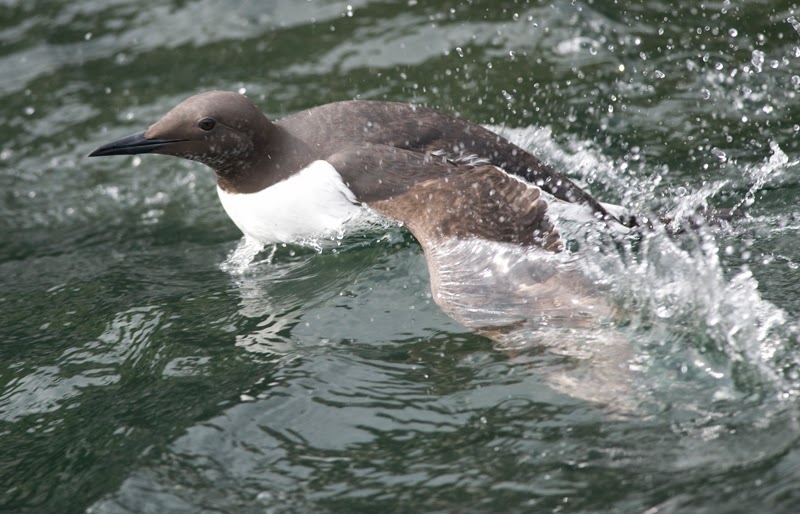
If the boat's too close, the Guillemots 'escape' by rushing along the surface with their wings beating.

Before we landed at Staple, we sailed around it a bit to look at the Guillemots and other seabirds on the clifftop and ledges.


Guillemots of the 'bridled' form were few and far between.

Those wings barely look capable of flight. But they are quick on the wing, though not exactly agile.

Yet another flight shot.

Guillemots (and Puffins for that matter) do a lot of flapping. Some individuals of both species were also pretty grubby, presumably because of the rain making for muddy surfaces.

A Guillemot from Inner Farne, going past one of the Billy Shiel boats.

Razorbill is the scarcest auk here, with only about one pair per 100-150 Guillemot pairs.

This one's pose reminds me of an orchestra conductor. Fortissimo!

And these two were happily canoodling, ignoring the row of photographers about one metre away from them.

Part 2 will cover the other Farnes birds, and part 3 will be stuff I saw on the mainland around Seahouses.