Thursday, 5 September 2013

Reflections on summer

The weather forecast says that tomorrow it will be freezing cold with torrential rain. Can't wait. Meanwhile, I decided to pop down to the local patch for another crack at the Kingfishers, as it was (like yesterday) looking like a beautiful still and sunny day. I set off at about 8am, only intending to stay an hour or so, got home about 1pm. Whoops.

I headed for Willow hide. When I was almost there I noticed a green caterpillar dangling on a thread from a tree. This bungee-jumping is something that a lot of tortricid species do to escape danger. But in this case it didn't work. There was a parasitic wasp on the caterpillar and it looks like her ovipositor has found its target. Pity the light was not better.

There was another birder/photographer in the hide, and as the morning went on a couple more joined us, all intent on Kingfishers and looking set for a long stay. Because the tall stools in the hide have gone awol, and the benches are too low for me, I have to stand up when I want to take pictures. And because I wanted to take pictures of lots of things that weren't Kingfishers, I was standing up and sitting down a lot, to the consternation of the others in the hide who kept thinking I'd found a Kingfisher when in reality I was taking pictures of a Teal, Black-headed Gull or something similarly uninteresting (if your heart's set on Kingfishers). To be fair I did let them all know immediately whenever I saw a Kingfisher, which happened five or six times during my stay (though in some cases the bird didn't stop to have its picture taken).

While it was still just two of us and the light hadn't reached the nearest bit of mud, two Grey Wagtails arrived, but they didn't stay long enough for sunny photos. Still, good to see. It takes a lot of mud to tempt them down to this lake.

No, I didn't accidentally hit 'rotate file'. There were a dozen or so Canada Geese loafing on one of the muddy islands and I decided to take a photo of just the reflection of one of them. Not sure the result is terribly edifying but it does show how beautifully still the water was.

The geese presently waddled into the water, and then started making a racket before taking off for the fields for a leisurely day of grass-eating.

Then two Lapwings arrived. Both looked like this year's youngsters, and they hung around the whole time I was there, moving between the mud islands and generally being pretty. I took a lot of shots of them...


Gorgeous birds. I also tried a 'reflection only' pic, which I think was a bit more successful than the goose one, because of the golden tones in the water.

A few Jays were going back and forth at the back of the lake. Also seen around the margins were two Great Spotted Woodpeckers and one or two Stock Doves.


This Black-headed Gull is freshly moulted into its winter plumage and wanted to show off. The outermost primaries are not quite full length yet.

There were three or four Kingfisher visits to the sticks. Sadly all were rather brief and I didn't manage any flight shots, let alone any plunge-into-the-water shots.


Two Grey Herons, an adult and a youngster, came down to the water. This one walked across the full length of the lake, ending up too close to fit in the frame. I thought for a while that it was eyeing up a half-grown Moorhen chick which was swimming about with its parent, but the parent made sure the little one kept a good distance away.

The chick in question. It's at that awkward age where it's covered with both fluff and feathers.

I left the hide at about noon and wandered back to the car park. I had originally intended to visit other hides but it was now very hot and I was tired and headachey so I didn't. I did note some late-summer birdsong going on - Chiffchaffs chiffchaffing, Coal Tits tswee-tswee-tsweeing. There were still a lot of Common Blue Damselflies about, plus a few Migrant Hawkers.


I did stop in the wildlife garden for as long as it took to photograph this gorgeous female Southern Hawker, laying eggs in the tiny pond there.

Wednesday, 4 September 2013

Arachnophilia

OK. If you don't like spiders, you're not going to like this post. You'd better find something else to read.

That includes you, Rob.

OK, now we've got rid of that lot... Today was very warm and totally sunny, and I visited RSPB Rainham Marshes with Shane, Graham and Tony. My main objective was to find and photograph a local eight-legged speciality - the Wasp Spider. I failed in the first part but succeeded in the second, thanks to some assistance from Rainham Man in the Know Howard Vaughan. But first things first.

It just happened that the first thing was a spider. A female Four-spot Orb-weaver to be exact. Shane found her alongside the grassy area by the Ken Barrett hide where Howard had told us the Waspies live, but I (despite my near total ignorance of all things spidery) was pretty sure she wasn't the right species, as she lacked stripes on her hefty abdomen. Howard V later confirmed the ID for us.

Yet another Migrant Hawker. But they're having to work hard to be included in my blog now. This one made the cut by sitting on a lovely purple Phragmites head.

Aaaand... yet another Ruddy Darter. I just liked the pic. And it's interesting to me that we are still seeing lots of Ruddies - I'm sure they finished earlier than this last year.


While scouring the patch of grassland that was reputedly full of Wasp Spiders (and not finding any), we did find several of these nice-looking beetles. I'm hoping someone will ID them for me... ETA - and I've had an ID now, thank you MarJus - species is Chrysolina banksi.

Further on, things were nearly birdless though we'd noticed a few Hobbies up above and been shown a distant Greenshank on the Aveley pools. through a kind fellow birder's scope. I didn't do this scene justice but in case it's not clear what's going on, these are juvenile Moorhens and they are preening each other (allopreening). Very sweet, and not a behaviour I've seen or read about in this species before.

A Small Tortie up near the Butts hide. Other butterflies about - Common Blues, Speckled Woods, all three common whites and one Clouded Yellow which, typically, was in a tearing hurry.

Up here we had a closeish flyby Hobby, then what seemed at first glance to be two more but a proper look revealed they were female-type Kestrels, wheeling about together most companiably. The only shot I managed with both in frame is blurry so here's one on its own.

They drifted off, then we saw them again a bit further off. Except it wasn't them, it was a Hobby and a Kestrel. I guess these must have been about the same distance from me as they're both more or less in focus, so this is a shape/size comparison. Not a very helpful one though, as they are in completely different poses.

On the way back, I noticed another female Four-spot Orb-weaver. This one had attracted an admirer, a skinny male who obviously appreciates a well-rounded female figure. He kept trying to get close and being repelled, but I did catch a brief arachnid embrace. I am not sure if females of this species habitually dine on their partners but he certainly seemed willing to take the chance.

About here, we had the closest Hobby of the day (still not very close though). I would estimate there were at least five different Hobbies around today.

Anyone fancy IDing this cute grasshopper?

As usual, a Little Grebe was on view through the bars by the Marshland Disovery Zone. I include its photo mainly because I like the ripples.

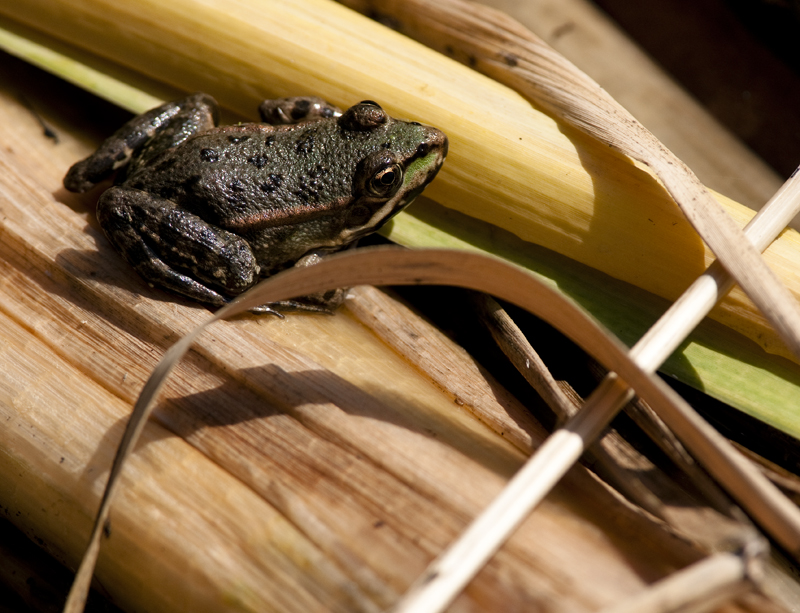
We'd been trying to find Water Voles all day with no success. A last look from the bridge by Purfleet hide was also fruitless vole-wise, but did produce this Marsh Frog resting on a discarded bit of RSPB literature. (Now RSPB litterature).

We went in to the cafe and purchased refreshments. While we were up there the guy on reception was notified by walkie-talkie of a couple of nice sightings - a Marsh Harrier over Aveley pools and a Green Sandpiper on Purfleet scrape. I managed to see both of these through the full-length windows. Then Howard came over to talk books, and when I mentioned that we'd not found any Wasp Spiders by the Ken Barratt hide, he offered to take us back there and find some for us.

He was as good as his word, finding about five of the little (actually, two of them were massive) beauties. There's a knack to it, which he'd actually explained but I'd totally misunderstood. You need to look for a 'hole in the grass', like the smallish, roundish area of squashed grass you'd get if you stepped with one foot into long grass. The Wasp Spider makes this hollow (somehow) and in it spins its web. This means that the spiders are a) pretty low down and b) surrounded by tall grass, so they are really hard to photograph well, especially with a long lens as you have to stand well back which means lots of grass gets in the way. A shortish macro would be much better, I reckon. Here's one of my better attempts. And I know now how to find them, for next time. Thanks again, Howard :)

Wednesday, 28 August 2013

Rainham on Monday, Sevenoaks on Wednesday

This is a two-for-the-price-of-one blog post, because Monday's trip to Rainham wasn't terribly eventful but there are a couple of photos I'd like to put up from the day (which was, for those who are interested in such things, a very warm but breezy sort of day with mostly blue skies).


Plenty of Ruddy Darters about, a few even posing on things other than the unphotogenic boardwalk.


Also representing dragon-kind - Common Darters, and of course Migrant Hawkers which were noticeably more numerous than they were a couple of weeks ago (though still not up to the ridiculous levels of last September).

The buddleias near the Tower Butts hide were stuffed with Small Torties, plus a couple of Peacocks. No Jersey Tigers today though.


From the same spot, I was very happy to find two Whinchats. No other passerine migrants around today, though there have been Wheatears and Black Redstarts reported recently.

Lots of tiny young Marsh Frogs around today, and they seem much more confiding than their bigger and older relatives.

Big Starling flocks out on the fields - it was interesting to see a juvenile posing alongside an adult - not too much difference between them now.

A rose bedeguar gall aka 'robin's pincushion', which I have discovered is produced by the wasp Diplolepis rosae.

And that's Rainham. There was also at least one Hobby about and I saw but couldn't photograph a high-speed Clouded Yellow. No waders of note. Now on to today's look at Sevenoaks Wildlife Reserve, which I visited between 12-3pm because it was at that time that Robert on the RSPB forums got some very nice shots of a Kingfisher from Willow hide. I had expected to find the hide busy but in fact had it entirely to myself for more than an hour.

The lake was very quiet. Close to hand was a Moorhen with a half-grown chick, further out a light scattering of Coots, Mallards and Tufties. Then a Teal flew in, followed by two more, and they spent some time working around the edges of the muddy islands that are appearing in the 'shallow end' of the lake, near the hide.

I noticed a young Grey Heron up a tree on the left-hand island, doing some yogic stretches. Then it flew down to land in the shallow water, and began to slink from left to right, clearly hunting but as far as I could see not managing to catch anything.

In between birds, I tried to photograph the various tandem pairs of darters that were going round egg-laying in the shallows.


It was a half-hour wait before the first Kingfisher arrived. It flew teasingly in a loop around the middle island before settling on the walking stick-shaped stick, from where it fished (like the heron, mostly without success). I took tons of pics of it perched, and fluked a couple of flight shots (no 'splash' pics though - there's always something to keep a photographer going back!). It stayed maybe 10 minutes, then left, then came back for another five minutes of fishing.

Not much else showed up here. A Clouded Yellow flew across the lake, and a trio of Gadwalls landed at the back. I decided to forget about birds and spent the rest of my time photographing plants and insects. The Purple Loosestrife is out and looking lovely, the Common Carder Bumblebees seem to love it.

A closer look at the purple stuff. The flowers are wonderfully ill-disciplined and 'blowsy' when you look closely.
It seems to have been a bad year for ladybirds, even the Harlequins. Saw just one today - in other recent years any summer visit would produce loads of sightings of adults and larvae.


Butterflies today, besides the afore-mentioned Clouded Yellow, were lots of Speckled Woods, one Red Admiral, Large and Small Whites and one tiny  browny lycaenidy thing that I didn't get a decent look at, which could have been any of Small Copper, Brown Argus or female Common Blue. The Speckled Woods were being complete stars, allowing me to get very close with the BigMac lens and only taking off when they needed to chase another butterfly out of their territory.

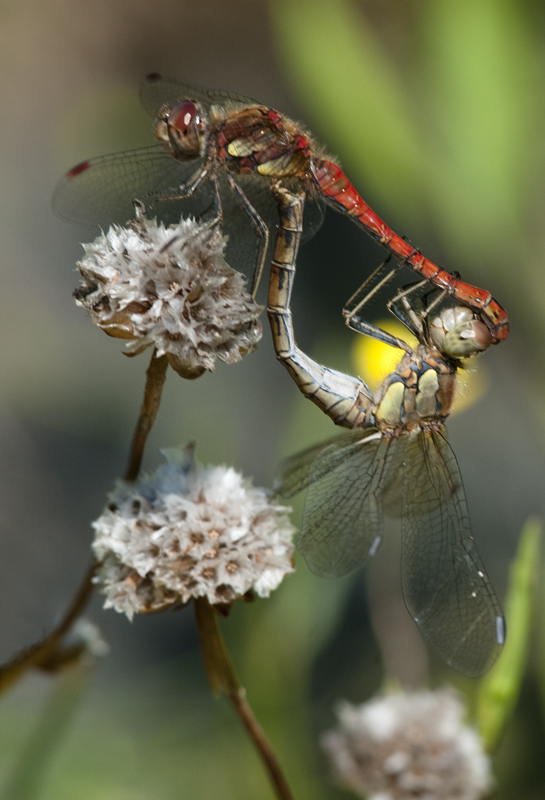
Back in the wildlife garden, I actually saw these two Common Darters meet each other and have an extremely whirlwind romance in midair, before they came crashing down together onto vegetation by the little pond.

I tried a backlit shot from the other side. I quite like those starburst blobs but from what I've heard most photographers hate them...

Overhead, a male Brown Hawker was hawking about, moving in the extremely unpredictable manner that is typical for this (annoying) species. But I finally caught it against the sky for a (nearly) sharp photo.

And then - wonders will never cease - it actually landed! Where I could see it! It chose about the shadiest spot possible but hey, it's still only the second time I've managed perched pics of this species. A most satisfactory end to the visit.