Thursday, 6 June 2013

Rye Harbour in the sun

Yesterday Shane and I went to Rye Harbour, to hopefully see lots of terns and stuff. It was just about breezy enough to justify wearing fleece plus t-shirt, but sky-wise we had uninterrupted sunnyness. We reached the reserve at about 9.30am, the huge car park by the caravan park was almost empty. Heading out towards the sea, we were soon noting Skylarks and a stream of commoner gull species overhead.

Near Lime Kiln Cottage we found this monopedal House Sparrow, who has clearly found her disability no obstacle to family life.


A singing Meadow Pipit flew out from the new saltmarsh area and paused in a pathside bush before continuing its song flight out over the old saltmarsh area.

We had a look in the wader scrape hide but there was little to see in binocular range, and the scrape itself looked very dried out.

By the fence edge a Carrion Crow was walking along, trying to look nonchalant. These Oystercatchers, one of several pairs dotted about between here and the beach proper, were not convinced and booted the corvid out of their territory.

The corner of shingle at the far south-eastern corner of the reserve, before you get to the sea, is known as 'Flat Beach' and is the area where the Little Terns are breeding this year, as evidenced by some Little Tern-shaped dummies to attract the real thing, and plenty of electric fencing. We saw a few real Little Terns flying up and down the river, but I only managed blurry photos of them. Here instead is another Flat Beach inhabitant, a Ringed Plover.

The next leg of walk was fairly uneventful, though commuting Cormorants and Sandwich Terns went over our heads now and then, as did gulls including one or two 'yowking' Mediterraneans, a Wheatear flicked away over the rolling shingle and plenty of Linnets were around. We opted to go to the hide on the south shore of the Ternery Pool first.

Most of the islands were packed with Black-headed Gull nests. On some islands the gulls were still incubating, on others they had half-grown chicks. I guess this means that certain islands are 'favourites' and are occupied first, with the latecomers being relegated to the less cool islands. On one island there was a large cluster of Sandwich Terns.

The terns that were carrying fish were mainly incoming from the west, so I guess that's the direction the good fishing was.

This Redshank was slowly picking its way along the near shore towards the hide. We were hopeful of some very close views in due course but something (possibly us, we were probably quite visible through the oversized hide window) spooked it and it flew across rather than walking around the little bay in front of the hide.

We took a quick look at the beach. Lots of shingle vegetation to admire, including massive purple mats of Ivy-leaved Toadflax, but there was nothing much moving offshore - it did indeed seem that the terns were not fishing at this spot but further down to the west. So we retraced our steps along the seaside path and turned inland to visit the hide at the eastern tip of the Ternery Pool.

The island immediately in front of us was festooned with Black-headed Gulls, with a few Common Terns shoehorned in among them. This tern took its time making a descent onto the few square centimetres of shingle that comprised its home.

There were also Sandwich Terns down at this end of the lake, along with Coots, Tufted Ducks, a few Shovelers and some Mallards. A Little Egret flapped ponderously over, and more distantly a Starling flock whirled about.

The Black-headed Gulls had frequent quarrels among themselves, though this was as nothing compared to the uproar that broke out when a large gull species dared to try to overfly the pool.

Then across the track to the new hide, from where we saw more gulls'n'terns.


We went on towards Narrow Pits, but only as far as the path back towards the car park. On the way we passed some shallow new pools where nesting Avocets were guarding their chicks, and here we saw some wonderful flying shows.

We followed a narrow loop which eventually took us back to the two hides east of the Ternery Pool, via a reedy ditch where this Sedge Warbler was singing. A Hairy Dragonfly, my first 2013 dragon, was here too, hawking over the grimy-looking water.


Lepidoptera had been rather thin on the ground, just a few newly arrived Large Whites over the beach, but on the return leg of the loop we found first a Cinnabar moth and then a Small Heath.

Back to the two hides, which we did in reverse order, beginning with the new hide. These two Black-headed Gull chicks were piping plaintively in hope of some parental attention (which was eventually forthcoming). Some of the older chicks were actually swimming about, going well away from the safety of the islands.


Back across to the hide east of Ternery Pool now, and we spent an age in here thanks to lots of Mediterranean Gull action, several flying about close by and a pair actually landing on the nearest island, where they sidled round each other a lot, crooning and looking coy, before the male abruptly puked up some food for the female.


A 'three-bird flight' of Gadwalls went over and I took some distant photos, not realising until I examined the pics later that I'd caught some rather underhand tactics between the two rival males.

On the last stretch of path, this Linnet sang very nicely for us and even allowed a close enough approach for some photos. He looks very fetching in his pink bikini...

Having noticed several Little Terns along the river I suggested we take a closer look when we got back to the village (the riverside is not accessible on the actual reserve, too much muddy saltmarsh). At the village end though, there are lots of moored boats and with them lots of large gulls, enough to put off any Little Terns, I suspect.

Here's the next installment of my occasional series - 'Herring Gulls with weird prey'. I dread to think how it was going to deal with this starfish. No wonder the other gulls weren't pursing it trying to steal the prize. Across the river a young Great Black-backed Gull that had a fish was being chased by dozens of others.

Last pic of the day is this Collared Dove, which was cooing away from a telegraph wire but decided to fly for it when it spotted my camera.

Monday, 3 June 2013

West Sussex tour

Last week I was in Brighton, on a cat-sitting gig. I'm pleased to report that nothing went wrong, cat-wise, this time, and Mango and Pepper were charming company. Knowing that Shane often comes down this way for birding purposes, I suggested a meet-up and on Friday we had a quite unproductive but enjoyable look around some of the coastal and downland sites. It was a warm and mostly sunny day, though with a cool breeze up on the tops. We kicked off at Woods Mill, headquarters of the Sussex Wildlife Trust.

The reserve is a good place for Beautiful Demoiselles - the little streams that rush through (or trickle through and sometimes dry up at this time of year) seem to suit them. We saw half a dozen individuals, including this male which let us get very close (it turned out to have a damaged eye).

There was a multitude of damselflies around the small dipping pond, including this newly emerged Large Red, and my first Azures of the year.

I wouldn't reckon to see many Orange-tips by the end of May but it's been a VERY slow spring. This female was in fact the only one we saw but she looks in good nick still.

The main lake here, a lovely lily-studded stretch of mellowness, has recently been drained and emptied of its massive fish population, in a bid to make it more generally wildlife-friendly (many of those fish were garden-pond throw-outs). In what little water remained, lots of half-grown tadpoles were swimming about.

Birdwise, there wasn't a lot around here. The reserve is often good for both Turtle Dove and Nightingale, but neither of these two lovely singers were in evidence. The Reed Warblers were still chuntering away and there were occasional interjections from Blackcaps and Whitethroats, but the place is so lushly vegetated that actually seeing any little birds was nigh on impossible.

Next stop, a look at Mill Hill, a local nature reserve in the downs behind Shoreham. As soon as we left the car, it was coats-back-on time, there was a real chill in the breeze up here. The site looks pretty good for downland butterflies, but it was too windy and cold today. I took some pics of the lovely Germander Speedwells that were flowering in profusion.

We went coastwards after this, stopping to examine the Adur Estuary from the large and lovely wooden footbridge (the old Shoreham Tollbridge) that crosses the river just north of the airport. I'd not been here before, and was most impressed by the birding-friendliness of the bridge. Its sides are above head-height so there are no obvious human outlines to scare the birds, but there's a wide 'viewing slot' at the perfect height to look down the muddy estuary. Just a pity there weren't any birds there, really...

There were gulls aplenty, Herring and Great Black-backed, mainly loafing on the sandbanks. This one found a crunchy treat in the shallows. There were also one or two Mallards. Not terribly exciting... but it is that time of year. I can imagine there being plenty to see in a few months' time.

A House Sparrow, by the toll bridge. Not a bird I see that often in my day-to-day life so that's why it's here. There were also lots of fledgling Starlings around, making insane amounts of noise as they chased after their parents, begging for food.

We headed for Widewater Lagoon via the airport track. On the way we stopped to watch a hunting Kestrel, hovering at fairly close range.

It dropped lower and lower in stages, and finally dived grasswards, surfacing shortly afterwards with a vole firmly clasped in both feet.

On to the lagoon. Here, you might see waders, egrets, gulls, even a Kingfisher or two. But today was a tamer affair. These five domestic Mallards were certainly colourful. The one coming in to land was a female, and almost as soon as she hit the water one of the drakes jumped on her back for the duck version of sweet lovemaking.

A pair of Mute Swans with seven cygnets came gliding elegantly down the landward side of the lagoon. The cygnets were already half-grown, this seems to be a pretty safe place for wildfowl babies.

We went on to Shoreham Fort to check out the Wall Lizards. Things were starting to warm up properly now and there were several lizards soaking up the rays.

After that, we rounded off the day with a trip up to Devil's Dyke in the downs, a gloriously picturesque area of rolling green hills and far-reaching views. Sadly the chill breeze was still in evidence and the hoped-for butterflies didn't materialise.

Actually one did eventually materialise - just one though. My first Small Heath of 2013, it even settled for photos, unusual for this hyperactive species. We also saw a Meadow Pipit marching through the grass collecting food for its chicks, and a couple of Skylarks spilled song down from a great height in the blue sky. We'd hoped for a raptor or two up here, but the only things making use of the thermals were Herring Gulls and a guy on (in?) a hanglider.


On the drive back down, though, Shane spotted a big raptor just as we went behind the flank of a hill - coming out of the other side we saw it again and to our joy discovered it was a Red Kite. Shane pulled over and I jumped out to grab a couple of shots of the fast-disappearing bird. Then for a finale we found a Common Buzzard soaring alongside the next stretch of road, but this was moved on by a gull before we could find a spot to stop.

Monday, 27 May 2013

A glance at Rainham

I spent a couple of hours on Saturday afternoon at Rainham with Rob - we only had time to get as far as the Tower hide and back but it was good to be out in the sunshine. Not a lot of wildlife seen but I still managed to take more than 400 photos. To be fair, though, a very large proportion of those were of Swifts. I may have an addiction...

Canada Goose family. The parents are teaching their goslings how to stick their heads in the air and look imperious.

Rainham is always good for Collared Doves. I managed a few flight shots from the car park.

Many of the Coots on the reserve have chicks now. We saw a Grey Heron eating one of them. This adult Coot had no babies so plenty of time to attack other Coots.

Cormorant heading river-wards. We are getting into moult season now, when large birds start getting gappy wings as they replace their flight feathers.

This Grey Heron rose majestically out of a ditch next to the path by the Tower hide. A family of non-birders noticed and stopped to watch, clearly impressed, which was nice to see.

Kes the Kestrel was hunting on the riverbank side of the reserve as usual, and eventually hovered quite close to the path.

We saw two Mallard females with small ducklings. The central bit of the reserve has fencing to keep out mammalian predators (ie Foxes), to help nesting birds, though it seems not to be completely successful as a Rainham blog annouced today that the Kingfisher nest by the Marshland Discovery Zone had been dug out and predated.

 An Oystercatcher doing its rounds. There were also a handful of Dunlins and Redshanks around, though wader and wildfowl numbers are both pretty low at this time of year.

I assumed this distant falcon would be a Hobby. I was wrong. It's the first Peregrine I've seen here for quite a while.

This male Pheasant is apparently a regular around the feeding station, but it's the first time I've seen him here.

Here's one of the Redshanks, looking dark and speckly in its breeding plumage.

The warblers are a little less vocal now, as breeding activity becomes a more pressing concern than singing. But this Sedge Warbler was still giving it plenty from a hawthorn by the river bank.

I took a ridiculous number of Swift photos. I think this is one of the better ones but I've not really looked at all of them properly yet.

The last couple of times I've been here, I've seen but not photographed Water Voles. Today, the second vole I saw was crossing a particularly wide ditch so there was time for a flurry of shots as it paddled across.

Sunday, 12 May 2013

A go with a D700

Yesterday was my birthday but the planned day out didn't happen because it rained nearly all day. Ah well. At about 6pm Rob and I went to Sevenoaks Wildlife Reserve, me armed with Rob's D700 just for the hell of it. Coupling a full-frame camera with my 300mm f4 + 1.4 teleconverter gives about the same magnification as the 300mm on its own with my D300's crop sensor. In other words, not really enough for most bird photography... but I was interested in seeing what the D700 made of some really low-light situations.

So here you have it. A Robin near Willow hide, photographed at max ISO (on the D700 that's 6400!). No kind of noise reduction. I'm quite impressed by how minimal the noise is.

I liked what the camera did with colours in sunlight too, though I should have composed this pic a lot better. Plenty of Bluebells out around the reserve now.

We didn't actually see a lot of birds (mainly that was down to not trying very hard) but did enjoy watching this family of Egyptian Geese from Tyler hide.

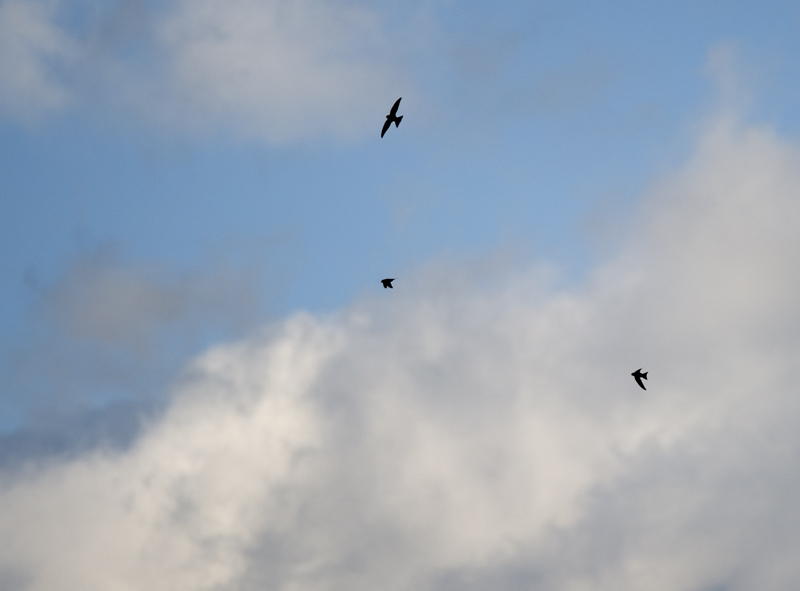
Over the couple of hours we were there, I took about 350 photos, and 300 of them were of Swifts. It was too dark, the Swifts too distant and the magnification available to me not strong enough for anything super-sharp and frame-filling, but there was some good sky going on to provide interesting  backdrops for little Swift silhouettes. So here's a selection of Swifts and sky (and, in one case, a tree).