Tuesday, 7 May 2013

200th post...

... and it might end up being a bit similar to the 199th post, because I went to Rainham again today, with Shane, Clare and Dean. We had a lovely walk around, although the weather was not quite as dazzling as last time with a bit of grey murk around.

Shane and I arrived about an hour before Clare and Dean, so we had a wander to the woodland area, in search of Cuckoos. We met a volunteer en route, who pointed out where he had seen them just now, which was great, just not quite as great as it would have been if the Cuckoos were still there...

On the way to the woods we found this noisily singing Sedge Warbler, which showed very well for us but insisted on only doing its song flights when I was looking at something else. There were also plentiful Reed Warblers singing and refusing to show at all.

The warm weather was encouraging plenty of butterfly activity. Here's the first Green-veined White I've managed to photograph this year.

In the woods, there were several Blackcaps singing, and a Willow Warbler which was one of those intriguing 'mixed singers', its song phrases beginning with a couple of 'chiff-chaff' sounds before it switched to proper Willow Warbler descending-scale song.

Once again we found a singing Lesser Whitethroat, this one positively showing off, though sadly not as close or well lit as last week's views.


Just for balance, a couple of (Common) Whitethroats to go with the Lesser. Plenty of these around, and I somehow fluked a flight shot of one of them. OK, not the greatest ever flight shot but you can tell what species it is...

The first Comma I've seen this year. It was behaving most oddly, running about on the stony track (surprisingly fast). Nothing wrong with its wings though, as it demonstrated shortly afterwards by flying up into the scrub.

Another insect 'first' - a beautiful Large Red Damselfly. Though it's quite orangey rather than red so I guess it is not quite mature yet.

As we headed back to the visitor centre to meet the others, we paused to enjoy the lovely song of this well-hidden Linnet.

There was a sorry sight by the visitor centre, a Magpie sans tail. Wonder what predator ended up with a mouthful of iridescent feathers rather than a meal.

We met Clare and Dean and headed out towards Purfleet hide. On the way, Dean spotted a very close Water Vole from the bridge, but I just couldn't get a clear view of any recognisable part of it. I did take a photo, which shows a random area of soggy brown fur.

Pick of the birds showing from the hide were a small gang of Whimbrels. The Wigeon pair were still around too. Then there was a flurry of excitement as two Cuckoos chased through, a little far away though for good photos.

Outside the hide, a Reed Warbler broke cover for a few microseconds. Note how it's cricking its neck twisting round to see if I was pointing my camera at it.

We continued along the trail, noticing as we went that there were several Swifts around (plus one House Martin). As usual I couldn't resist the chance to take Swift photos, and neither could Clare, so we stayed there for a while while the gentlemen went on ahead.

Several interesting birds flew by over the next few minutes, including Kes the tame Kestrel and a couple of high Hobbies. Also, this high-flying, non-calling wader which at the time I presumed would be a Redshank. I was surprised to see, on (very severely) cropping the best (least rubbish) image, that it seems to be a Bar-tailed Godwit.

Then one of the Cuckoos (or a third Cuckoo) came back the other way, a bit closer this time.

Just before the tower hide, we stopped for a sit-down and enjoyed the spectacle of two Marsh Frogs having a croak-off. I hadn't realised their cheek pouches inflate quite THIS much...

I didn't stay long in the tower hide. I never seem to see anything much from there (um, apart from that one time that I found a Baillon's Crake...). Instead I sat down by the ditch that runs behind the hide to see if any Water Voles would be forthcoming.

No vole luck, but I did see a male and a female Marsh Harrier out over the Target Ponds, and the two Hobbies made a brief reappearance. Most notable, though, was this Ross's Goose, escorted by two Greylags. It is of 'unknown origin' and has been around, on and off, since the winter, but I hadn't seen it before. Cute little thing.

A random female Mallard. Can't recall where I saw her, but there were several 'three-bird flights' going on, also some involving Gadwalls.

The return half of the loop brought the second damsel of the day - a pretty fresh-looking male-type Blue-tailed. And just after this we had a very brief but close encounter with a Water Rail, which ran off out of sight into thicker reeds before I could take its photo.

A couple of the nesting Coot pairs have hatched out some of their weird-looking chicks. This baby was one of four. I don't think I've seen a baby Coot's feet before, they don't seem to have much sign of the lobes that they will have as adults.

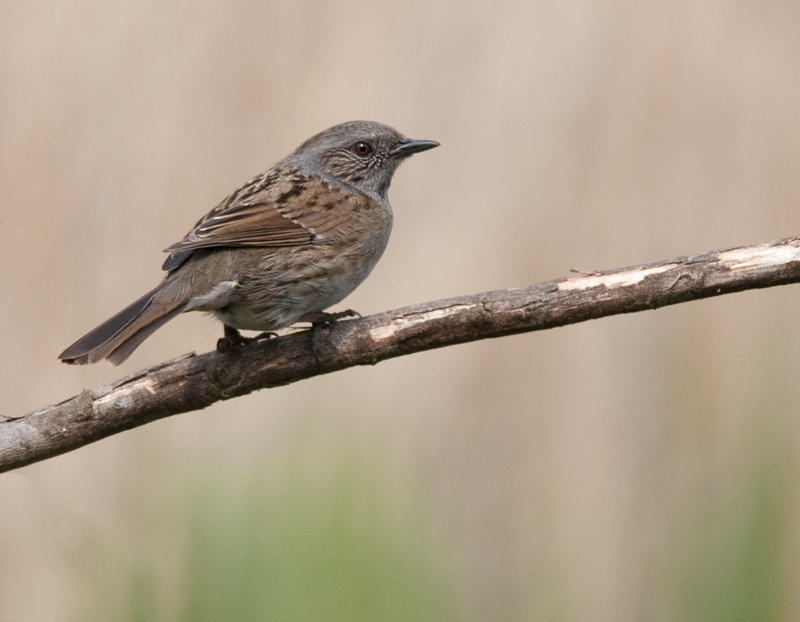
The woodland feeding station is still operational but they will stop stocking it any day now - it's a winter thing really. Today the usual suspects were present, including this lovely Dunnock and a not-so-lovely Brown Rat foraging at ground level.

Last pic of the day is the 'mixed-singer' Willow Warbler, still chiffing, chaffing and warbling away and showing quite well. Looks-wise, it's a bit dull-toned but otherwise looks completely Willow Warbler-like to me. I'm not sure if such birds are ever considered to be hybrids.

Thursday, 2 May 2013

Rainham, and a long-awaited photo-tick

I spent Wednesday getting my nose sunburned at RSPB Rainham Marshes, in company with Shane and Graham. Please take a look at Graham's brand new blog here, to read his other birding adventures at home and away.

We began with a look over at the riverside along Ferry Lane, where up to four Black Redstarts have been seen on the rocky shore in recent weeks, but I think we missed out by a few days. There was plenty of exposed mud, but no waders to enjoy it, just a few Black-headed Gulls (all in first-summer plumage, the adults have moved off to breed now), and a few Mallards, Gadwalls and Shelducks. On to the reserve itself.

We walked clockwise, calling in at the first hide but seeing very little from it. The reedbeds were alive with Reed Warbler song, but none of the little blighters would show well for us today. We had a little more luck with the equally numerous Sedgies.

This stretch of trail brought us our first sighting of Kes, the very approachable female Kestrel who is regularly seen hunting in this area. She was carrying the only Common Lizard we saw all day.

There were a few Skylarks singing high over the grassland. Then a few more came over the wall from the riverside.


As the temperature climbed, we began to see good numbers of butterflies. They included a couple of Small Tortoiseshells, a fine male Brimstone, a Green-veined White and a couple of Orange-tips, but by far the most numerous species was Peacock. All of those we saw were feeding from the curiously stunted Dandelions that line the trails. All Peacocks around at the moment are overwinterers, with seven or eight months of adult life under their belts, and some had clearly had a more wearing time of it than others.

By the dragonfly pool this male Reed Bunting sang and posed. We saw several other males but no females, presumably they are incubating eggs at the moment.

At the far end we found a distant Hobby, which wheeled about over the Target Pools but refused to come any closer. Then we were diverted by this fabulous male Wheatear, feeding near the outside classroom area.

We'd just moved on from here when this Grey Heron came over, causing us all to do a double take as it went into an incredible Peregrine-style dive towards the pools, accompanied with a loud, angry call. The subject of its ire was another Grey Heron, which it chased away.

Along the creek behind the Tower Butts hide, we spotted a Water Vole disappearing into its burrow, and after a short wait had a few more, similarly brief views. I made a mess of the photo opportunity when one swam briskly across the creek, much to my annoyance. We opted to go into the Tower Butts hide, and try again for the voles afterwards.

There wasn't much to see from this hide, apart from more first-summer BHGs, swimming about rather aimlessly and bickering among themselves. A Little Grebe fished nearby, and in the distance a Little Egret flew in to join another.

We went back to the creek and sat on the bank for a while. I didn't see any more voles but did notice this spider's web, full of mosquitoes. That spider has some serious eating to do.

From the Ken Barrett hide, we saw this Mallard pair with a trio of ducklings - presumably there were a lot more than three a few days ago. It's unusual to see a dad Mallard accompanying the female and youngsters. No bad thing in this case, as the poor female was soon being hit on quite forcefully by two other drakes.

We carried on, via the feeding station where Collared Doves, Reed Buntings and the usual tits and finches were coming and going, while a Cetti's Warbler sang from its magic invisible hiding place. Then into the woodland, which is a real suntrap and consequently felt very warm indeed, certainly at least 20 degrees C. Here we heard our first Blackcaps and Chiffchaffs of the day, and then the Yellowhammer-esque rattle of a Lesser Whitethroat.

Because I have had a primal, passionate longing to get photos of Lesser Whitethroat for several years now, I insisted we wait for a while, though I was sure it would be pointless. The song was coming from deep inside a huge, dense tangly brambly clump of stuff. But then to my joy and delight the little bird popped out and sat in full view. I managed three sharp frames before it disappeared again, and there was much rejoicing.

Just before we reached the visitor centre, I noticed a feeding web of Browntail caterpillars in a hawthorn bush.

We revived ourselves with cake - I can really recommend the ginger cake with ginger fudge icing, it's amazing. Then we opted to walk down the clockwise path as far as the one-way gate, and come back by the river.

The Marshland Discovery zone hide currently has its windows draped with netting, as there are Kingfishers possibly nesting in the bank very near to the corner of the hide. We went in and peered through gaps in the mesh, but the RSPB person in the hide said there had been no sightings today. I opted to go back outside and try again for that Reed Warbler shot while I waited for the others. No luck, but Kes made a return and obligingly hovered right in front of me.

We went through the gate and up on to the riverside path. On the river, a parade of sailing boats went by one way, a couple of Cormorants the other. Looking back across the reserve, we spotted a Hobby wheeling about above the Purfleet hide.

The Hobby earned itself lots of brownie points by flying towards and then past us at close range. Thanks, Hobby.

We finished by walking down to where the Mar Dyke comes in off the Thames, as this is said to be one of the Kingfishers' haunts. No KF, but Graham spotted a wader out on the mud which on close inspection proved to be a Whimbrel. Then he found another, this time a Common Sandpiper.

Back on the patch

It's that time of year, when a young(ish) woman's thoughts turn to taking bad photos of newly arrived warblers on her local patch. Tuesday dawned sunny, and I was on my way to Sevenoaks Wildlife Reserve by 6am. Arriving at the reserve, the first thing I noticed was two fat Rabbits inside the wildlife garden, where they are Not Supposed To Be (there are gates and a fence to keep them out). I decided this probably wasn't my problem, and instead busied myself trying to photograph the Garden Warbler that was singing lustily from trees behind the garden. I didn't have much luck so went into the Grebe hide, noting Coal and Marsh Tit among the birds coming to the feeders.

Here's the Marsh Tit. I'll hold off posting a pic of the Coal Tit as I went a bit mad with them in my recent posts from Scotland :)

I headed for Tyler hide first. The daffs and narcissi are out on the woodland trail. I visited Tyler, Sutton, Kingfisher and Slingsby hides but saw rather little from any of them - the lake is now almost gull-less, and wildfowl (besides the ubiquitous Mallards and Tufties) down to a handful of Teals and Gadwalls.

On the walk back through the woods, I heard a couple of Willow Warblers singing and after much patience managed some shots of one of them.

I was just heading up towards Willow hide when I heard a familiar, much-loved and entirely unexpected song - Sedge Warbler. This was a patch tick for me - happy days! I had always hoped to find one but really didn't expect to do so here, in quite a thick bit of the woodland - the more open areas by Long Lake look much more suitable. But I'm not a Sedge Warbler, so what do I know? The Sedgie was exploring the riverside and showed quite well a few times.

A patch tick is always a treat. I continued towards Willow hide in cheerful mood, pausing to photograph (badly) some Blackcaps just by the hide. Then I briefly got my lens onto another warbler and nearly fell over with shock - ANOTHER patch tick, a Whitethroat. Again not really where I thought I'd find one, I would have put money on my first patch Whitethroat being near the big field at the far end of this part of the trail. But again, I'm not a Whitethroat... I sat on the bench and waited, and it showed well on a pile of cut logs.

The walk to Long Lake brought photos of a more expected warbler - Chiffchaff. There were also Reed Warblers in all the usual places but I barely managed to see any of them, let alone get any pics.

In the little meadow by Long Lake, I checked the refugia and found this lovely Grass Snake under one of them. It didn't move a muscle as I took its pic, only flinching slightly when I gently replaced the refugia. Pity about that ruddy great shadow on its face.

I went as far as the big field, which was very quiet. I flushed a Green Woodpecker here, which flew up into the trees and hid (almost).

Then back to the meadow, where I found another singing Garden Warbler. I managed to approach this one without its knowledge by sneaking around behind a bush and got some close, if rather obscured, photos. Then I explored the meadow in search of insects, although it was still chilly. A careful look around eventually produced my first Bee-fly of the year. Also a pair of Long-tailed Tits here, looking like they were nesting.


I went back past North Lake, where I saw my first Coot chicks of the year.

There are dozens of Blackcaps on the reserve at the moment, and I'd seen plenty of both sexes, but it wasn't until I'd nearly finished my walk that I managed a vaguely passable photo of one.

The reserve was getting busy (with people) by the time I got back to the car park, and the wildlife garden was full of children on a school trip. Hopefully they dealt with the rogue bunnies :) I finished with another look in Grebe hide - the Marsh Tit and Coal Tit didn't show though, so I had to make do with this rather fine-looking Chaffinch.

A week in Sri Lanka - part 6

This really is the last bit now. Just as well as I have some local stuff to blog about too and I'm weeks behind with photo-filing... anyway, I'll begin with reptiles, then do the mammals.

This Indian Cobra wasn't actually wild, though we did see a wild one at the same place (Kanneliya). We were shown assorted captive snakes by the guide after our walk. The guide was handling small venonous snakes with total unconcern, but it was a little unsettling when he dumped this (really quite large) cobra on the floor of the little open hut we were in to give us a good look. I was too close and it was too shaded to get a good shot, but I loved the marking on the hood.

This is a Water Monitor, in the grounds of Vil Uyana hotel. It was really close to the boardwalk and I couldn't find an angle for a good shot.

A lizard in need of an ID, photographed in Negombe.

We saw many of these Kangaroo Lizards in the Kanneliya rainforest.

Also in the rainforest, a pencil-slim and very pretty Common Bronze-backed Tree Snake.

Another Kangaroo Lizard, ickle baby one this time, showing off its ridiculous tail.

Still in the rainforest, this was introduced to us as a Hump-nosed Lizard. It was very placid, allowing the guide to gently reposition it on its perch for the photographers.

And now the mammals. Of the three monkey species in Sri Lanka this one seemed the most common - we saw some at most places. It's the endemic Toque Macaque.

A whale-watching trip on day 6 brought one Blue Whale, which (despite being the biggest creature ever to have lived) evaded my lens, and two Orcas, which didn't :)

Spinner Dolphins, part of a pod of about 500, which swam by our boat for a while.

 Monkey no. 2 is another endemic and a rarity also. It's Purple-faced Langur, aka Purple-faced Leaf Monkey, seen in Kanneliya.

I met this evil-looking mongoose on my way back to the hotel after a solo early marshland walk. I think it's a Ruddy Mongoose.

Some not-wild animals now. This baby Asian Elephant is one of more than 100 resident at the elephant orphanage at Pinnawala. Part of the daily routine at the orphanage is a visit to the river, which is obviously much enjoyed by all the elephants.

Random dogs are very much part of the scene in Sri Lanka. Most are medium-sized, sandy-coloured and good-natured, and most do have homes, they're just allowed to roam free.

 Far fewer cats than dogs at large. The handful we saw all seemed to have homes as well.
And back to the wild. The third monkey species is Grey Langur, a lovely-looking animal. We saw a few near the marshland area.

This little critter is very common, in town and country alike. It's Indian Palm Squirrel.