Wednesday, 20 March 2013

Speyside

Hello, and sorry for the long time no blogging. I've just got back from two weeks in the Spey Valley, based at Nethybridge, on a (doomed) quest to see a Scottish Wildcat. Needless to say, I took thousands of photos of other things instead. The weather wasn't great, cold and grey mostly with some snow in week 2, but I did have a few sunny intervals. Here, in no particular order, are some photos.

Female Chaffinch by Loch Garten, waiting for a handout of food.

One of several Coal Tits that visited the garden of my holiday cottage.

Common Buzzard, this was by the river Spey on the way to Grantown, one of a group of four all thermalling on a sunny morning.

Crested Tit in Dell Woods, the bit of Abernethy Woods that is nearest to where I stayed. Noisy little critter!

This Crestie was further south in Abernethy Woods, near the Loch Garten Osprey Centre.

 Crestie again, in Dell Woods.

This Dipper lives on the river Nethy, in the centre of Nethybridge village. I did walk much further along the river several times, but only saw the Dipper on the village stretch.

Feeder by the Osprey Centre, which is shown on a streaming webcam in winter, when there are no Ospreys at the nest.

A female GSW in my cottage garden. She and her mate were in lively springtime mood with lots of chasing, calling and drumming.

Goldcrests are common in the pine woods. This one was near Loch Garten.

Another inhabitant of the river Nethy, a female Goosander.

Grey Heron, seen from the Speyside Way just east of Nethybridge.

The fields around my cottage were attracting flocks of pukka wild Greylags.

Most of the crows around here are Carrion so I was surprised to find a Hoodie. Pity I couldn't manage a better photo of it... taken at the Highland Wildlife Park, a zoo near Kingussie.

One of a small flock of Lesser Redpolls on the Speyside Way.

Long-tailed Tits were pretty common around the village.

An Oystercatcher flying over the Spey.

This Oystercatcher flock was at the Highland Wildlife Park, rubbing shoulders with bison, Przewalski's Horses and other exotica in the 'safari' area.

A hen Pheasant foraging in a horse paddock one VERY cold and frosty morning.

A few Pink-footed Geese over the Spey.

Lots more Pinkfeet in fields by the Spey.

This crossbill, photographed somewhere in the middle of Abernethy Forest, may be a Scottish Crossbill, but it may be a Common Crossbill. I have very little confidence in my ability to separate them... someone will come along now and tell me it's a Parrot Crossbill...

Aw. Red Squirrel. This one came to my garden each morning in search of peanuts, which were sometimes supplied and sometimes not. When the feeder had been filled, the squirrel painstakingly emptied it and buried the nuts all around the garden.

Massive tufts. When I was here in 2011 it was summer and the squirrels were tuftless, and so much less cute.

A snowy morning, and the squirrel shows where he's been jumping all over the garden.

This was a different squirrel, in a different garden.

Lovely sunshiney Robin, photographed in Aviemore while I waited for my lift to Nethybridge.

This Roe doe was in woodland along the Speyside Way near Grantown.

 ... and this Roebuck was in Abernethy Forest, in a small 'bachelor' herd.

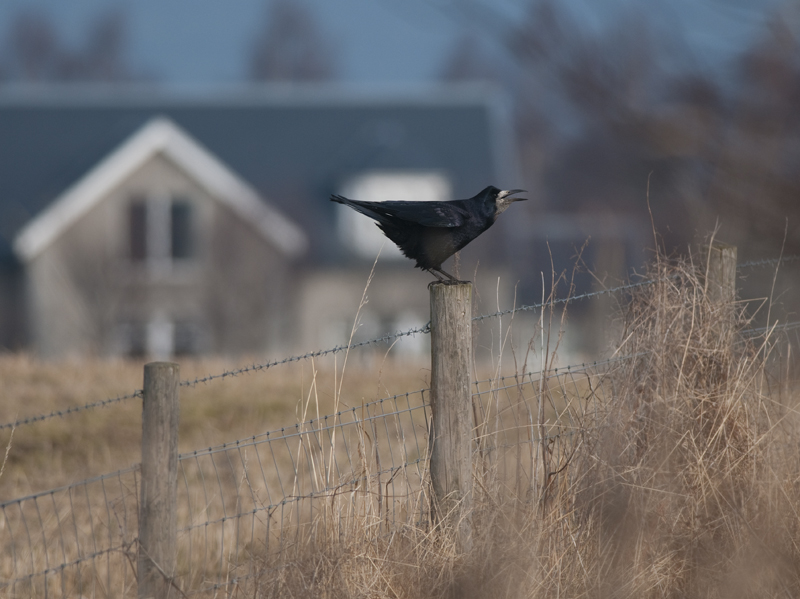
Rook, making a racket. Lots and lots of Rooks and Jackdaws here.

Also lots of Treecreepers, in the forest, along the river path, in the gardens, you name it. I wonder if the lack of Nuthatches and Lesser Spotted Woodpeckers here means a bigger niche for them.


I found a small flock of Waxwings in Aviemore on the day I arrived (Saturday 2nd, late morning, after an overnight coach journey from London - I was a zombie but still noticed that distinctive cresty shape).

Woodpigeons, everywhere. I liked the graphic look of this one's pine tree perch.

A Yellowhammer, along the Speyside Way.

The many Coal Tits that frequent the area around the Osprey Centre are extremely tame and gather in flocks to stare at you as you walk by. If you have brought food for them, they'll come and take it from your hand. It's all very Disney, or very Hitchcock, depending on your point of view.

Finally, a very nicely posing Blue Tit from the cottage garden. I had really painful blisters after several days of too-long walks and had to take it easy for a while - in this time I spent hours photographing the garden birds. And watching classic old gameshows on Challenge - a bit of a novelty for me as I've no TV at home. Whether you're in Kent or the Highlands, you can't beat a bit of Bluey.

Thursday, 31 January 2013

Different Dungeness

Today I went to Dungeness with Phil Sharp (see his ace blog here). We met at West Malling train station (I saw a brilliant close-range Buzzard from the train near Kemsing), and drove south-eastish, arriving at about 11.30am. We went to the sea first, and after an entirely fruitless lap of the observatory walked out onto the beach, where the strong wind was whipping up some pretty big waves.

I'd hoped for a repeat of the seabird-fest of bird-race day, but there were no Gannets around and a lot fewer auks. The very different weather conditions presumably have a lot to do with this. We did see a few auks, including this sextet of Guillemots, two already sporting their dark summer heads.


There were still loads of Kittiwakes around though, mostly flying into the wind just offshore and looking very pretty in the sunshine.

We got to the fishing boats and went through the assembled gulls in search of the elusive Glaucous, which today was at maximum elusiveness. The flocks did contain many Black-headed, Herring and Great Black-backs, plus a few Kittiwakes and a couple of Skylarks, which flew off tweeting in dismay when they realised they weren't gulls.

I've included a few pics of random dogs over the years/months of doing this blog, and I don't see why I should stop now. This well-upholstered specimen was standing guard while his/her owner was fishing.

Next, we drove to the RSPB reserve, pausing for the obligatory look at the Tree Sparrows (seen here with one imposter House Sparrow) around the warden's cottage.

The news in the visitor centre wasn't terribly inspiring. We decided on a crazy whim not to walk around the reserve but instead to go to Greatstone and look for the Snow Bunting that had been reported there.

I've never been to the sandy beach at Greatstone. It's like a mini Camber Sands (complete with marram-cloaked dunes and expensive car parking). The most curious sight here was a fence that was decorated with colourful rubber gloves.

We'd hoped there would be other birders around to point us in the right direction for the Snow Bunting, but there were only dog walkers to be seen. We walked eastwards anyway, where the beach soon became shingly.

When the tide is out here, there is a huge acreage of muddy sand or sandy mud exposed, which attracts waders. Today the tide was very decidedly in, but we found a small crowd of waders sheltering by a groyne. Besides the Oystercatchers and Redshanks, there were also many Turnstones and at least one Sanderling.

Because the Oystercatcher in the photo with the Redshanks was blurry, here's another one, from the walk back along the beach. We also saw a seal (Grey, I think) bobbing about in what must have been very shallow water, and added another gull to the day's tally - Common.

We'd planned to go to the ARC pit next, but then Phil made a passing remark about wanting to go to Hythe sometime to look for Purple Sandpipers, and after some discussion we decided, sod it, we would give the ARC a miss and go to Hythe RIGHT NOW instead. I was keen on this idea as Hythe is on my list of possible places to go and live, when I make my much longed-for relocation to somewhere seasidey.

So we drove past New Romney and Dymchurch and into Hythe, and parked up on the sea road. It was just a short walk back the way we came, escorted by masses of gulls, to reach a large rocky breakwater where, we hoped, Purple Sandpipers would be lurking. We went down onto the beach on the well-lit side of the breakwater and had a good look.

Um, OK. This wasn't really what we'd come to see. But very pretty nonetheless.

The first waders to pop their heads above the parapet were the inevitable Turnstones. But a bit of patient searching revealed a Sanderling and at least four Purple Sandpipers. Here's some more pics...


Photographing this lot was tricky, as they kept disappearing between the rocks. But we managed it in the end.

With the light on its way out, I finished off with a few backlit shots of this supremely imposing Great Black-back, which was busy smashing cockles to bits on the beach behind us. It hadn't been quite the day I'd expected but had been great nonetheless. And I decided I like Hythe, very much.

Tuesday, 29 January 2013

Bearded ladies

I read somewhere that a couple of female Bearded Tits showed up in Hyde Park during the snowy spell. I wondered which of the few tiny patches of Phragmites the birds had chosen to settle in, and how on earth they had managed to find it. With sunshine forecast for Sunday, and no desperately urgent work to finish, I decided to go up for the day. I had a very relaxed attitude towards the Beardies - I didn't check before I left that they were still there, and I didn't head for the reeds straight away but spent a good three hours photographing various other things first.

 I started my walk on the north side of the lake, which was silly. The light (looking towards the lake) would have been much better on the south side. This Cormorant illustrates my point, though it made up for its badly lit state by striking various exotic poses. I crossed the bridge to continue my walk on the south shore.

From the bridge - a pair of Great Crested Grebes getting frisky. I only saw one other all day, which seems a bit down on previous visits.

This young Grey Heron was on one of the same row of posts as the Cormorant, but on the other side of the lake. (You can tell it's on the other side because it's facing the other way...) See what I mean about the light?

I went over to the area where I've seen people hand-feeding assorted little birds, by a fenced-off area of woodland. This involved traversing some serious mud but it was worth it. Waiting in the trees were various songbirds, eyeing me with interest as I got my sunflower hearts out.


 Several Great Tits and Blue Tits made snatch-and-grab visits. One of the Great Tits (this one) was unusually pale and colourless (nothing wrong with her black bits though). A Starling landed on my hand, looked askance at the sunflower hearts and flew back into the tree, where it sang enthusiastically. A male Chaffinch was much keener and fed at length before being scared off by a Feral Pigeon (about fifty had gathered and were milling around my feet).

But the most eager recipient was this beauty. I was very surprised when a female Ring-necked Parakeet landed on my hand. Although all our RNPs do descend from pet (or at least aviary) birds, the feral population by and large seems very wary and flighty. But these are clever birds and it's not really a surprise that some are learning that it can pay to be friendly with the humans. The parakeet was fearless. She even fended off the pigeons with ease. She also chewed my finger rather hard when the seed ran out. Another person feeding the birds handed her a monkey nut, which she took up a tree to demolish, allowing me to get a photo.

On towards Round Pond. On the way, I stopped to kneel down for an eye-level photo of Egyptian Geese. Kneeling down actually quite hurts (which will be an issue if/when I do my next aikido grading) but it was worth it on this occasion. The park is heaving with Egyptian Geese, I saw at least 30.

There are Shovelers on Round Pond. This strikes me as odd. There are Shovelers on the Serpentine too, but that is a  proper, big lake with lots of marginal vegetation and places for the Shovelers to hide (which they do - not for them the feeding frenzies with the other ducks). Round Pond though is small, and circular, with nothing whatsoever overhanging it.

Round Pond is mainly about gulls. Lots of Black-headed, a few Herring, and my favourites, the Common Gulls. They patrol around the edges of the pond, homing in on anyone who looks like they're packing Mother's Pride. Pretty face.

Round Pond is also about Starlings. They loiter around the water's edge to drink and bathe, then head for the cropped grass nearby to look for insects. They are absurdly tame and approachable, so you can really appreciate their fantastic winter  plumage.

Back at the Serpentine, a male Pochard. The total number of Pochards here isn't huge - maybe they just about reach double figures. But no sign of their Red-crested brethren today, nor any Mandarins.

More Shovelers. A proper, grown-up pair this time, unlike the scruffy first-winter male I posted before. I wonder if they breed here.

Here's a Sparrowhawk, seen while I was having a rather half-hearted (and fruitless) search for the Tawny Owl tree. This was one of two Sprawks seen today -  my pics of the other one are even worse than this.

Better flight pic, arguably less interesting bird though. But looking at the primaries and secondaries, this Carrion Crow looks like it may have a touch of that odd dietary leucism that seems pretty common in London crows.

The park is of course stuffed with Feral Pigeons and Woodpigeons, so it was nice to find a lone Stock Dove, high up a tree and surveying the scene below.

OK, time for the Beardies. As I got near the reedbed I could see half-a-dozen birders pointing big lenses reedwards. Also, there was Jim, and Becca, who greeted me warmly and passed on the encouraging news that they had already enjoyed good views of the birds. It wasn't long before I got my first glimpse of the two little birds as they nipped along the base of the bed. I stayed there a couple of hours and eventually the girls both showed beautifully. They are sporting BTO rings, which I've learned were acquired when they were at RSPB Rye Meads in November last year. So they haven't come that far, but it's still mind-boggling that they managed to locate this tiny reedbed in the middle of the concrete sprawl of London. I suppose they saw the water (the Serpentine is pretty huge) and took it from there. Despite it being a windy day, they were climbing to the tops of the reeds, and also at one point came down to ground level to drink. They are the first Beardies ever known to have visited inner London, and their showiness has been appreciated by many a non-birder (LOADS of people stopped and asked about the birds) as well as those of us who came especially to see them. I took huge quantities of photos, here's a few that I like, plus one not so good one but it shows the two birds together.


Monday, 21 January 2013

A (local) patch of snow

I had to work most of the weekend, so decided I could spare a couple of hours today for a snowy shuffle around Sevenoaks Wildlife reserve. We've had a couple of heavyish snowfalls here the last few days, amounting to maybe 10cm of laying snow. Today, no more snow falling but it remained below freezing, and very still with boring grey skies.

My first stop was at the Grebe hide to see what was coming to the feeders. With snow on the ground, Robins start showing a serious interest in above ground-level feeding opportunities, and there were three or four sitting nearby, periodically visiting the seed feeder where they bullied and intimidated the Blue and Great Tits that were also trying to feed. Two of the Robins also came into the hide to see if I had anything for them - one actually sang a bit while sitting on the windowframe.

It took this Dunnock ages to pluck up the courage to have a go on the hanging feeder, long enough for me to take 27 photos of it. There was also a Chaffinch lurking around, but no sign of Nuthatch or Marsh Tit today.

Just down the trail from the visitor centre - two Goldfinches, looking like little fireworks among the snow-laden branches.

I went up to the viewing mound, from where I could see that the whole of East Lake was, like West Lake, free of ice. So it can't have been as cold as it felt. The snow-covered islands were crowded with birds. I dithered a while over what to do, feeling the pull of my favourite hide (Willow) as I always do, but finally decided to head for Tyler hide first.

On the foreshore of the Serengeti, various species were either hunched on the shoreline or swimming in the shallows nearby. Most excitingly, to me, was this pair of Snipes, which were kind enough to stay put while I opened (as quietly as I could) the viewing window.

This photo shows a sizeable proportion of the species present and viewable - Lapwing, Black-headed Gull, Moorhen, Greylag Goose, Teal and Snipe. Also out there were Common Gulls, one or two Great Crested Grebes, an islandful of Cormorants, a few each of Gadwall, Shoveler, Pochard and Tufted Duck, but alas no sign of anything more wintery. I'd hoped for a Goosander or two but no dice (nor any Goosanders).

This pair of Gadwalls seemed very close, well on the way to becoming a bonded pair. I wondered if they might get hold of either end of the same bit of underwater weed and have a 'Lady and the Tramp' moment but they didn't. Was today going to be nothing but disappointments?

Five Shovelers in V formation, the lone female at the front, came paddling along to cross in front of the hide. Of the four males, three were moulting first-winters, in varying states of scruffiness.

Poor Lapwing. The weather conditions have frozen his crest into a silly shape.

I left the hide and again pondered which way to go - retrace steps to get to Willow hide, or see if there was anything doing from Sutton hide? I opted for the latter and began the slow trudge alongside the lake. It turned out to be a good move.

Ahead, high in a tree, I could see a biggish bird perched quietly on its own. Usually, biggish birds in trees are Woodpigeons, but there was something about this one that made me look twice, and when I got close enough for IDable views I was pleased to see it was a male Sparrowhawk, sitting with his back to me and showing some characteristic white 'pearl' markings on his back.

I kept going til I was level and past the Sprawk, then looked back and fired off a few shots. The Sprawk didn't care for this and gave me a hard stare before stepping off his perch and flying away through the trees.

Only a couple of paces further on I found another goodie, this Redwing lurking low in the undergrowth. Feeling guilty about flushing the Sprawk, I took care to give the Redwing lots of space and it repaid me with a nice pose.

Goldrests, unlike Sparrowhawks and Redwings, don't have much truck with the idea of personal space. I'd stopped to look for the Treecreeper I could hear high above, then noticed this little poppet darting about in a sapling about an arm's reach from where I was standing. The problem here was not the risk of frightening the bird, but the fact that it would not keep still for more than a millisecond.

In between Goldcrest-watching, I did also locate the Treecreeper, doing its tree-creeping thing. I suppose not much changes for Treecreepers when there's a snow day.

After all that, Sutton hide itself was a disappointment - nothing to see but a few depressed-looking gulls bobbing on the water, and a Moorhen stalking along the shoreline. I didn't stay, but made my way back via the woodland trail, noting a Green and a Great Spotted Woodpecker, and a flock of some 30 Siskins.

Then I found another, or the same, Goldcrest and watched it for a while. It was deeper into the wood now, and quite high up, not really worth photographing. Then with a swish of wings a Sparrowhawk (the same one as before, perhaps) swooped down and must have only just missed snagging the little 'crest on its way through. Not that the Goldcrest seemed bothered. It directed an irritable, scolding little call at the hawk's retreating tail, and carried on foraging.

I continued past the viewpoint and took the trail towards Willow hide. My hopes of finding a fabulous concentration of wildfowl here were dashed when I opened a window to behold an expanse of ice. If I'd stayed here all day I bet I would have been there to witness a Water Rail creeping along the edge of the frozen lake, if I didn't die of exposure first. I stayed all of five seconds and then moved on.

Wrens were everywhere today but in full camera-dodging mode. This was the only one  that kept still long enough for even one rubbish photo. Perhaps it was momentarily stunned by the coldness of the ice on which it's sitting.

Noting that the whole of North Lake was frozen too, I'd elected to give Carter hide a miss, but loitered around the area a while as there were many birds calling. Some of the noise was coming from another feeding Goldcrest, but most of it was a large Siskin flock a little higher up in the alders. The Siskins scattered with a whoosh of wings and alarm calls when yet another Sparrowhawk scythed through the treetops. I didn't see whether it got one or not. Again, the Goldcrest didn't give a monkey's.

I've never managed to photograph a Goldcrest in hover mode before but this one gave me so many chances that eventually I got one I liked.