Saturday, 12 January 2013

January Bird Race 2013

I love bird race day. A mad dash along the East Sussex/south Kent coast to rack up as many species as possible before the all-too-short daylight hours were over. It reminds me of when I were a lass and birding was all about what you saw rather than what you photographed, and it didn't matter if the light was rubbish and it rained all day. Well, it didn't matter that much.

I've been doing this January bird race with assorted chums for about 11 years now. Nigel, who instigated the whole tradition, has been doing it for a lot longer. He has kept meticulous records of what's seen each year, and they make interesting reading. Some species used to be dead certs but have become rare and infrequent (eg Scaup). For others the reverse is true (eg Little Egret). The average day count is 82, the record is (tantalisingly) 98. The cumulative list stands at a pretty impressive 151.

So on Thursday evening I stayed at Nigel's house, where he and Cheryle were so lovely and welcoming that it was ridiculous, and I had an early night in the hope of being up early enough Friday morning to hear the local Tawny Owl. I didn't manage this, but Nigel did, so it was the first bird on the list. My first bird, though, was the Robin who sent a tendril of song through the bathroom window as I got out of the shower, still well before first light.

The house is out in the wilds of rural Ninfield, and the garden attracts plenty of worthwhile birds. The bird race, therefore, always begins in Nigel's conservatory, drinking hot tea and squinting out into the garden as the growing light gradually reveals the bird feeders. Ticking off the likes of Blue and Great Tit, Dunnock, Wren, Chaffinch, Blackbird, Woodpigeon etc is a piece of cake. The real prize though, is Marsh Tit. For some reason Marsh Tits don't get up as early as their relatives, and we were still Marsh Titless when Nigel went out to collect Alice and Jasmine from Battle station. I stayed put, eyes glued to the feeders, added Coal Tit and Collared Dove. Nigel returned with the girls, served a fabulous breakfast, and Rob and then Jim rolled up as 9 o'clock approached. Then the Marsh Tit finally deigned to show its face, we added a close-range Goldcrest, and then it was into the cars and off to Fairlight cliffs. On the drive there we added Goldfinch, which had been a no-show in Nige's garden, and a few other sundry items.

Our seawatching vantage point at Fairlight is accessed via a longish and (on this occasion) exceedingly muddy slog across fields to a precipitous sandstone cliff edge. A couple of years ago a large segment of adjacent cliffs fell down, but our bit is still intact. Way across on the slid-down bit, I spotted a vixen watching us intently, while on the slope below her fella was having a wander about.

Telescope views of the Foxes brought smiles to everyone's faces, and much comment about how much better-looking they were than the average London street Fox. Bird-wise, things were a little disappointing, but Nigel's hard work scoping the sea produced a few goodies, best of which was a small party of Common Scoters. We also got the expected Great Crested Grebes, Fulmars and Red-throated Diver.

A waddle back across the fields, and then on to Pett Level. Here, there is wet pasture and some large shallow pools, home (hopefully) to waders, wildfowl and geese, and on the other side of the road a high bank separating road from sea. We parked up and scanned the fields, wherein were Lapwings, Curlews and Starlings in abundance. We added Turnstone and various ducks, and a Marsh Harrier sulking in a bush. The full power of the Swarovski scope was deployed when Nigel picked up two Peregrines sitting companiably on a very distant gate.

I climbed the steep bank to look at the sea. This was pretty much a waste of time as the tide was right in, though I found a couple of Turnstones on the shingle. Cormorants were going to and fro overhead, some pretty close. This one seems to me to have a strikingly wide gular angle, making it an example of the subspecies sinensis and giving the lie to the notion that inland Cormorants are all sinensis while coastal ones are all carbo (read this if you have no clue what I'm on about but are intrigued: http://www.paxton-pits.org.uk/id.htm)


Moving on a little further, we found heaps of geese feeding in the fields. Most of them were Greylags and Canadas but among them were one or two others, including a family of White-fronts, which were really too far away to bother photographing (but I did anyway), and a small flock of Brents which flew about restlessly before striking out seawards and disappearing from view.


Just a couple more from Pett. I took the Curlews photos from the car while it was still moving quite fast, am amazed it came out this well. And here's a lovely Rook, last of the corvids to fall to our list. We had also added Reed Bunting and assorted common ducks, but it was disappointing not to get a few more waders here.

Next stop was Scotney, the huge gravel pit that straddles the East Sussex/Kent border on the road through Camber towards Lydd. Often there is a rare grebe, duck or diver lurking somewhere out there but not today.

The most interesting bird for me here was a leucistic Greylag. Funny how I'd never seen a leucistic one til last month, and now here's another (plus I IDed one from a photo for a friend recently). Scotney also sometimes has a few feral Barnacles around but they were AWOL today.

We did finally track down the Scotney Golden Plover flock, at the far end of the lake. Here too was a Redshank, amazingly the only one I personally saw all day, and Rob found a Stonechat on the fence behind us. We added Stock Dove here too, and Little Egret if I remember rightly.

We carried on, Dungeness-wards, and took a detour down Dengemarsh Road and  back, as this often yields partridges and sometimes wild swans. Today it didn't, but we did catch a lucky break when Nigel found all three of our missing thrush species - Mistle Thrush, Fieldfare and Redwing - feeding together in a roadside field.

We went on to the ARC pit, following the trail to the hide and collecting Cetti's Warbler on the way. From the hide, the birds were distant and spread out, but one of the closest was a lovely female Goldeneye. She was very actively feeding, meaning she was underwater about 70% of the time. Further out were a few Smews, including one adult male, sticking out like a sore thumb (or maybe a deep-frozen thumb, as he was mostly white) among a flock of Pochards.

We picked up some 'gen' in the hide that there was a Firecrest around, keeping company with a tit flock. So after leaving the hide we had a little search and in the scrubby willows nearby picked up the various 'pip' and 'prrp' and 'ping ping prrrr' sounds of the tit flock, but seeing the actual birds through the mesh of twigs was difficult. We spread out along the boardwalk and around a corner - I was on my own when I raised my bins to check the second bird I saw, a tiny mite monentarily in plain view on an exposed twig. I was so bowled over by its sheer prettiness that I didn't have the presence of mind to raise my camera, but I did start yelping 'Firecrest! Here! I'm looking at it!'. I heard Nigel exclaim that he could see it too. Then it dropped down. I hurried back to join the others but the Firecrest didn't reappear, though we found three or four Goldcrests.

Time was ticking on and stomachs were rumbling. We headed back towards the car park, stopping briefly to admire the male Smew, with a redheaded companion, from a point on the path that gave a slightly closer view than the hide.

On the way to lunch at the Pilot, we made a dangerous stop on the straight but very fast and narrow road that passes between the ARC pit and the 'new diggings' to admire this Great White Egret, one of several resident at the reserve this winter.

We rocked up to the Pilot pub on Dungeness beach and ordered our fish and chip lunches. Told that the food would take 15 minutes, three of us (Nigel, Jim and I) opted to nip down the road to Littlestone and see if we could find any waders on the beach. On the way out of the pub I noticed a swirl of white things over the sea, and checking through my bins was surprised and delighted to see that they were Gannets. We often manage to snag a distant Gannet or two from the beach here, but there were hundreds out there, and not far offshore either. They were feeding - periodically one would stop its lazy swirlings to fold itself into a javelin and plunge headfirst into the waves.

We drove to Littlestone (two minutes away) and walked out to the beach. The tide was well out now. This view towards Greatstone shows the weather we'd had more or less all day - a fair bit of sunshine, but lots of thick cloud around too which kept switching off the lights.

Birdwise, we found Oystercatchers and Shelduck. Nigel then got a Grey Plover in the scope, and as I took my turn at the scope a Sanderling obligingly scuttled across the field of view. I also checked inland but only found this row of Starlings, all mysteriously sticking to just one of the four wires available to them. Then my phone went - the food had arrived and our chips were in danger of being stolen. So we hurried back.

By the time we'd finished our huge platefuls, it was getting on for 3pm. Short days really do help focus the mind. We decided to head for the beach next, in hope of finding our bogey bird - Glaucous Gull.

The Dungeness 'Glonk' is back for its third winter. In the course of its stay I've dipped it about five times, including twice on bird races. Nigel has seen it about five times (but not on a bird race). I really, really wanted to see it but couldn't help but feel pessimistic, especially as when we checked the regular beach flock it was a) very small and b) didn't have the Glaucous Gull in it. There are of course gulls elsewhere on the beach, lots of them, but we just didn't have time to check that many different places. Nevertheless, I stomped seawards, really in hope of seeing if all the Gannets were still around. Near the shore, I could see a large number of gulls flying about near the fishing boats, and a birder standing nearby, pointing his scope at them. Nigel went off to swap 'gen' with this birder, while the rest of us got distracted by a sea that was busy with Great Crested Grebes and auks (Guillemots and Razorbills both present in good numbers).

Soon I noticed Nigel was making frantic hand signals in our direction, and surmised that he, or the other birder, had just found the Glonk. We all rushed over and Nigel said that the Glonk was right there, flying over the boats. Unfortunately so were about 150 other gulls. But we all eventually picked up the beast we wanted. It was indeed a beast, big and barrel-shaped, with a profusion of brown head and chest streaking that made it look like a very messy eater, and those trademark white-tipped wings - even in the now horrible light it really stood out once you got your eye in.


Delighted though I was to see this particular Glonk, the species is never going to be my favourite gull. But as luck would have it, that species was present too. As I stood on the shingle ridge nearest the sea, a stream of Kittiwakes went by overhead. These lovely gulls flew right past us, quite unafraid, and if it hadn't been such awful light I'd have managed some nice photos, I think. There were both adults and stripy first-winters (or 'tarrocks' as I think the Shetlanders call them). I've never seen anything like this at Dunge before.

It was nearly 4pm now and there was really no light to speak of. So the camera went back in the bag for the last bit - a quick look at the RSPB reserve. We got in just before the centre closed, and headed for the big hide set on the corner of the pit, from where we found another newbie for the day list - Pintail. We also got another Great White Egret here. Then we went out to scan across the reedy bits of the reserve in hope of catching a Bittern going to roost.

All credit to Nigel - he stood up there on his shingly knoll until it was almost dark, after the rest of us had given up. But his patience was not to be rewarded with a Bittern. Instead, he found a distant Sparrowhawk, and we all heard the pained squealing of a Water Rail. The day total was 87, Glaucous Gull a new addition to the cumulative list, and everyone was tired but happy as we said our goodbyes and made our separate ways homewards. This could be the last bird race, as Nigel's looking to move to Norfolk - if so, I think it was a fitting send-off for what's been a highlight of my birding year for a long time.

ETA - here's the list, for anyone interested...


Blackbird, Black-headed Gull, Blue Tit, Brent Goose, Canada Goose, Carrion Crow, Cetti’s Warbler, Chaffinch, Coal Tit, Collared Dove, Common Gull, Common Scoter, Coot, Cormorant, Curlew, Dunnock, Feral Pigeon, Fieldfare, Firecrest, Fulmar, Gadwall, Gannet, Glaucous Gull, Goldcrest, Golden Plover, Goldeneye, Goldfinch, Great Black-backed Gull, Great Crested Grebe, Great Tit, Great White Egret, Greenfinch, Grey Heron, Grey Plover, Greylag Goose, Guillemot, Herring Gull, House Sparrow, Jackdaw, Jay, Kestrel, Kingfisher, Kittiwake, Lapwing, Lesser Black-backed Gull, Little Egret, Little Grebe, Long-tailed Tit, Magpie, Mallard, Marsh Harrier, Marsh Tit, Mistle Thrush, Moorhen, Mute Swan, Nuthatch, Oystercatcher, Peregrine, Pied Wagtail, Pintail, Pochard, Razorbill, Redshank, Red-throated Diver, Redwing, Reed Bunting, Robin, Rook, Sanderling, Shelduck, Shoveler, Smew, Song Thrush, Sparrowhawk, Starling, Stock Dove, Stonechat, Tawny Owl, Teal, Tree Sparrow, Tufted Duck, Turnstone, Water Rail, White-fronted Goose, Wigeon, Woodpigeon, Wren.

Wednesday, 2 January 2013

An hour in the park

After spending New Year's Eve with friends in south-west London, my route home took me through central London so I spent a bit of time in St James's Park. It was a sunnyish afternoon, though I'd left things a bit late and the sun was low enough that most of the lake was in shadow. There were no remarkable birds to see (unless you count the not-wild ones) but it was enjoyable nonetheless.


Here are two of the SJP pelicans. I'm not too well up on my pelicans but I think the pinky-billed one is a Great White and the yellow-billed one an American White. They were fishing together at the eastern corner of the lake, though they mainly seemed to be catching leaves.

Nearby, a drake Wigeon. Part of the captive collection but he makes it into the blog because I caught him in the middle of a 'wheeeee-ooo'. There were also several Fulvous Whistling Ducks here - I'm sure the collection only had one of these last time I visited it, so either that one has cloned itself or a few more have been thrown over the fence.

There are lots of captive geese here, including Ross's, Hawaiian, Bar-headed and Barnacle, and a few funny hybrids too. However, I think this Canada is leucistic rather than a hybrid with a White-front or something, though I could be wrong.


On the bridge, someone was throwing bread for the Black-headed Gulls to catch. The gulls made a catch every time, but I didn't quite manage to catch them doing their catching.

This park is full of very assertive Grey Squirrels, which will climb up you to check for snacks, and reject most offerings that don't meet their high standards - bread, for example, isn't good enough for them. I noticed this squirrel rolling vigorously about on the grass, seemingly wrestling with several sticks.

It was actually trying to strip bark off the bigger stick, and finally succeeded. I guess the bark was needed to provide a nice cosy lining for its drey.

By the cafe, loads of Coots and gulls were swarming around scrounging food from passers-by. I tried to get a shot that isolated one Coot among the melee and ended up with this frankly disturbing image. This seems a good place to drop in a factoid I learned recently - Coots sort out their dominance hierarchy by the relative size of their facial shields. They all look  pretty similar to me... maybe they do to the Coots too and that's why they're always attacking each other.


That's pretty much it, really. I'll close with a freak photo of two in-focus flying birds at the same time (sorry they're only Feral Pigeons) and a young Herring Gull looking regal, obviously aware it's in a Royal park.

ETA - just thought I'd add one more pic. This is a White-fronted x Bar-headed Goose hybrid (I am almost sure that's what it is anyway). I photographed this same bird back in 2009 so it's nice to see it again.

Saturday, 29 December 2012

Gaps in the clouds

Hope all you folks out there had a lovely Christmas, and are going to have a splendid New Year too. What a horrible few days it's been, though. Lots of potential birding time but too much rain for the idea to really appeal . I did go out to Elmley on the 23rd (grey and gloomy but no rain), and had a couple of productive hours in Susan's garden in East Sutton on Boxing Day morning when there was a freak spell of sunshine.


OK, Elmley. It was quiet. Very little but Lapwings, Starlings and distant Curlews from the access track. The traditional look over the wall next to the loos revealed many Teals on the pools below, and a few Wigeons too.

The first section of track was unflooded, though the fields beyond looked pretty damp. There were flocks of Wigeons out there, plus a large, strung-out flock of Brent Geese which I checked for anything more exotic, to no avail.

Those who've been here will recall there is a board bridge across a small ditch to get to Wellmarsh hide - the water in the ditch was about as high as the bridge which was disconcerting, but it was passable. From the hide, there was little to see at close range, but further off were huge numbers of Lapwings which all went up now and then as a Marsh Harrier went over.

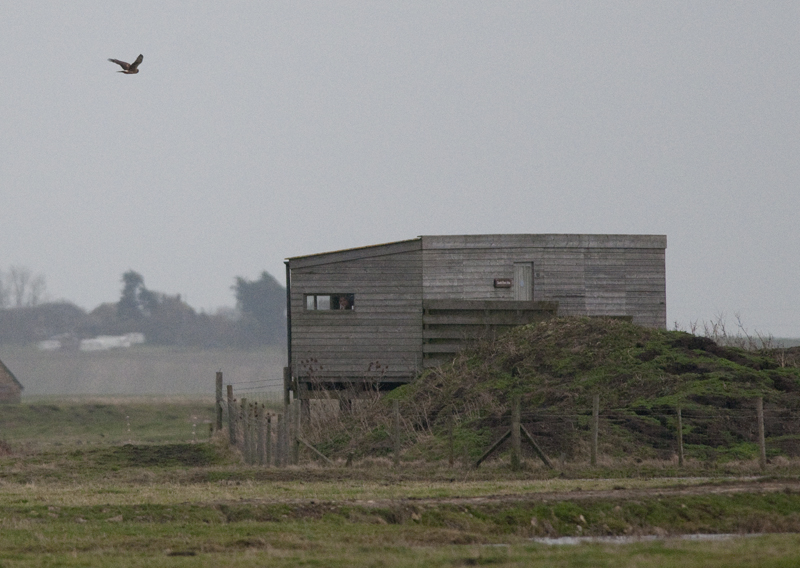
The track from here to Counterwall hide was closed off because of flooding, so it was necessary to head the other way, for South Fleet hide. This is a photo from some distance away of South Fleet hide, with a ringtail Hen Harrier flying right past it. I wish I'd been in the hide!

View from South Fleet hide. What a lot of Teals. Not very close, and the light was fading fast, so it's a horrid noisy mess of a photo. But I think I can make out a drake Pintail among this lot, at about 3 o'clock.

On the way back, several parties of Brents went over, heading for the Swale.

Now on to Boxing day. Sunshine, and the East Sutton garden was a hive of activity. I saw/heard 27 species in an hour of watching, before the grey clouds rolled in once again. Some of the best I failed to photograph. A big flock of Lesser Redpolls in the tall alders. A very close-range flyby Great Spotted Woodpecker. And a Sparrowhawk that shot right past me at about knee height and bobbed neatly over the hedge into next door's garden where, judging by the awful noises that ensued, it dispatched an unlucky Starling.


A small flock of Siskins came and landed in a smaller and closer alder than those favoured by the redpolls.


I found a place to stand where I could see as much open sky (in good light) as possible and waited to see what flew by. Results included these Collared Doves and multiple Magpies.


Stand still long enough and often a little bird or two will come and check you out, in this case a Coal Tit and a Dunnock.

We went for a lovely muddy country stomp later, after the sun had gone in but before the rain arrived. I took the camera but made little use of it, though I did photograph this nice-looking plant which might be Old Man's Beard (but I'm not sure, and would welcome confirmation/correction).

Wednesday, 12 December 2012

A tree in Sauternes

I'm just back from a few days with my sister and her family in Sauternes, a village near Bordeaux in south-west France. It wasn't a birding trip, more a family catch-up trip, but I did spend a little time chilling (literally) by the pool, pointing my big lens at a tree. In this landscape of flat vineyards, trees are few and far between, and a range of local birdlife called in at this one.


Cirl Buntings! These were around in small parties, though they were shy and I didn't manage any very good shots, whenever I saw one there was always a twig or leaf or far too many metres between it and me.

Tree Sparrow. Plenty of these too, along with House Sparrows, though the latter hung around near the houses (appropriately enough) and the Tree Sparrows were more out in the fields.

This was a surprise, though I've done some research since and discovered that Blackcaps do winter in southern France, though whether these are going to be British or eastern European birds, I don't know. This one was certainly as furtive and hard to photograph as your average British Blackcap in summer.

I'd have liked a (much) better look at this, the only Serin that I saw during the stay.

Lots of Starlings were congregating in the next tree along, a larger specimen with room for hundreds of Starlings (and well away from me and my camera) but a few dropped into 'my' tree as well.

When not flocking in the big tree, the Starlings sat along telegraph wires. Here they are keeping company with a few Woodlarks.

One of the local stars is Black Redstart. This one (female? first-winter male?) was hanging around by my sister's veg patch, I also saw it picking the tiny mutant grapes from the vines that cover the house.

The birdlife round here is VERY jumpy and jittery - with good reason, judging by the number of gunshots I heard. The exception to this was the garden 'rouge-gorge', which when not chasing away other birds was posing prettily for my camera.

Other birds? Not a lot, really. Blue and Great Tits and Blackbirds abounded. There were Carrion Crows out in the vineyards, and I clocked several Chaffinches and Goldfinches going over. Heard many Green Woodpeckers, but the only raptor I saw was a single Buzzard. On the last night, I heard the bugling of what sounded like a LOT of Common Cranes, but it was too dark to see anything.

Finally, we had a day in Bordeaux - it rained and I took lots of photos of architecture. The only thing seen that warrants inclusion here was a number of Coypus, around the muddy shore of the Garonne. It was the first time I've photographed (in fact the first time I've properly seen) these hefty aquatic rodents and I took many poor photos (wrong lens, no light), including these two.