Sunday, 11 November 2012

SWR sunshine

What a contrast to yesterday. I set off at about 7.30am, under pure blue skies, the rising sun beginning to catch the treetops, and walked down to Sevenoaks Wildlife Reserve. I got settled in Grebe hide, as this was where I'd arranged to meet Lisa and Adam for a morning of photo-taking.

The feeders were fully stocked, and within the first couple of minutes two Nuthatches and a Marsh Tit had visited, in addition to many Blue and Great Tits and a couple of Chaffinches.

I'm not sure if my presence kept it from visiting the feeders, but this Great Spotted Woodpecker flew in and surveyed the scene from a nearby, very shadowed tree trunk. Much Photoshopping was needed to stop it being a silhouette.

Lisa and Adam arrived soon after this and joined in with the feeder photography. I found a place to stand where I had a good view of a particular branch that some of the birds were using as a 'pre-feeder' perch, and got a few photos.

I was delighted when the Marshie came and sat on 'my' stick. The light was bad and shutter speeds not great, but a few were sharp enough.

The Nuthatches wouldn't use this stick though, so to catch them I had to look elsewhere. Luckily they sometimes hung around for a few seconds, just long enough to get a lock on.

This Robin showed up and began to hover ineptly before the feeder. I couldn't catch it in action but managed a few while it was getting its breath back. Meanwhile, another Robin had come into the hide and was hopping around our feet, searching for crumbs.

I'm not sure what the bright blue thing is behind this male Chaffinch. I suspect it's something that looks much better when completely out of focus.

We wandered up to Willow hide after this, not seeing very much on the way. East Lake was positively steaming as the sunshine started to work on it, resulting in a low, picturesque mist which I couldn't photograph as I didn't have a wide-angle lens with me. Sorry about that.

The view from Willow hide was disappointing - the water was high and most of the birds on it were Coots. A few Gadwalls, Mallards and Tufties joined them, plus the resident Mute Swans.

This Jay flew into one of the trees on the island. Knowing it probably wouldn't stay there long, I was prefocused and ready for when it flew, though I didn't really expect it to fly directly towards me. Of the resultant burst of shots, only this one is anything like in focus.

Although we saw no 'proper' winter thrushes today, it was nice to see several Song Thrushes, including this one on the way to Long Lake.

Long Lake was fairly quiet too. The Mutes that live there came over to see if we were going to feed them, and when we didn't the male started eating the bulrushes at the water's edge. Meanwhile, this young Cormorant flew over. At the far end, a Kingfisher flashed by and landed - too briefly for photos - in a lakeside tree.

We went down to the big field beyond Long Lake and looked out at a load of grass and not much else. Three Ring-necked Parakeets flew past, going into the same group of trees by East Lake where we'd found a nesthole back in May.

We returned to the start and walked along the south shore of East Lake, calling in at the Tyler hide where we found, in addition to stuff already seen elsewhere, Teals, Shovelers, Common and Herring Gulls with many Black-headed, a lone Snipe and a lot of Lapwings.

Then it was on to Sutton and Slingsby hides. Nice group of Tufties plus a male Pochard outside Sutton. Nothing from Slingsby except this male Sparrowhawk flying over distantly with a Carrion Crow in hot pursuit.

We returned to the visitor centre for much-needed tea after that. Lisa and Adam only had a little time left and opted to spend it in Willow hide, as we'd been told there had been Kingfishers seen earlier.

On the way we stopped to photograph this particularly dazzling Beech tree's foliage. I struggled to find a good angle for a nice composition. This was the best I managed.

All was even quieter at Willow hide, though a Wigeon had appeared at the far side of the water. Then a large flock of mainly Canada Geese flew in, with this fivesome of Egyptian Geese bringing up the rear.

Among the geese was this white one. I've seen it before, paired up with a Canada. Not had such close views of it before though, it's normally out on East Lake. This bird puzzles me, as the few very dark feathers on its back don't seem to tally with a barnyard Greylag (which is what most white geese turn out to be). I might post this pic for identification somewhere.

The Egyptians had landed on the far side but came swimming towards the island, giving us nice views as they went.

The Canadas, meanwhile, more or less simultaneously decided it was time for a vigorous bathing session. I happened to be looking at this one through my camera when it performed a forward roll, and I got my best pics of this amusing manouevre.

Other birds seen but not photographed included a few Siskins, and a Green Woodpecker that followed us around laughing heartily but refusing to be seen.

So, a good day all round, and photographing anything is a joy in weather like this. I was really happy to get some better Marsh Tit and Nuthatch pics in particular. But my bird of the day, by a country mile, is the gorgeous crocheted owl that Lisa presented me with at the end of our walk, a lovely surprise. Thanks so much, Lisa, I love him. Here he is :)


Widewater and Shoreham beach

After long weeks of doing nothing very exciting, this weekend I've been birding twice! Including once in the pouring rain! On Saturday I went to see Mike and Kathy in Brighton, and in the morning Mike and I went for a walk alongside Widewater Lagoon in Shoreham. The path goes between the shingle beach and the lagoon. Because of the weather it was pretty quiet, people-wise, but there were a few nice birds to see, and after a while it did stop raining.

The lagoon is long, narrowish with a bit of mud around its shores. It is (Mike assures me) magnetically attractive to interesting birdlife when there's been some heavy weather at sea, and when it's a bit later into the winter. Right now, it harboured Mallards, Black-headed Gulls, Little Egrets, several Little Grebes and a few Redshanks.  This one looks like it's in breeding plumage, which is weird.


The slope down to the lagoon on the sea side has some scrub on it, which was full of House Sparrows. Also a few Greenfinches here.

There are regularly spaced groynes on the beach, made of huge grey boulders. Around one such groyne flitted a few Meadow Pipits, an incongruous Robin, and this lovely Wheatear who should be heading south by now, I'd have thought.

Among the parties of Meadow Pipits, there was at least one Rock Pipit.

I should mention that I had failed to readjust all necessary camera settings after an evening of fireworks photography last week, and didn't discover this until we'd nearly finished our walk. Consequently, many of today's pics were horribly blurry because of too slow a shutter speed. It's more luck than judgement that any of them came out OK.

A large flock of Brent Geese approached, and had the decency to fly directly overhead. Here are a few of them.

We walked down to the beach after that, and found several Sanderlings and Turnstones there, plus a lone Oystercatcher.


I could have spent all day photographing this lot. Good job I didn't, as I wouldn't have noticed I had the camera set up all wrong. On a sunny day it would have been great (or maybe it wouldn't, as the beach may have been full of dogs and dog-walkers).

We turned around after that and headed back along the path, chasing a trio of Pied Wagtails on the way.

No sign of the Wheatear on the way back, but the beach-dwelling Robin was showing nicely. Here it is in its (un)natural habitat.

On the way back I got a photographic first, though didn't realise it at the time - a Black-headed Gull producing a pellet.

A volley of excited whistles drew our attention to a far-off Kingfisher flying in a wide arc over the lagoon.

Back at the car park, the closest Little Egret of the day was having a wade in the lagoon.

We decided there was time for a quick look at the beach at Shoreham Fort, and drove the short distance there. It had started to rain again. We'd hoped to find Purple Sandpipers on the stone 'arm' that guards the mouth of the River Adur, but the sea was crashing over the ledge where they'd have been sitting so that was a bit of a non-starter.

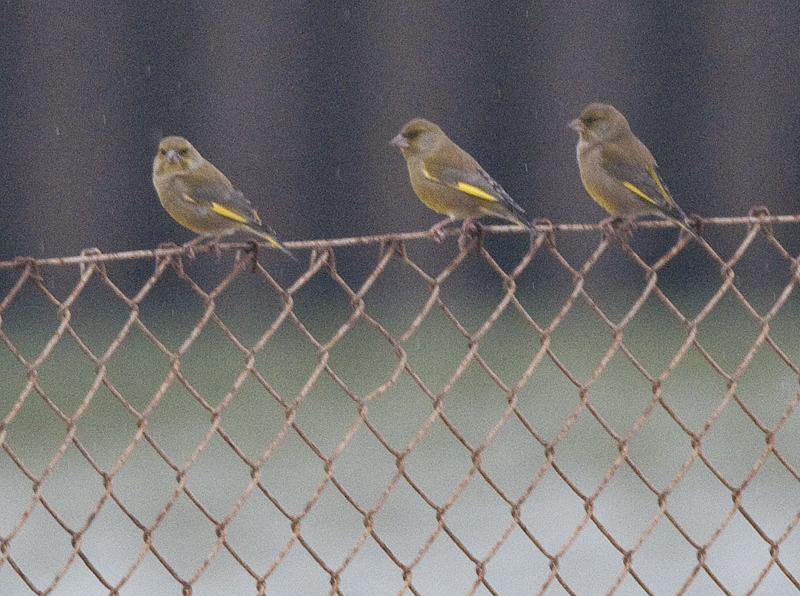
Down on the fence that stops people falling into the estuary, a large flock of Greenfinches were perched. Only these three were posing nicely enough to make it into this post.

At the shore a large flock of gulls, Herring and Great Black-backed, were resting, with a few more going by over the sea. For me, photographing gulls never gets old.

Sunday, 14 October 2012

Reculver and Oare

Today I went with the local RSPB group to Reculver and then Oare Marshes. After threatening rain all week the forecast has a last-minute change of heart and predicated a lovely sunny day, which was what it was.

We kicked off at Reculver at 10am. While everyone was arriving and getting their stuff sorted out I had a quick watch of the sea, which was singularly unproductive. I saw a Turnstone. And then some gulls.

Nothing unusual in the gull department, sadly, just Herring and Black-headed. Still, the light was very nice.


Shortly after this, the group leader John called 'Kestrel. No, hang on. Female Merlin.' I stared where everyone else was looking and eventually discerned a raptorial speck circling high over the sea. Happily she came close enough for some recognisable photos.

We walked up towards the two towers of the Roman fort and down onto the seaside path, where we scanned the rocks and the fort for Black Redstarts, to no avail. Then we turned inland to follow the path around the oyster farm. This path goes in between said oyster farm (a complex of very fresh-looking trenches, which held a few Redshanks) and large arable fields. A few Skylarks, Meadow Pipits and Linnets bobbed overhead, but this stretch of the walk was uneventful.

We looped around and rejoined the path along the sea wall. This was busy with dog walkers and cyclists, so vigilance was necessary. We stopped for a look out to sea, and one of the group picked up a distant grey thing which with good scope views resolved itself into a Red-throated Diver. Our attempts to get everyone to see it were a little hampered by someone's exuberant collie dog who had no interest in Red-throated Divers and kept coming up to us wanting a stick to be thrown.

I couldn't get a shot of the diver, so here's the collie instead. Handsome beast, with an impressive case of heterochromia iridum.


We were all on Snow Bunting alert after hearing from another birder that one was about. Here's the advantage of going around in a big group - all of us were scanning the beach as we went but it was the guy walking at the very back who actually spotted this little beauty. We all hurried back and enjoyed very prolonged and close-range views of what I think is a first-winter male. What a poppet.

Nothing much else happened between the Snow Bunting and the car park. I photographed this Carrion Crow going over the sea, pity it wasn't an Arctic Skua.

After a bit of lunch, we drove on to Oare Marshes. The flood looked very full of water and very quiet, bird-wise, as we passed it (no room to stop). We parked at the sea wall and did the loop around the East Flood clockwise, so beginning along the sea wall. The tide was some way out and there was plenty of exposed mud.

There were numerous waders out on this mud, mostly on the far side, but a few came over to our side, including this Black-tailed Godwit. Also on view were lots of Redshanks, a few Dunlins and a couple of Bar-tailed Godwits.


We were scoping a big, distant flock of waders when I spotted a Stonechat, and then another Stonechat, in bushes just off the path on the landward side. We could also hear much Bearded Tit pinging, but only managed fleeting glimpses of the birds themselves.


We stopped again at the far end of the flood to check out what was on the islands and water. The island nearest to us was generously carpeted with Golden Plovers, and as we watched another bus-load of them arrived and did a lovely flypast for us before settling.

Noticing a bit of squeaky panic among the few Redshanks on the near shore, I looked out for an approaching raptor. A Kestrel duly appeared, and had a bit of a hover over the path a little further down before moving on.

Just where the path swings landwards again, we heard more pinging, and this time the pingers took to the air at some height. For the few seconds the two Beardies were flying high, I fired off shots of one of them - my first ever Bearded Tit photos. Let's hope my next ones are a bit better than this pile of rubbish.

We could see there was nothing much likely to be visible from the East Flood hide, so gave it a miss and rejoined the road. The flood was indeed very quiet, probably because the water was too deep. The island on which Avocets nested in 2011 was reduced to about one square inch of dry land. A few Lapwings and Teals sulked around what islands were still islands. On the other side of the road was this Grey Heron, scratching its chops.

By the time we got back to the car park, it was getting a little cloudy. Everyone went home apart from John, Phil (who, like me, had taken a lift with John) and I. We walked the other way along the sea wall in hope of Corn Buntings, but only came up with this Pied Wagtail.