Thursday, 4 October 2012

I've got visual!

Today, just before I set off home after two fairly quiet hours at Sevenoaks Wildlife Reserve, I had a patch 'first', although I've heard one here before. Let's start at the beginning though. I arrived at about 7am, under clear skies, and checked in at the screened feeding station in the wildlife garden, which is usually pointless as the feeders tend to be empty. Not today though. Both feeders were full, and on one was a Nuthatch and on the other was a Coal Tit. Nice. (Though it was too dark for photos.)

On to Willow hide, my plan being to sit there til the sun lit up the water and then, hopefully, a Kingfisher would come and pose for me. (Spoiler alert - this didn't happen.) When I walked in, there were several Gadwalls and a couple of Teals very near the hide but they paddled hastily away, despite my attempts to keep quiet. Having arranged the furniture to my satisfaction (the benches are too low for a short-arse like me but luckily there are a couple of kitchen stools in there too which are a bit higher) I settled down and waited.

The female Mute Swan was feeding quite close at hand, but her fella was nowhere to be seen. I hoped he was OK and, if he wasn't, that she'd be OK. She was making do with the company of a lone Canada Goose. No Egyptian Geese around today, and the only Greylags I saw were a trio that flew overhead at height.

 Because the water was still shrouded in shadow, I focused my attention on the sky and attempted to photograph whatever flew by. This Great Spotted Woodpecker came out of the big tree on the island opposite, heading straight towards me. I'm amazed I managed to catch it - I suppose to get an in-focus shot would have been too much to ask...

Sun getting higher now. The lit-up autumn foliage made a nicely coloured backdrop for this not-quite-sharp male Mallard.

My very best ever Jay in flight pic was taken from this hide a couple of years ago, and I have yet to rival it. This was the best of today's efforts and it's not great, but there was certainly no shortage of acorn-laden Jays, just none of them close enough. Those white blobs in the background are half of a flock of six white domestic pigeons that were wheeling about beyond the lake.

Phew, he's OK. Mr Mute checked in about an hour after I arrived, and powered across the lake in full blown-up aggression mode to join his mate.

Another flyby, a young male Blackbird, yet to develop his yellow bill. I also saw a Mistle Thrush... but that doesn't really amount to impressive winter thrush movement. However, I did see a couple of small flocks of Siskins and, a vestige of summer, a trio of Swallows.

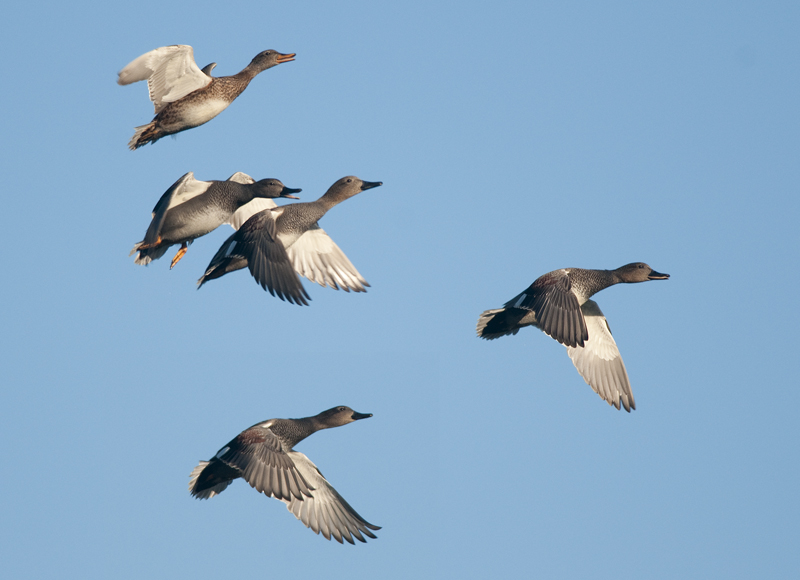
Several frisky Gadwalls arrived, and bickered together with much nasal quacking, before five of them took off and circled the lake, the four drakes all overexcited in the presence of a lone (and rather worried) female.

Another drake, who had been on the water directly in front of me, leapt air-wards to join them.

I left soon after this and walked back towards the visitor centre, noting singing Chiffchaff and Wren, and another little gang of Siskins. I went into the wildlife garden and looked through the screen - still too dark for photos, and moreover the bench was soaking wet. So I walked around the outside of the screened bit to see if I could spot anything interesting in the willow that serves as a launchpad for birds using the feeders. I found a good spot to stand and noted Chaffinch, Great, Blue and Coal Tits, plus a Nuthatch.

Then a Marsh Tit appeared, posed beautifully on one of the screen posts for 0.002 milliseconds and flew. I had to wait, after that, and eventually after four repeat performances from the tit I was pointing my lens the right way at the right moment, and got the photographic evidence of the first Marshie I've seen here, nine months after I heard but failed to see one up by Long Lake.


Monday, 1 October 2012

Two-tree Island

Saturday morning, sunshine, Two-tree Island, Essex. This was a 'first' for me. The island lies in between Canvey Island and the long, built-up stretch from Leigh-on-Sea to Southend, and is a flat, marshy little slab of land, protected as an Essex Wildlife Trust nature reserve. A short walk from the car park there are two hides, the first looking out onto the Thames Estuary, the second, more promisingly, on a patch of marsh separated from the estuary by a steep bank. This is a high-tide roost for waders, although it's quite large and the waders tend to gather at the far end, well out of range for my lens.

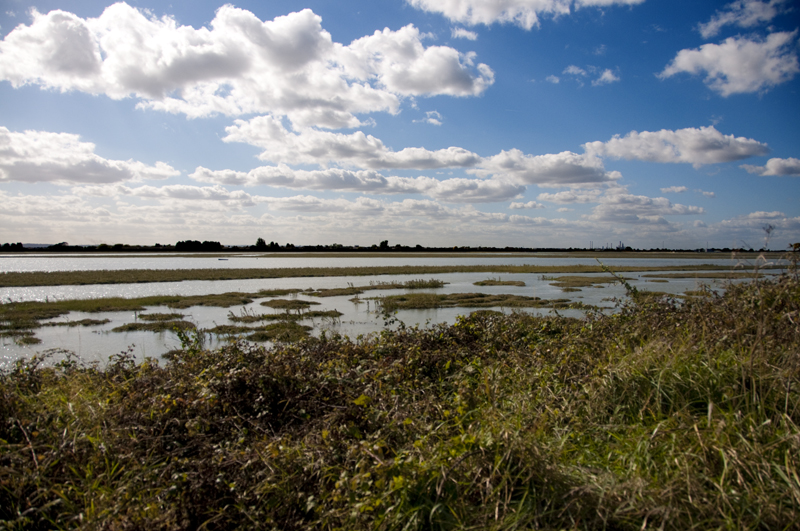
Here's a view from the island out towards the Thames. The path is pretty busy and the place is popular with dog-walkers, so it's no surprise that the water here didn't hold anything much.

A view from hide 1. Over the many boats on the Thames came a great flock of what must be Brent Geese, though they were too far off for any detail to be discernible. But the patterns they described, of long straggly lines, looked very Brenty to me.

A few Swallows were passing through, presumably finding enough flies to make it worth their while. There were also one or two Migrant Hawkers about.

 On to hide 2. The marsh has many small islands, each marked with a large letter so you can tell your companion that the *extremely rare wader* is on island K, or B, or whatever. Many of the resting birds were too far off even for confident identification, let alone photos, but when they took to the air as they periodically did (mainly when someone walking on the raised path alongside the landward side of the marsh allowed their dog to run down the bank), better views were possible. Here are some Ringed Plovers and Dunlins.

A mixed bag of blurry waterfowl. Herein are Redshanks, Black-tailed Godwits, more Dunlins and some Teals. Maybe other things too.

There were also a few Greenshanks, which didn't venture very close. This is my best effort at a photo of a bird that is notable for its almost total absence from my blog. Others present in small numbers included Golden Plover and Turnstone.

The Oystercatchers were the most obliging in terms of close fly-bys...

... with the Lapwings not far behind. Here accompanied by a confused young Starling.

In a quiet moment (bird-wise), I took a few shots of this very pretty sailing boat making her way along the channel that separates Two-tree Island from Canvey Island to the west.


The walk back produced a few Curlews going by over the Thames, a Kestrel, a few drifts of Linnets and (photographably) a nice close Common Gull and some Little Egrets over the marsh.

Monday, 24 September 2012

Autumnal sunshine

Apologies for the rather repetitive nature of my blog lately. Work pressure has limited the potential for exciting outings, for now... but I am trying to get a few local patch visits in when possible. I had a few hours there on Saturday morning, when it was sunny (but with a chilly breeze). The first thing I saw was a male Blackcap munching elderberries in the wildlife garden, which was a nice start.

The Buddleia clump where the trail splits between East and West Lake still has a few purple blooms on the go, and there were four or five Commas feeding on them, plus a lone Red Admiral.

I went to Tyler hide, from where there was plenty of wader-enticing mud on show, but no waders. (And after the uber-rain on Sunday and today, I expect the mud has now gone too.) Not much else either - lots of Greylags, quite a few Teals, the usual Lapwings, Cormorants and so on. The recent dry weather has seen the Serengeti expand to the point where it is now connected to the nearest island, and across this expanse of green and brown wandered two well-camouflaged female Pheasants.

I walked on to Sutton hide. More tempting mud on show here, and the channel that runs in front of Kingfisher hide has completely dried up, meaning that you are even less likely to see a Kingfisher from there than usual. Out in the shallows loafed another cluster of geese, a few Black-headed Gulls and a couple of Moorhens.

Feeling a little discouraged, I retraced my steps, noting calling Great Spotted and Green Woodpeckers, the pinging and purring of Long-tailed Tits, and a few Jays flapping ponderously overhead, their throats stuffed to bursting point with acorns. I took the West Lake route around towards Willow hide, seeing one of the resident Great Crested Grebes on the way.

At Willow hide, I was pleased to find this Little Egret, a bird I rarely see on the patch. It was way over the far side, and soon after I got to the hide it flew away, but here's the proof that it WAS there.

 There were six pairs of Egyptian Geese present, all on the far bank near the egret. These two took to the water and swam past, sending suspicious glares in the direction of the hide as they went.

There was plenty of mud on show here too, and several Teals were nearby, paddling about in it. More excitingly from my point of view was a trio of Wigeons, which sadly kept a long way away from me and my lens. I see from my old posts that last year's first Wigeon on the patch (for me) was 15 September. Other wildfowl were a few Gadwalls and Tufties, and a pair of Mallards.

Rob showed up at about this point, and we had a long stay in the hide although not a great deal else happened. A Kingfisher raced past. Flybys included more Jays and a couple of Stock Doves. I kept thinking I could hear a distant Buzzard but scanning the skies revealed nothing.


The resident Mutes decided to throw us some photo opportunites, and drifted over from their favourite distant corner, to stand in a shallow bit and have a lengthy preen.

Then the four or five Coots that had been peacefully foraging in various bits of the lake decided to come together for a big rumble. That was fun.

The Teals, which had paddled off rather hurriedly after Rob arrived and set up his hide clamp slightly less than silently, were drifting back to enjoy the muddy patches.

We left soon after this and went back via Carter hide. Alongside North Lake we stopped to photograph a Great Tit that was resting low in a tree, and later on checking the photos discovered that it had a really awful-looking injury on its belly. Presumably it had escaped a predator - but the damage looked too much to be survivable.

On to Carter hide, where we had a close flyby from two Kingfishers, and saw one of the local Grey Herons having a swim, duck-style off the island. Numerous tandem pairs of Common Darters flew low over the lake, the females jabbing their rear ends into the water as they laid their eggs.

Back at the wildlife garden, we were just starting to pack up when a male Common Darter arrived for a bask on a picnic table. Rob borrowed the big macro lens for some gruesome close-ups. As you can see, the dragon didn't particularly object to this.


Sunday, 9 September 2012

Afternoon patch visit

Today Rob (yes, that Rob) and I met for a walk at Sevenoaks Wildlife Reserve, in warm, sunny but increasingly breezy conditions. Though I didn't take many photos (and hardly any good photos) it was a good day with some nice stuff seen.

A quick look at Grebe hide revealed a steady procession of Great and Blue Tits coming to the feeders. These have been moved a little further from the hide windows - a good thing in my opinion, the birds certainly seemed more relaxed when visiting them.

The walk towards Willow hide was briefly delayed by this Peacock feeding on one of the remaining Buddleia blooms. At first glance the butterfly looked great, but its right hind wing is in tatters, the 'eye' marking almost completely gone. I think that the Peacock's large 'eyes' function as a 'startle' pattern, designed to alarm predators rather than divert them to attack the wrong end, as with some other butterflies' smaller eyespots. If that's the case, clearly it didn't work that well this time.

Nearby was this male Common Blue Damselfly, relaxing on a spent Water Mint flower.

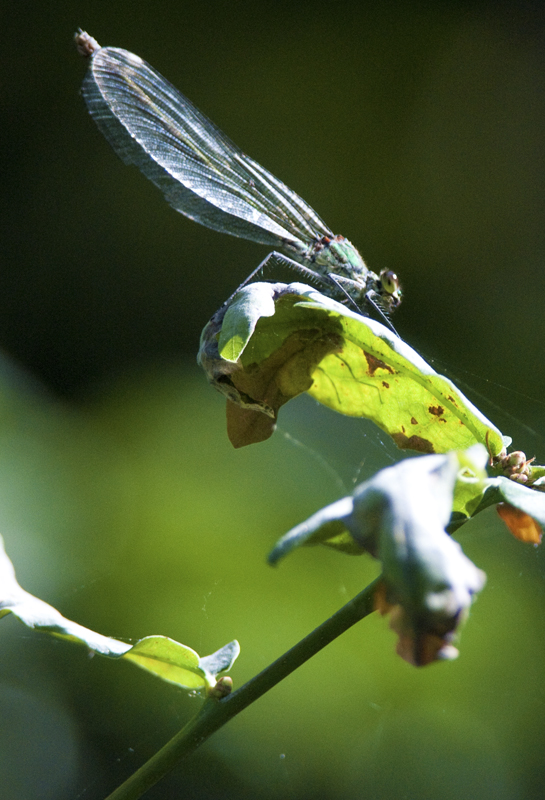
A little further on, I thought I found something exciting in the form of a biggish, pale greenish damsel. But a closer look proved it to be a female Banded Demoiselle, one that I guess is getting on a bit as her wings and body were both much paler than is usual in this species.

We went into Willow hide and watched Mallards, Coots etc paddling about. The water levels are beginning to fall, and patches of weedy mud are appearing. Noting this, I remarked that we should look out for Green Sandpiper, and moments later a Green Sandpiper flew across the lake, flaunting its white bum at us. Similarly white-bummed were a couple of flyby Jays. There was a Kingfisher around too, we heard it piping, but no views.


On we went to Long Lake, as far as the big field, which is full of rampantly tall wild flowers of various species. At the far end we found a male Migrant Hawker. This individual was really obliging, coming close then hovering on the spot to be photographed. The only problem was that he'd picked a rather shady corner in which to do all this showing off, so we were struggling with low light/slow shutter speed/high ISO.


We were busy trying to photograph the hawker when there was a commotion around the trees beyond the lake - crows mobbing a raptor. I managed one shot before it disappeared - a Common Buzzard. Moments later, a Sparrowhawk flapped briskly into (then out of) view from the same area . Horrible photos, but a two-raptor day here is fairly unusual...

We had a look under the refugia while here, and found a Slow-worm beneath one of them, which showed very little reaction to being exposed to daylight. Then we headed back, going via Carter hide.

As soon as we entered Carter hide we spotted a Kingfisher, quite a long way off and sitting with its back to us on a curved branch at the water's edge. I took a few pics, even though darkness and distance made this almost pointless. After a while, the Kingfisher turned around, showing the brown breast-band and dopey expression that identified it as a recently fledged youngster. However, it was no slouch as a fisher, and caught itself a snack before flying away across the lake.

It was getting late and darkish by now, but we did score one more goodie - another Green Sandpiper flying high overhead just before the visitor centre. Hopefully next time I'm here I'll find one on the deck.


Saturday, 8 September 2012

Something special

On Wednesday night, I noticed a blog post from Howard Vaughan (of RSPB Rainham Marshes fame) saying that a Southern Migrant Hawker aka Blue-eyed Hawker had been found on the reserve. Alas, I had to wait in for my new sofa to be delivered on Thursday (but it IS nice to have something to sit on). So it was Friday morning that I headed Rainham-wards, going by train for the first time.

Train journey is pretty simple - to London Bridge, Jubilee line to West Ham, then overground to Purfleet. From here it's a short and pleasant walk by the river to the visitor centre. Mr Vaughan himself was at the desk, and said that there had been no further sightings of the SMH since Wednesday. He advised me to check every hawker I saw...

I set off clockwise, as this looked a quicker option to get to where the SMH had been seen. It was soon evident that the reserve was alive with Migrant Hawkers (of the non-Southern variety). Every bit of water, every stretch of  path, had a patrolling male or two. I checked each one carefully (apart from the ones that scarpered before I could) but no sign of old Blue Eyes.


At least the Migrants were photographable. They do have a habit of hanging in mid-air on the spot, sometimes long enough for pics. I didn't see any females apart from a few that were already firmly attached to males.

I reached the large pond crossed by a boardwalk, and paused here for a while, as I could hear something rummaging in the reeds. Eventually I discerned a small orange object moving up and down a reed stem, and after intense squinting I further discerned that this object was in fact the orange incisors of a Water Vole, munching away. It had climbed about 50cm up into the reeds and didn't seem to have noticed me. Sadly the view was too obscured for decent photos.

Family of Little Grebes. They were most entertaining to watch. The parent would pass over a fish to the most insistently begging chick, and then watch closely as the chick grappled with it. More often than not the chick would drop the fish and the parent would dart in to grab it, then give it back to the chick for another try.

Birdwise, it was really quiet. A couple of Kestrels hunting by the river. The usual scattering of common waterfowl, including a few Little Egrets.

Waiting for a better look at yet another hawker over a ditch, I noticed a large shoal of fish in the water (pretty much where you'd expect to find a shoal of fish, really). I think they were Roach but please correct me if I'm wrong... ETA - I WAS wrong, and Phil's kindly corrected me - it's a Rudd :)

There were a fair few Common Darters around, though the Ruddies seem to be finished or nearly so. The only other Odonata I saw were a few Blue-tailed Damselflies.

With no success at the SMH spot, I wandered on in a desultory way, thinking about turning back rather than completing the loop. Then I met a chap who said he'd had good views of Hobby from the Tower Butts hide, so I decided to go on at least this far. From the hide there were indeed several Hobbies on view, all busily eating hawker dragonflies like there was no tomorrow. I suppose there is a fair chance one of them put paid to the SMH.

After a while the Hobby action petered out. I was watching another Little Grebe family in the nearest stretch of water when I noticed a stripy-flanked something furtively moving along the reeds on the far side. I took a few shots, although the bird was distant and the light rubbish, and looking at the pics on the camera screen I could see I'd got something a bit... different.

I puzzled over the images. Clearly this wasn't a Water Rail, the likeliest option. So... what else was there? Spotted Crake? I didn't really consider either of the tiny/super-rare crakes, because this bird had looked too big, and because I never find anything super-rare...

So I went back towards the visitor centre, to find someone to look at the pics. On the way I took a lot of photos of this extremely confiding Kestrel...

... and a couple of this rather fabulous Marsh Frog.

Back at the visitor centre, I found Howard Vaughan and showed him the pics. He became rather quiet and short of breath, went off and got a copy of Collins, and after some scrutiny of my horrible photos on the camera screen informed me that he thought my bird may well be a juvenile Baillon's Crake. We went up to his office, looked at the photos on a PC screen with the Collins at hand, and I had to agree. Well, blimey. And of course the fact that it is a juv indicates local, if not on-site, breeding. ETA - been corrected on this, apparently crakes can and do migrate while still in full juv plumage so it could have come from further afield. The crake was seen again later that evening, the news is out and it was refound this morning. A couple more pics...


Tuesday, 4 September 2012

I'm back, baby!

My broadband at home was wired up today, so I can participate properly in blog-land again after a long hiatus. Very happy about this! I don't have any recent photos to show you so instead here's a drawing of a tiger.