Monday, 26 July 2010

Queendown Warren

This weekend, Team Wildside managed two butterfly-watching trips in between our other important duties (sleeping, aikido practice and, in Rob's case, watching the first and second Toy Story films so we can watch the third one tonight). This post is about the Saturday trip to Queendown Warren. I'll tell you about the Sunday trip later, when I've figured out where Rob has hidden the card reader.

So, Queendown Warren. A Kent Wildlife Trust reserve in the North Downs, off the A249 where it links the M20 and M2. We found the general area easily enough but locating the reserve car park took an increasingly frustrating half-hour of weaving around very narrow lanes. Eventually a little car park materialised and we gratefully stashed the Passat in the shade. It was a very warm, mostly sunny and quite still afternoon.

The reserve is cut up into several chunks by the aforementioned weaving lanes. The first bit we explored was steeply sloping Rabbit-cropped grassland with patches of scrub.

The general impression was of a place that looked the absolute business for downland butterflies. The rougher bits were full of flowering Teasels and Spear Thistles, the hedgerows had plenty of brambles.

Gatekeepers have only been out for a short while and the ones we saw were in great nick, much better than the Meadow Browns which have been on the wing since late June.

Exploring this small bit of the reserve, we saw numerous Common Blues, Meadow Browns and Gatekeepers, several Green-veined Whites and a lone Marbled White. The most baffling find was the remains of a male Stag Beetle, neatly divided into three bits (head, thorax and wing-cases - whatever killed it evidently ate the abdomen).

  The path led into a shady wooded area, where I found and photographed this slightly tatty Ringlet, enjoying a bask on a sunlit leaf.

Carrying on, we crossed a lane and found another stretch of downland. This had an extensive area of Wild Thyme, knapweeds and other butterfly-friendly flowers, and was attracting brisk trade from the local Lepidoptera.

 A Brown Argus. This is one of my favourite species. While not exactly colourful, the colours that it does have are seriously rich and warm. Also this one was a very obliging little poser.

There were reasonable numbers of Marbled Whites here, though all were past their best. They ignored the thyme and sought out the knapweeds, perhaps realising how much better they look sitting on a knapweed flower.

When I looked at Rob's photos (taken with the macro lens) of this pair of Common Blues in cop, I was a bit alarmed. It looks likes something rather violent is going on around their nether regions. I haven't seen anything like this in other mating pairs of butterflies. But I googled some images of lycaenid butterflies getting it on and saw a similar yellow/red 'thing' going on, so hopefully it's all completely fine and normal. If anyone can shed any light on it I'd be most grateful!

Soon we had reached the end of the thyme-dominated strip and reached another very short-grazed slope. We were standing around here debating whether to continue or go back, when a woman who'd been higher up the slope came down to join us on the path and told us there was an Adder asleep on a log just ahead. That made up our minds for us.

We hurried up to the large logs which lay on the slope and then crept along them til we spotted our quarry. The Adder, a young female (you can tell by the darker ground colour - the black zigzag stands out much more on the otherwise paler males), was coiled up in a heap soaking up some rays. We took lots of photos and didn't get bitten. Result.

Friday, 23 July 2010

Birdwatch magazine, August issue

Just a quickie - my article about joining the Springwatch camp with BirdLife Malta appears in the August issue of Birdwatch magazine (the one that includes the Birdfair programme), out now :)

Thursley in summer

Another weekend, and the Bigmos and Sigmonster are both still in Welwyn Garden City, being subjected to rigorous (we hope) testing by the Sigma folk. With no big lens for the birds, we decided to go to Thursley Common on Sunday, where there would be plenty of insects around to distract us from the unphotographable birdlife. It was a fine and sunny afternoon but rather windy (not nearly so bad as it had been at Stodmarsh though).

The lens situation meant a rare outing for the 16-85mm, as Rob set about taking high dymanic range landscapes and panoramas of the Thursley scene. This one shows one of the many boggy pools that are so attractive to dragonflies. Blog readers, do you think we should make a point of including a scenic or two alongside the wildlife pics?

The dragons and damsels around were the same species mix that we saw on a similar trip here last year, with Black Darters and Keeled Skimmers stealing the show. I was hoping for a Golden-ringed but no go.

We did find one new species for the photo library, lurking in a fast-drying ditch alongside the path. The male Emerald Damselfly is a real stunner - a large damsel with a mainly metallic green abdomen and thorax, offset with accents of powder-blue. It also has the habit of resting with its wings open, so you can see all those body colours very clearly.

It's getting a bit late in the year for Large Skippers but there were still a few about. This spotlit male looks like he only has one antenna but photos from another angle show that the other one is present and correct. I think he's just looking at me with his head quizzically tilted to one side.

It was VERY quiet birdwise. One or two Swallows flew briskly overhead. At the northern corner, where there is still a lot of visible fire damage from the arson attack in 2006, we found a Stonechat family. Although Stonechats are cited as classic heathland birds, I think they are more fond of gorse bushes than heathland per se, and Thursley doesn't have a lot of gorse. Along the short section of path through pine and birch wood, we saw a couple of Redstarts.

The boardwalks are usually good for seeing Common Lizards. Not today though. A few insects did pause to warm up on the wood, including this Keeled Skimmer. The shadows of its wings made me double-take at the photo. An eight-winged dragonfly?

Almost back at the car park, we found this Four-spotted Chaser with its lunch - and dinner, and breakfast the next day, going by the size of it. You know it's a good day when you get to eat a meal that's as big as your own head.

Friday, 16 July 2010

Quiet times at Sevenoaks

I've got my blog posts in a twist. This one is about a trip to Sevenoaks Wildlife Reserve two weeks ago, and I didn't think I had enough photos to make up a blog, but then I looked again and decided I did, just. A warm and sunny day, not much about bird-wise as is usual for this time of year...

... but I couldn't not blog about seeing one of these. A gorgeous, fantastic Crab Spider, lurking on a suitably yellow flower (I think it's a Corn Marigold) in the cultivated 'wheat-field' bit of the Wildlife Garden. I watched it make its way from this flower to an Ox-eye Daisy, via a neat little silk bridge.

On the way round to the Willow Hide I flushed a Kingfisher from the same half-submerged branch that I'd photographed the young Grey Heron on a week before. If I'd been walking more slowly and had my wits about me I might have got a pic... but probably not.

The Willow Hide provided an uninspiring view across almost birdless water. One of the birds that was on view was this eclipse drake Mallard, looking quite dapper as eclipse ducks go.

I went to 'Reed Warbler corner' for a little while. There were passerines moving about, but the vegetation's so high now that it's hard to see anything. Much peering through the foliage finally yielded this dozy male Blackcap, who clearly thought I couldn't see him. I also saw a Brown Hawker dragonfly from here.

From the silent and furtive to the vocal and visible. Close to 'Reed Warbler corner', this Goldfinch twittered brightly away from the most prominent perch around, and put up with me standing at the foot of his tree aiming a large lens up at his face with remarkable patience.

While I was photographing this lot, Rob was once again camped on the lake shore, doing focus tests with the Sigmonster. The results of these tests convinced him that the lens had to go back to Sigma to have its distance softness problem investigated, and he decided he would take the Bigmos in at the same time for a look at its back-focusing on close subjects. Hopefully we won't be without our big lenses for too long... and in the meantime it will be mainly macro stuff and landscapes for us.

Stodmarsh and Grove

Long time no blog. However, I got out for a bit of birding yesterday, and although it didn't go according to plan AT ALL it was still most enjoyable. Sue and I drove to Grove Ferry with the intention of hooking up with the Sevenoaks RSPB group, but they were nowhere to be seen. Undaunted, we walked around the reserve alone, starting with the short trundle down to the Grove Ferry viewpoint. It was cool and windy, with sunny spells.

I'm not sure I've ever been here without a scope (or access to someone else's scope) before. The birds on the little lake or lagoon or flash or whatever you want to call it were distant, and the light was bad, but not so bad that I couldn't make out Greylags, Mallards and Cormorants. If there were smaller water birds out there though, they eluded me.

Assorted birds flew by - or were blown by (it was actually really, really windy), among them Common Terns, Stock Doves, Cormorants and this Sand Martin. As the Bigmos is currently in the lens hospital (needlessly occupying a bed according to Sigma, who have so far found nothing wrong with it despite Rob explaining about its back-focusing problem), I only had the 70-300mm. I can only apologise for this and the other not-terribly-good photos you're about to see.

All the birds went up soon after this, flushed by a couple of juvvy Marsh Harriers which didn't deign to come within photo range.

We went on to the main reserve entrance after this, and strolled through the trees to the Marsh Hide. On the way, we saw lots of Red Admirals, which seem to have staged an invasion this summer as their cousins the Painted Ladies did last year.

Painted Ladies and Red Admirals are closely related, and both occur as northbound migrants in Britain during the summer. Over the last couple of decades, the Red Admiral has broken new ground by beginning to overwinter here. Its cryptic underside provides it with camouflage through the long months of immobility.

When those wings open up, you're looking at a seriously bright and distinctive butterfly. Most of the dozens we saw around Stodmarsh were pristine. This summer's influx is probably down to a big arrival of continental migrants rather than a massively successful breeding effort by the overwinterers.

The high winds kept reedbed birds low and quiet, with just the occasional snatch of Reed Warbler and Reed Bunting song audible over the sound of a gale rushing through thousands of reed stems. We settled in for a long spell in the Marsh Hide, which overlooks wet grassland and were rewarded with some nice sightings.

There's a tern raft on the large lake at Stodmarsh, occupied by several nesting pairs of Common Terns. Several came to fish in the river visible from the Marsh Hide. This is uncropped - not a bad effort from the 70-300mm as the backdrop is quite nice to look at.

And here's a cropped pic. The terns were a delight to watch as they hovered over the water, adopting some strange aerial poses as they struggled to keep those long wings and tail from getting blown about.

From this hide we also saw a selection of common stuff and a couple of distant Turtle Doves. We went back from there to the car park, had a drink, had a look at the sightings board which noted several things we'd failed to see, and then went to the nearby Reedbed Hide which overlooks open water surrounded by well-established reedbeds.

I was most surprised to see this Great Crested Grebe towing a monster reed across the water. Nest-building at this time of year? Apparently so - it went back and forth the whole time we were there, bringing assorted soggy vegetation back to its hiding place in the reedbed.

Our patient vigil also yielded a distant Marsh Harrier, a food-carrying Reed Warbler, a trio of Green Sandpipers lurking on a muddy bank almost out of sight, and a very distant Hobby. Nothing spectacular, but it's always a joy to spend time at this gorgeous reserve.

Friday, 2 July 2010

Take what you can get

I haven't done much birding or wildlife-watching lately. However, I did manage a short Medway walk last Friday, on a very warm but overcast afternoon. It was still and muggy, birds were thin on the ground but there were a few nice insect encounters.

My efforts to find Red-eyed Damselflies at Sevenoaks have failed so far, but there are plenty on the Medway. The trouble is that they seem to prefer to rest on lily-pads rather than riverside vegetation, and there aren't many lily-pads within photographic reach of the riverbank. I got lucky today though and found a pair in tandem, apparently about to be rudely disturbed by a curious pond-skater.

Readers of a sensitive disposition, look away now (sorry, it's probably too late). I hoped to capture pairs of Banded Demoiselles 'in cop' but this angle is positively pornographic. Ahem.


I also saw a Large Red Damselfly along with the usual swarms of Common Blues and Azures, and my first Large Skippers and Meadow Browns of the year.

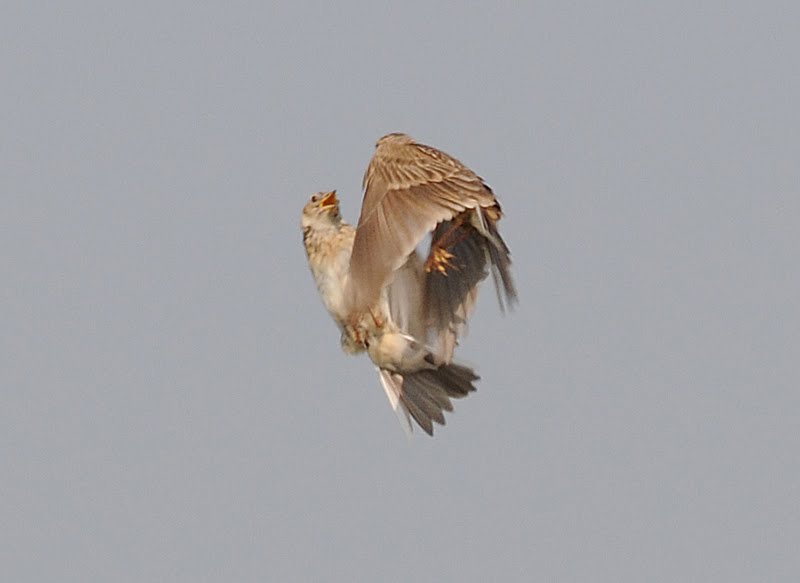
The next day, Rob and I went to the Biggin Hill airshow. He is keen on planes - I'm not desperately interested in them but it seemed like the decent thing to do, given how thoroughly Rob has embraced my obsession with wildlife. I had a pleasant surprise though - almost throughout the whole show there were Skylarks disporting themselves in and over the grass between us and the runway. So there were many moments when all cameras but one were pointed hard left waiting for the Spitfire or Tornado or whatever to appear, while I was clicking away at a small brown bird right in front of us.

One particular male (recognisable by a sticky-up covert on his right wing, not visible at this angle) was coming up in song flight at regular intervals. Over the course of the day I took a couple of hundred photos of him.

I was worried that the planes would disturb him, and he did go a bit quiet after the Eurofighter ripped the sky to shreds in its searingly noisy display, but he was soon back again.

A couple of times an intruder wandered too close and an escalating aerial tussle ensued - the territory owner furiously kung-fu kicking at his rival in flight.

In the late afternoon, a parrot species flew over, squawking as it went. It didn't sound like a Ring-necked, but it wasn't til I got home and looked at the distant photos on screen that I could see what it was - a rather flashy male pied Cockatiel. It was by far the most exotic bird around that day with a supporting cast of Carrion Crows, Meadow Pipits and a lone Kestrel. I'd hoped a Red Kite or something might drift over, but it was not to be. However, I was still much entertained by the Skylarks, and the planes weren't too bad either...

Friday, 25 June 2010

Uptown birds

Today I had lunch with Simon in London. I got an early train to do a couple of hours' birding in the nearest park before we met. It was another warm and sunny one, though clouds gathered through the morning. Summer isn't that great for birding and, in the middle of the big smoke, you're never going to be falling over lots of interesting insects either. Nevertheless, there was more than enough to keep me and the 70-300mm lens amused.

To go with yesterday's close-up juvenile Grey Heron, here's an adult. It was sitting nonchalantly on a post in the shallows, ignoring the numerous camera-phones pointed in its direction.

I was admiring one of the fountains, and idly hoping some bird would swim under the falling water for a nice photo, though I didn't really believe any of them would be dumb enough to actually do it. This Coot proved me wrong, battling determinedly through the torrent with its stick.

One of the nice things about bird photography in a London park is how approachable everything is. I took lots of close-ups of things - Mute Swans' eyeballs, Coots' weird feet, and this Greylag delicately nibbling its toenails.

The loudest thing on the lake - a baby Great Crested Grebe. There were quite a lot of these, squealing loudly and persistently for parental attention. I even saw one hanging around an adult which had another, much smaller baby still on its back.

People who've read my stuff in Birdwatch may remember that I tend to use Egyptian Goose as an example of one of the, well, less attractive bird species found in the UK. However, the youngsters are bundles of cuteness, though I do think this little one looks like he's plotting something diabolical.

More cuteness. This Red-crested Pochard had only the one baby, a downy little doppleganger who stayed close by her side. London has lots of feral RCPs, the males with their bouffant ginger hairdos particularly enlivening the typical park lake fauna.

Want to experience extreme frustration? Try photographing a bunch of restless fledgling Goldcrests flitting about in a very shady tree. This pic's probably the best of a bad bunch, but what a little cutie. It was hard to tell how many of them there were - at least three I reckon, plus their knackered-looking (but still lively as anything) mum who I also photographed (badly).

Just before it was time to go, I bumped into this Wren, furiously alarm-calling through its mouthful of unidentifiably squashed insects. It stayed put for a couple of minutes, letting me approach quite closely and get a bushel of pics.

Insect-wise, there were quite a few Black-tailed Skimmers about, a solitary bright green hawker dragonfly which was probably a female Southern, and a few damsels. No butterflies, sadly.

I put the camera away on leaving the park but the birding wasn't quite over. As I had lunch with Simon outside a pub in a side street off Edgware Road, we were serenaded (if that's the right word for such an uninspired singer) by a Black Redstart. The little blighter was high on a rooftop so out of sight, but I was still delighted with a long-overdue encounter with my favourite species.